
July 26, 2013
The federal budget deficit for fiscal year 2013 will be about $350 million smaller than was projected six months ago. The projected deficit for 2014 is likely to be smaller by a similar amount. That is welcome news. But in the years beyond it will be difficult to sustain that improvement. So despite one or two years of downside surprises, the economy continues to face longer-term budget hurdles. The overall picture has not changed. The issue still needs to be addressed.
In February the Congressional Budget Office (CBO) anticipated a budget deficit for this fiscal year of $863 billion. With data through June or the first nine months of the fiscal year now available, the current year’s deficit is likely to be just $500 million.

The improvement has come largely from tax revenues which are 13.5% above the earlier projection. Presumably, this is the result of faster than expected GDP growth which for the fiscal year should be 1.8% or so compared to the forecast of 1.4%. Expenditures are roughly 6.0% below what was expected in February as sequestration has reduced spending. As a result, the deficit as a percent of GDP will be 4.0%. In February CBO anticipated that the deficit would be 5.3% of GDP.
The projected deficit for fiscal year 2014 had been $615 billion in February. It, too, will be smaller or roughly $300 billion. In February the CBO projected GDP growth in fiscal year 2014 of 2.6%. If our forecast is accurate and GDP growth is roughly 3.2%, revenues should once again be higher than anticipated. Similarly, government spending will be reduced even more sharply by the second round of sequestration. Thus, the FY2014 deficit could shrink to $300 billion or 2.1% of GDP. In February CBO expected the deficit to be 3.7% of GDP.
In subsequent years improvement will be harder to come by because the CBO anticipates GDP growth of roughly 4.0% in each of those years. Those forecasts appear a bit optimistic. Nevertheless, there will be a reduced deficit as the spending side shrinks. Thus, the deficit as a percent of GDP will be smaller than projected, but the improvement will be greatly reduced relative to what we will see in 2013 and 2014. Because the improvement is likely to be small – perhaps 0.5-0.7% — the CBO forecasts for 2015 and beyond shown below have not been modified.

Our greatest fear is that the recent improvement in the budget outlook will give the President and Congress an excuse to do nothing and conclude that the budget problem has been greatly exaggerated. That would be a huge mistake. While deficits for 2015-2023 will be somewhat smaller than shown, the important point is that after shrinking impressively for a couple of years, they start to grow again – to unacceptable levels — in the second half of the century. With the exception of periodic increases in the debt limit, the deficit/debt problem is unlikely to be addressed until after the 2016 election.
Why is the deficit going to rise? Because every year more and more baby boomers retire. People in that age group were born between 1946 and 1964. The current age to receive full Social Security benefits is 67. This means that as a group they will retire between 2013 (now) and 2031. There is no escaping this demographic. And the problem gets worse beyond 2023. As noted earlier, the baby boomers keep retiring until 2031 and the problem is a cumulative one. Each year more and boomers become eligible to receive Social Security and Medicare benefits so the ranks of those receiving such benefits gets steadily larger, which makes the annual deficit forecasts continue to climb.
Remember, every year that the government incurs a budget deficit it must issue an equivalent amount of debt to finance it. So while the 186% debt to GDP ratio that the CBO projected in February for 2037 will shrink, it is not going away. Most economists view a 90% debt to GDP ratio as a potentially dangerous level. Without legislative action we are not going to get there.
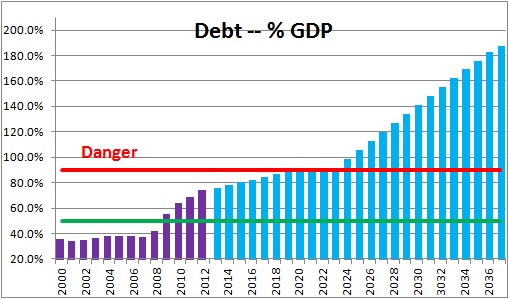
Our leaders in Washington should not get lulled to sleep by the recent improvement in the budget outlook. Problems continue to lurk in the not-too-far distant future.
Stephen Slifer
NumberNomics
Charleston, SC
Follow Me