
November 15, 2013
A critical element in our view that GDP growth next year will accelerate to 3.0% is an expectation that job gains will climb from 200 thousand per month currently to at least 225 thousand. To hire that many new workers employers will increasingly have to rely on younger people to fill some of those slots, and perhaps convert some part time positions to full time slots. If all of that comes to pass, a large number of people will far be happier at the end of 2014 than they are today.
Our expectation is that GDP growth next year will climb to 3.0% as every sector kicks in to contribute to the faster pace of expansion. Consumers will be bolstered by somewhat larger job gains which will lift income and provide the fuel for consumers to spend more quickly. Business people will be encouraged by a more rapid pace of GDP growth to deploy some of their sizable cash holdings and stimulate investment spending. The trade deficit will continue to shrink as technology in the oil sector boosts oil exports and reduces imports. The rapid decline in Federal government spending in 2012 and 2013 caused by winding down the two wars in Iraq and Afghanistan should come to a halt. With little bits and pieces coming from every sector of the economy it is easy to envision growth quickening from 2.0% in 2013 to the 3.0% mark.
If GDP growth climbs to 3.0% and productivity expands by its trend rate of about 1.0%, then employers will have to boost hiring by the difference or 2.0% to produce enough goods and services to satisfy demand. With payroll employment at its current level 2.0% jobs growth for the year works out to 225 thousand per month versus 200 thousand currently. That is a significant pace of job creation. As shown in the chart below there are very few periods in which employment increases more rapidly on a sustained basis.
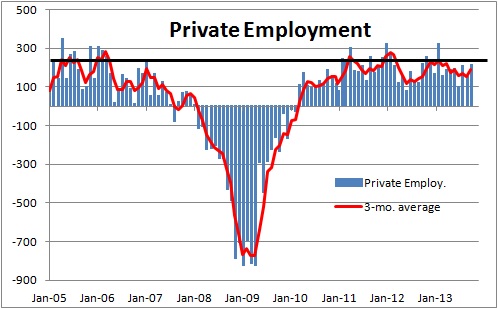
So where might employers find that many additional workers? Growth in the labor force currently has slowed from 1.0% in 2012 to 0.3%. Some economists argue this slowdown represents unemployed workers becoming discouraged about their job prospects, give up looking for a job, and thereby drop out of the labor force. This undoubtedly plays some role, but a far more important factor is that the baby boomers are retiring. They were born between 1946 and 1964. Adding 65 to each of those numbers it is clear that they will be retiring between 2011 and 2029. As a result, the 0.3% increase in the labor force in the past year translates into just 40 thousand per month. Jobs have been climbing, and will continue to increase, far more rapidly than that.
This means that firms will have to dip into the ranks of the unemployed to satisfy their hiring requirements. But with the unemployment rate at 7.3% today and steadily falling versus 10.0% a couple of years ago, the pool of unemployed workers is considerably smaller than it once was.
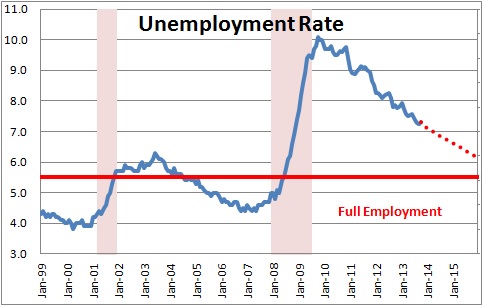
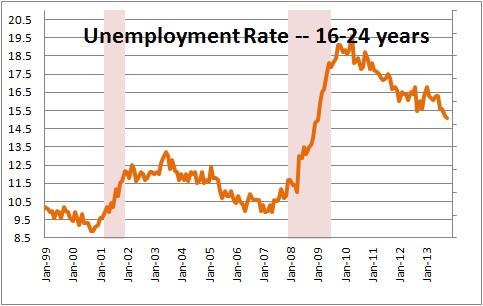
What this seems to suggest is that firms will increasingly have to turn to those groups that still have large numbers of unemployed workers. One such place to look is at our youth. The 16-24 year old age bracket has an unemployment rate of 15.0% today which is more than double the official rate of 7.3%. By definition these people are young. For those who are also eager to learn, almost certainly many can be trained to fill any number of currently vacant positions.
It may also be that employers choose to offer some of their part time employees full time positions. Quite clearly firms shed millions of full time workers during the recession and in many cases found that temps and part time workers could do the job as well without having to pay them benefits. That bias continues, but as the labor market tightens firms may well find outstanding workers amongst their part time contingent and reward them with full time employment. One advantage to hiring part timers and temps is to screen them for a period of time to see which ones are the hardest workers and which fit in best with the company culture. This might be the time to reward those who have passed the test.
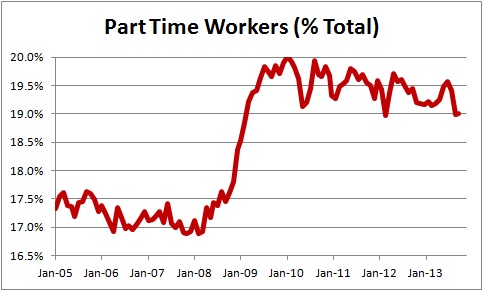
The point of all this is that a slight pickup in the pace of economic activity next year should significantly boost the employment prospects for those sectors of our work force where unemployment remains high, and help the plight of those workers who are currently being forced to juggle two or three part time positions to make ends meet. These problems will not disappear during 2014, but they should begin to show noticeable improvement.
Stephen Slifer
NumberNomics
Charleston, SC
Follow Me