
March 8, 2012
Despite budget concerns and a continuing stalemate in Washington, the U.S. economy is gathering momentum. The stock market is at a record high level, housing and employment are improving rapidly. We cannot forget that the first few months of 2011 and 2012 looked promising but growth fizzled later in the year. Hopefully that will not be the case this time.
The Dow Jones Industrial Average recently reached a record high level. The S&P 500 is poised to do the same thing. Every newspaper in the country highlighted that event in bold headlines on the front page. Investors could decide that they want to jump on board the stock market train which would propel stock prices far higher. During the recession, investors shifted enormous sums of money out of stocks into the safety of U.S. Treasury securities and money market funds. But those investments are yielding less than 1.0%. People could easily decide this is the time to seek a higher rate of return on their investments
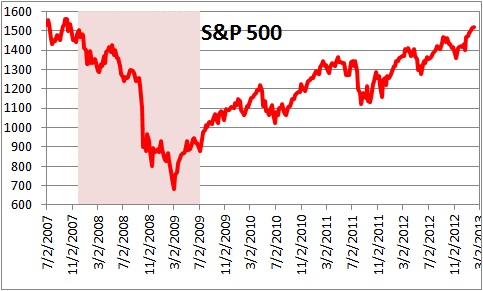
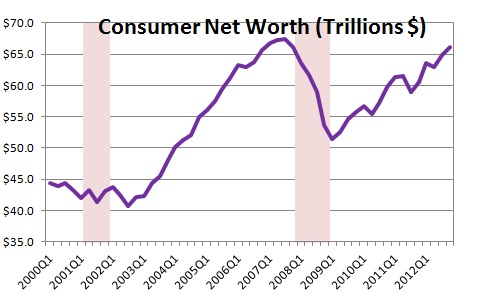
A rising stock market helps the economy in many ways. It bolsters confidence, and if we feel good we are more inclined to spend. It also enhances consumer net worth which has now erased all of the losses recorded during the recession. The increase in net worth was fueled exclusively by the run-up in stock prices. Now that home values are also on the rise, we should expect net worth to continue to climb.
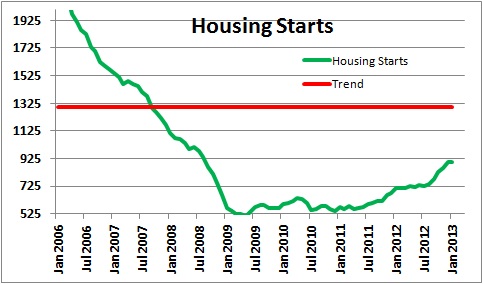
Fueled by record low mortgage rates potential homeowners are taking the plunge. Sales are rising rapidly, particularly at the low end of the market. Housing shortages, particularly for new homes, have begun to materialize. And home prices have risen by 7.0% in the past year. Sensing an opportunity builders are boosting production of new homes and apartments as quickly as they can, but housing starts have a long ways to go.
On the business side things are also looking good. Corporations continue to make money thanks to cost-cutting measures adopted during the recession and near-zero per cent interest rates. They are sitting on an enormous stockpile of cash but those cash holdings earn less than 1.0%. CEO’s are seeking opportunities to deploy that cash and boost their return on assets. In the fourth quarter they increased dividends to stockholders in advance of the higher tax rates that would become effective at the beginning of the year. And as the economy demonstrates signs of steady improvement they will not only spend more money on technology to boost productivity or re-furbish an existing plant, but they may also choose to buy the competition. And, indeed, in the early stages of 2013 a wide variety of companies have merged or put themselves up for sale. We have seen U.S. Air and American Airlines, Office Depot and Office Max, and H.J. Heinz and Berkshire Hathaway agree to merge. Time Magazine, Dell Computers, and the Boston Globe are up for sale. These mergers tend to push the stock market higher.

Firms also seem willing to hire as job gains now routinely surpass the 200 thousand mark. Indeed, in the past three months private sector employment has risen on average 203 thousand per month. As shown below, it is rare that the economy produces more than 250 thousand jobs per month on any sustained basis. Thus, its current performance is impressive.
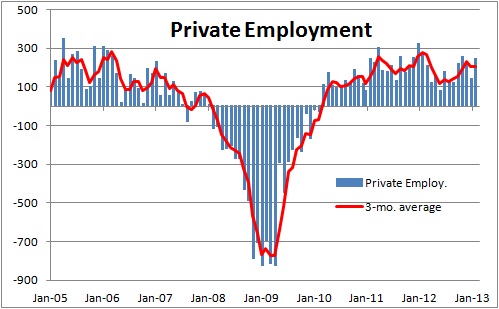
As jobs have been created the unemployment rate continues to decline and now stands at 7.7%. The full employment threshold has probably risen from 5.5% to 6.0% because some of today’s long-term unemployed workers no longer have the job skills required to compete in today’s labor market. Thus, the unemployment rate is still higher than we would like, but the slack in the labor market is steadily shrinking. We do not have to worry about the Fed beginning to raise interest rates until the end of next year, but for the first time in five years the time to raise rates is at least within sight.

At the beginning of this year economists generally were cautious given the potential pitfalls created by the fiscal cliff, the debt ceiling, and longer-term budget issues. But having successfully dealt with several of those potentially disruptive budget issues, and having survived horrible winter weather in February, both consumers, investors, and business leaders are feeling confident. Onward and upward.
Stephen Slifer
NumberNomics
Charleston, SC


What are your thoughts on the sequestration? At the Charleston Realtors Year In Review you mentioned it would an impact on interest rates etc and I am interested to get your updated thoughts.
Thank you.
Hi Jennifer,
The sequestration is proving to be a non-event. I believe I said at the Realtors conference that the impacat of the 2% increase in the payroll tax combined with the higher tax rates on wealthy individuals that occurred at the beginning of the year was about five times as big as the sequestration. The former was expected to subtract about 1.25% from GDP growth this year. The latter should subtract about 0.25%. And, as we have seen from recent data, the economy seems to be gatheriing momentum despite all of the above.
What worried me the most was the possibility of a government shutdown on 3/27 and now, of course, that is not going to happen. I remain hopeful that we will get a budget deal of some sort during the next couple of months.