
December 3, 2010
The employment report for November was almost as bad as the October report was good. So perhaps truth is somewhere in the middle.
First, for the record, private sector employment rose just 50 thousand in November compared to an impressive 160 thousand gain in October. What that means is that since the beginning of the year monthly employment gains have been averaging 106 thousand per month. If you look at the chart below and average the October and November data, private sector employment has been rising at about the same pace for the past five months of so. The signs of strengthening in the labor market that seemed so apparent a month ago are less obvious currently.

At the same time the nonfarm workweek for production workers slipped 0.1 hour in November to 33.5 hours. That does not interrupt the steady uptrend we have seen over the course of the past year, but a 6 minute decline is less positive than a similar-sized increase. As shown below, the workweek has had several temporary declines over the course of the last year only to rebound in the following month. Our hope is that this is another aberration and not the beginning of a new trend.

Then there is the unemployment rate which jumped 0.2% in November to 9.8%. There is no obvious data distortion to explain away the increase. The labor force increased by 103 thousand, which is roughly equal to its trend, at the same time that household employment declined by 173 thousand. Put the two together and you end up with a 0.2% increase in the unemployment rate. However, it is important to recognize that the unemployment rate is a lagging indicator of the economy. So what we are seeing today is more representative of where the economy was 3-6 months ago. If the economy truly is gathering momentum, then the unemployment rate should begin a steady decline as we move into next year.

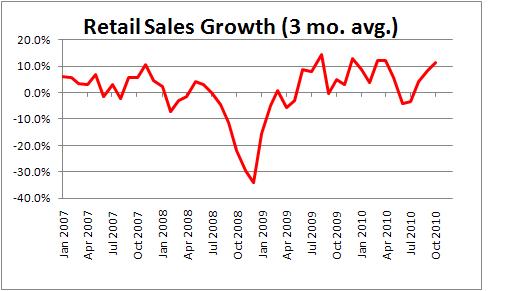
We are hanging our hat on the steady increase in consumer spending we have seen since June. Indeed, retail sales have increased sharply every month since June. And in the most recent 3-month period of time sales have been rising at an impressive 11.3% annual rate. As shown in the chart below, the summer slowdown is clearly visible as is the impressive snapback in more recent months. It is theoretically possible that this sharp pickup in sales reflects a big jump in spending on imported products which would not translate into a faster pace of GDP growth (remember, GDP reflects spending on domestically produced goods and services). However, our bet is that at least some of this spending is bolstering fourth quarter GDP. We currently are looking for a 3.5% GDP growth rate this quarter, up from a 2.2% pace in Q3.
Part of that faster pace of spending may be attributable to the fact that consumers are becoming comfortable with their debt burden. As shown below, consumers have been actively paying down debt for the past two years and their debt levels relatively to income are approaching a more normal level from an historical viewpoint. If so, they do not need to pay down debt at the same pace they have for the past couple of years, and can actually begin to spend just a bit more rapidly.

We have also noted on numerous occasions that corporate profits have been strong since the recession ended in the middle of last year and, as a result, firms have accumulated an unprecedented amount of cash. They have found that spending on technology has enabled them to produce more output with fewer workers, thus it is likely that at least some of this available cash will be spent on other productivity-enhancing technology.

In short, we view the October employment report as an aberration primarily because it does not square with other recent data which would include the retail sales reports, chain store sales data for the Thanksgiving period, initial unemployment claims, the purchasing managers’ indexes, etc. The data are now sending a mixed message and the obvious question is which set of data is correct. We believe that the preponderance of evidence is on the side of a strengthening economy, but only time and more data will tell.
Stephen Slifer
NumberNomics
Charleston, SC
Follow Me