
July 13, 2012
The Fed expects modest GDP growth and no change in policy between now and yearend. What events might cause Fed officials to change their mind? The answer may not be what you think.
One month ago the Fed expected 2.1% GDP growth this year and the unemployment rate to end the year at 8.1%. For the Fed to pull the trigger the economic situation must deteriorate to something worse than what it currently anticipates.
We are more optimistic than the Fed as we project 2.6% GDP growth for the year and believe that the unemployment rate will resume its slide towards 7.7% by yearend. While we can envision slower growth, it is hard believe it will be less than what the Fed expects. The housing sector is clearly in recovery mode, and falling oil prices will almost certainly provide some stimulus as the year progresses.
But there is one potential source of difficulty that is not being discussed and that is the annual revision to GDP data that will be released on July 27.
Our first look at GDP growth for any quarter occurs one month after the quarter ends. Then, GDP gets revised one month later or two months after the fact. That revision can sometimes be sizeable because the initial estimate was missing most data for the final month of the quarter. GDP gets revised again three months after the fact but that revision typically is small. Thus, we always see three different estimates of GDP growth for any given quarter. Then the process starts all over again for the next quarter. Whatever result we see initially may or may not be where it is upon revision.
To complicate matters further, at the end of July every year the Commerce Department publishes yet another revision. This time history changes for every quarter going back three years. In this case, the revision will affect data from the beginning of 2009 through the first quarter of 2012. These revisions can sometimes be substantial. Last year’s rewrite of history was the most dramatic in years, and demonstrates the extent to which annual revisions can completely alter the economic landscape.
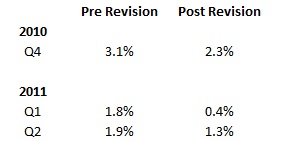
The damage from last year’s revision actually started in the fourth quarter of 2010 which saw GDP growth trimmed from 3.1% to 2.3%. The first quarter 2011 change was shocking. Instead of expanding at a 1.8% pace, the economy barely grew as growth was slashed to just 0.4%. Finally, economists expected second quarter 2011 GDP growth of 1.9%. They got growth of just 1.3%.
This means that instead of expanding at a moderate, but marginally acceptable, pace of 2.0% in the first half of 2011, actual growth was anemic at 1.0%. The economy barely grew. If you are in the Fed’s seat, that is clearly a devastating development.
Because some of the economic weakness early in 2011 was attributable to parts shortages caused by the tsunami in Japan most economists expected faster growth in the second half. At its meeting on August 9 the Fed deferred action to stimulate the economy, but six weeks later at its next meeting on September 21 it initiated its first round of “Operation Twist” which was designed to reduce long-term interest rates. Clearly the downward revision to GDP was instrumental in the Fed’s decision-making progress.
Once again we go into the revision thinking that the economy is expanding at a 2.0% pace. We saw GDP growth of 1.9% in the first quarter, and most economists expect a similar growth rate for the second quarter.
We have no reason to think that we will get another sizeable downward revision, but should it occur there can be little doubt that it would spur the Fed into action. A central bank cannot sit back and do doing nothing if the economy is expanding at a pace insufficient to reduce the unemployment rate.
One might just as easily envision an upward revision to GDP growth. Should that happen Fed policy would be firmly implanted on hold for the foreseeable future.
Stay tuned. July 27 may be an interesting day.
Stephen Slifer
NumberNomics
Charleston, SC
Follow Me