
December 6, 2013
The November employment report clearly raises the odds that the Fed will choose to reduce the pace of its bond purchases at its meeting on December 17-18. The transition from Fed Chairman Bernanke to Fed Chairwoman Janet Yellen on February 1 makes the December call dicier, but from an economic point of view reduced bond purchases are warranted.
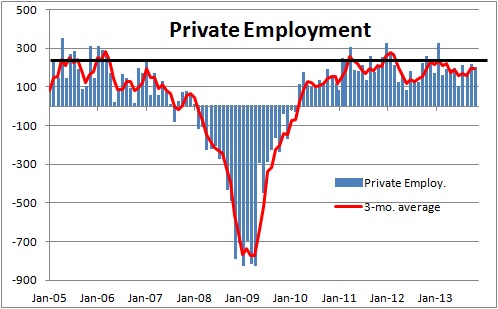
The economic evidence that the economy is on an upswing is compelling. Private sector employment is currently averaging about 200 thousand per month, and once the Fed completes its annual benchmark revision in February that average will probably climb to 225 thousand. That is about as fast as employment ever rises. There are always individual months that will exceed that amount but on a sustained basis it simply does not happen.
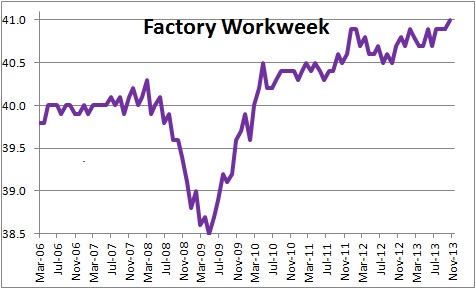
The manufacturing sector is poised for improvement. Not only did factory employment increase 27 thousand in November, the factory workweek and overtime hours both climbed to record high levels. Those longer hours are going to translate into larger factory job gains in the months ahead. At the same time the Institute for Supply Management’s monthly index of conditions in the factory sector climbed to a 3-year high in November. The backlog of orders continues to climb. The manufacturing sector is clearly emerging from the doldrums.
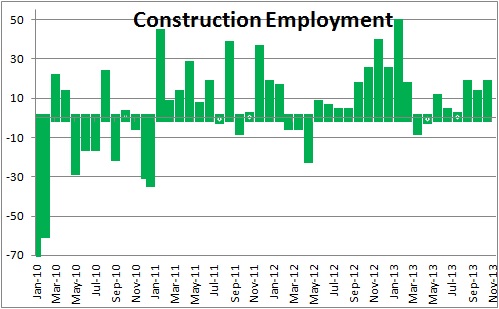
Construction industry jobs are climbing by 15 thousand per month. While some believe that higher mortgage rates and higher home prices will choke off the expansion in housing, recent hiring decisions by builders do not seem to support this conclusion.
Then there is the surprisingly large drop in the unemployment rate from 7.3% to 7.0%. Because the 0.1% increase in the unemployment rate in October was a result of the government shutdown, the 0.3% drop in November overstates the improvement. However, the unemployment rate has been falling very steadily – and much faster than anyone expected — for the past four years. It has been abetted in the past year or so by particularly small gains in the labor force which, in our view, primarily reflect baby boomers retiring, taking up golf, and leaving the labor force. Thus, a much smaller number of jobs will push the unemployment rate lower in today’s world than was the case a couple of years ago (specifically, about 50 thousand per month today versus 150 thousand per month that were required prior to the recession). This faster-than-expected decline in the unemployment rate is welcome news to those who were successful in finding employment. At the same time it will produce faster growth in income and stimulate consumer spending.
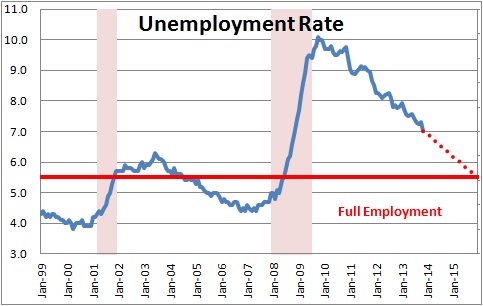
But the rapid decline in the unemployment rate also has a darker side. The faster it drops, the closer it gets to the so-called “full employment” threshold which is the level of the unemployment rate at which everyone who wants a job has one. That level used to be about 5.5%. However, the unemployment rate has fallen three percentage points from its 10.0% peak in October 2009, but the average duration unemployment has hardly budged. It is clear that few of the new hires have been from the ranks of the long-term unemployed. There is a mismatch between the skills that employers need, and the skill set that these long-term unemployed workers seem to have. Employers in today’s world demand their new hires to be tech savvy, and these long-term unemployed workers tend not to have that ability. As a result, many of these people are likely to become permanently unemployed. In that case the “full employment” threshold is higher, perhaps 6.0%.
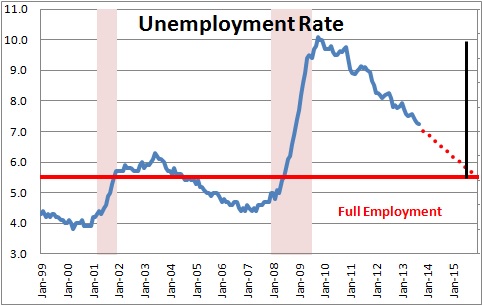
This full employment level is important because it is the point at which wage pressures will begin to rise. Because employers are unable to find an adequate number of workers, they are forced to offer higher wages to attract the people they need. And because wages represent about 60% of a firm’s overall costs, there is a tendency for firms to raise prices to offset the higher labor costs. Hence, higher wages translate into a faster inflation rate.
We currently anticipate that the unemployment rate will not fall to the 6.0% mark until mid-2015. It is at that point we expect the Fed to begin to push short-term interest rates higher. But if the unemployment rate continues to fall more quickly than is generally expected it could happen sooner.
Stephen Slifer
NumberNomics
Charleston, SC
Follow Me