
January 18, 2013
While budget issues diverted our attention, economic activity seemed to gather some momentum late last year. Vehicle sales, the housing market and the labor market have all accelerated.
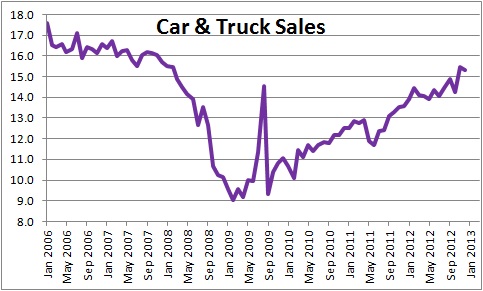
Car and truck sales jumped sharply as consumers replaced autos destroyed by Hurricane Sandy. At 15.5 million they are close to the robust sales pace that existed prior to the recession. For consumers a new car is a big ticket item. They do not buy a new car unless they feel confident that they will have a job in six months. They do not buy unless they feel they can manage the additional debt burden. This steady quickening in the pace of car and truck sales provides a hint that the economy will continue to do well in 2013.
We have argued for some time that the housing sector was poised for recovery. Record low mortgage rate levels, and the sharp drop in home prices have combined to make housing extremely affordable. And, indeed, we have seen sales of both new and previously-owned homes begin to rise. Like autos, housing is important because it is the single biggest item in our budget. If we are nervous, we do not buy a new house. The recent strength in housing also portends a pickup in economic activity in the months ahead.
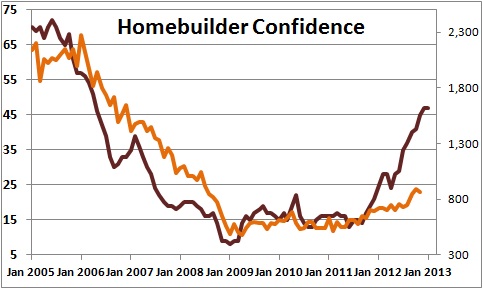
Builders are more optimistic than they have been since the boom times in 2006. Not surprisingly, there is a reasonably tight relationship between builders’ confidence and the number of new homes and apartments under construction. Based on their current degree of enthusiasm it is likely that housing starts will climb 66% to a 1.5 million pace by midyear versus about 900 thousand currently.
The strength in housing will provide considerable support to GDP growth in 2013. Housing represents 15% of the U.S. economy and includes not only the construction of the home or apartment, but the rents generated by rental properties, the utilities, the lawn and garden equipment, and furniture. In 2013 it is easy to envision a growth rate of 10% in that sector. But a 10% growth in 15% of the economy will boost GDP growth by 1.5%.
Late last year we noted that the “fiscal cliff” was causing business leaders to postpone investment projects and make them less willing to hire new workers because the cliff could push the economy into recession in the first half of 2013. With the fiscal cliff issue having now been resolved firms may become more willing to invest and hire. It is interesting to note that initial unemployment claims – a measure of layoffs – dropped to its lowest level thus far in the cycle in mid-January. Admittedly, it is a single week’s decline. But to get the 4-week average to contract we first have to see claims drop in a single week. Is this the beginning of renewed downtrend in claims and more sizeable job gains? Maybe.
The bottom line is that the economy seems to have gathered momentum late last year. Make no mistake GDP growth rate in the fourth quarter (which will be released on January 30) will be only about 1.7%. It was weak because firms became far less willing to hire and invest because of fear about the fiscal cliff, and because Hurricane Sandy weakened growth in the middle of the quarter.
First quarter GDP may be equally modest because consumer paychecks will shrink given the 2% increase in the payroll tax. And with the debt ceiling debate and further budget acrimony on the way consumers may remain wary.
However, our sense is that the economy is gathering momentum. In addition, we believe that the protracted budget negotiations between the president and Congress are likely to have a happy ending within the next two months. A couple of factors to consider:
First, it is likely that the debt ceiling will be raised without the controversy generated in August 2011. That is because Republicans have two other opportunities to force President Obama to compromise on spending cuts.
Second, at the end of February the automatic sequestering process will reduce government spending by $110 billion in the current fiscal year split equally between defense and non-defense spending. These automatic spending cuts were supposed to go into effect on January 1 but were postponed for two months as part of the fiscal cliff settlement.
Third, at the end of March the existing current resolution expires which means that beyond that date no government agency will be authorized to spend money. The entire federal government could be shut down.
If President Obama feels that these spending cuts are too onerous, he will have to sit down with Republicans and negotiate a compromise. In the absence of legislation to the contrary, these spending cuts will occur. In our view, the seeds for an end to our long-term budget woes have been planted. Two months from now the economy may begin a far more vigorous recovery as fiscal uncertainty falls by the wayside.
Stephen Slifer
NumberNomics
Charleston, SC
Follow Me