
April 20, 2012
Every month the government releases a series of indicators to help us better understand what is happening in the economy. Some of these indicators tell us where the economy is going, others help determine its current state, and still others tell us where it has been. Because we are all interested in the future, we should pay more attention to the so-called leading indicators. What are some of these leading indicators? How do they help? And what are they telling us currently?
Stock market. Stock prices are important because they reflect expectations about future earnings. The economy has never fallen into recession or begun a recovery without having the stock market provide an early indication of that change of direction. The lead time is variable, but it is typically three to six months. Focus on the S&P 500 index rather than the Dow Jones Industrial Average because it is a far broader index. At the moment the S&P is only about 2% below its peak level for the cycle.

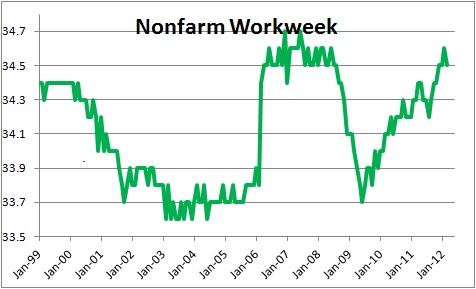
Factory workweek. When the economy changes directions employers will typically begin to work existing employees longer or shorter hours prior to changing the size of their work force. While the workweek slipped 0.1 hour in March, it declined from the highest level thus far in the business cycle. That hardly seems disturbing.
Factory orders. Orders are critical to the pace of economic activity. Manufacturers are not going to boost production without first having received a new order for their product. Similarly, if the economy softens manufacturers will quickly see orders begin to shrink. Currently the backlog of orders continues to climb. As the stack of orders gets bigger and bigger, factories need to boost production to satisfy growing demand.

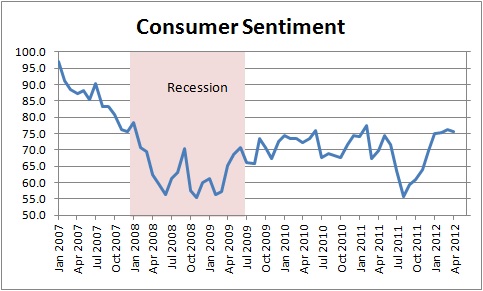
Consumer expectations. If consumers feel the economy is in the process of speeding up or slowing down, their willingness to spend changes accordingly. Currently consumers seem to be reasonably optimistic. The April level is essentially at its highest level thus far in the business cycle. That is particularly surprising given that gasoline prices rose steadily throughout the first quarter.
Building permits. The health of the housing sector is another of those important indicators of future economic health. Housing is the biggest ticket item that we purchase (followed by autos). If we get worried, we quickly defer plans to buy that bigger or newer house. As we become more confident about future economic health (and our job security) home sales typically accelerate. Building permits are a good leading indicator of such activity because most cities require a builder to get a permit before they begin construction. Clearly, this business cycle has been different from any other in recent history because the housing bubble burst. As a result, housing has lagged and been a drag on economic activity for the first two and one-half years of expansion. But permits now seem to suggest that, at long last, the housing recovery is underway.

Initial unemployment claims. This series is a measure of layoffs. As the economy begins to gather momentum and layoffs subside, fewer people will file for unemployment benefits and this series will decline. At the other extreme of the business cycle, when times get rough and more people are being laid off, filings for unemployment benefits turns upwards. Because this is a weekly series and is inherently volatile, it is best to use a four-week moving average. In this case, claims have risen somewhat in recent weeks from 355 thousand to 375 thousand. That is a far smaller increase than we had at this time last year, and it may be temporarily impacted by the floating nature of the Easter holiday. While the modest increase probably does not carry much significance, it bears watching.

While each of these series is a leading indicator in its own right, collectively they give a more accurate assessment of future economic activity than any single indicator. The question at this point is not whether the economy is on the verge of dipping back into recession, but is it at an inflection point and GDP growth could begin to slow? We believe that the preponderance of evidence suggests that the economy, if anything, is gathering momentum. But, as is always the case in the mysterious world of economics, not all of our colleagues agree and many are worried about slower activity in the months ahead.
Time will tell.
Stephen Slifer
NumberNomics
Charleston, SC


I’m one of the people helping home sales tick up (closing on a property shortly)… it’s nice to see others are joining me! Thanks for this concise overview of the most important economic forecasting signals.
We all have to do our part! Thank your for your contribution to the U.S. economy — that is very patriotic! Hope all is well.