
December 4, 2015
While some may think that the November employment report iced the cake and made a Fed rate hike on December 16 a virtual certainty, we would suggest that the decision was essentially made six weeks earlier at the previous FOMC meeting. The statement released at that time indicated that the Fed would consider a rate hike “at its next meeting”. The Fed does not make statements that are so specific. Yes, there were lots of caveats, but in Fedspeak that statement was a tipoff of what was to come as well as a test to see how the markets would react. The markets passed the test. Given that nothing terrible happened the Fed should finally end the suspense on December 16.
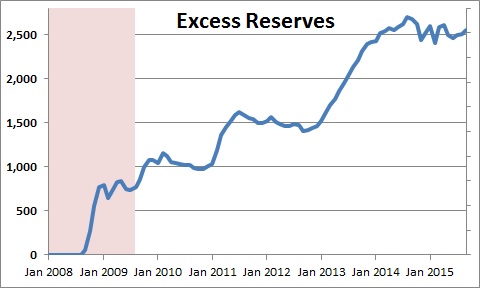
Why is the Fed so determined to start raising rates? Primarily because the job it has to do is so large. Since the end of December 2008 the Fed has flooded the banking system with $2.5 trillion more reserves than it needs. That represents the ability of the banking system to make loans. If consumers and business people become willing to borrow and banks become willing to lend, there are sufficient funds available to fuel an unprecedented spending spree. The Fed has to either eliminate or neutralize those surplus reserves. That cannot happen quickly.
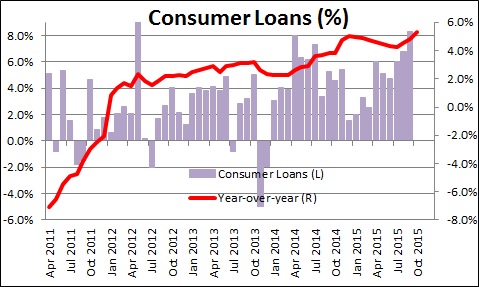
While a wild spending spree is almost certainly not underway, the reality is that loan growth has begun to quicken. Banks have been making loans to businesses for some time, but for the past several months banks have also become increasingly consumer friendly. Over the past year consumer loans have risen 5.3%; in the past three months the pace has quickened to 8.5%. Given that the lending process is gathering momentum, it is appropriate for the Fed to adopt a somewhat less accommodative monetary policy stance.
If the Fed does, in fact, raise rates 0.25% on December 16, how quickly will rates increase? The Fed has said it intends to proceed slowly? What does that mean? Historically, once the Fed starts raising rates it lifts rates by 0.25% at every FOMC meeting. They occur every six weeks. That works out to about 2.0% per year. The Fed’s “proceed slowly” policy has been widely interpreted as raising rates by 0.25% at every other FOMC gathering. That works out to about 1.0% per year. For what it is worth, we expect the funds rate to be 0.25% at the end of this year, and 1.5% by the end of next year. While a funds rate of 1.5% is higher than 0%, it is still quite low and Fed policy will remain accommodative. So how high do rates have do climb for Fed policy to become “neutral”? Our guess is that rate is about 3.5%. At that point the Fed is trying neither to stimulate the economy nor trying to slow it down.
How did we come up with that magic number? We examined the real funds rate – the level of the funds rate relative to inflation – over the past fifty years. That rate varies all over the place depending upon whether the Fed is tightening or easing. On average, in good times and bad, the funds rate has averaged 1.5% higher than the rate of inflation. We would suggest that if the Fed wants its policy to be “neutral” it should put the funds rate 1.5% above the inflation rate, and since the Fed wants a 2.0% inflation rate, we add the two numbers and determine that a “neutral” funds rate is about 3.5%. But if the Fed is raising rates at the pace of roughly 1.0% per year, the funds rate is not going to reach that neutral level until the end December 2018.

Finally, it is important to understand that the U.S. economy has never gone into recession until such time as the Fed has pushed the funds rate above that so-called neutral level. If the funds rate does not reach neutral until the end of 2018, we would suggest that the soonest we should be thinking about a recession in this country would be 2019. While we are not forecasting a recession in that year, for the first time rates will have risen enough that we have to start paying serious attention to the economic data. We will be a whole lot closer to a recession at that point than at any time since the recession ended in June 2009.
For the record, if this expansion lasts until June 2019 – which we think it will – this expansion will go down in the history books as the longest expansion on record. Not bad!
Stephen Slifer
NumberNomics
Charleston, SC


Steve, it is always good to read your analysis of what the Feds might do and why. Thank you for your insight.