
November 13, 2015
Sometimes we get so caught up in the near-term by trying to assess the latest GDP wiggle, the degree of strength in the labor market, or the likelihood of a change in Fed policy, that we miss huge changes that are taking place around the globe. Changes in the oil market have fundamentally altered the economic landscape for years to come. Countries that used to be high flyers no longer are. Consider the following:
The drop in oil prices from a high of $107 per barrel in October of last year to $41 or so today is the result of technology. Hydraulic fracturing and horizontal drilling have allowed drillers to tap pockets of oil that were previously inaccessible and, in the process, significantly lower costs. For example, the Energy Information Administration estimates that the cost of production a year ago was roughly $80 per barrel. Today the EIA estimates that because of improvements in technology drillers can now drill profitably at about $43 per barrel.
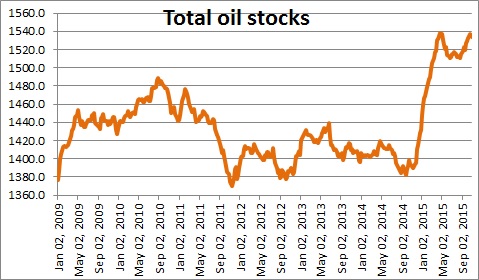
Over the course of the past seven years oil production has basically doubled. Demand has risen but by a far smaller amount, thus oil inventories have risen to a record high level. The world is literally awash in surplus oil. Not surprisingly, oil prices have fallen from a peak of $107 per barrel a year ago to about $41 today. That drop in oil prices has created winners and losers.
The winners are those countries that are oil-importers – like the U.S., Europe, and Japan. As oil prices fall consumers pay less to fill their car’s tank with gas which leaves more money available to spend on other goods and services. Manufacturing firms who use oil as a source of energy also benefit from a lower cost of production. Although, admittedly, the positive impact on consumers and some manufacturing firms has been countered by the negative impact on the oil patch in the U.S. as drillers have capped inefficient wells.
The losers are oil exporting countries which happens to be a rather long list – Saudi Arabia, Russia, Iran, Iraq, Nigeria, Venezuela, and Canada. These countries use oil revenues to finance government spending, so with oil revenue basically cut in half they are having budget difficulties. Slower government spending produces slower GDP growth. Most estimates suggest that for OPEC countries oil prices of about $60 per barrel are needed to balance the budget. Current oil prices are well below that level.
We have gotten used to seeing oil prices fluctuate between, say, $80-110. But given the extent of surplus oil around the globe oil prices are not going back to those earlier levels. We would take a guess that going forward oil will continue to fluctuate but in a much lower range from perhaps $30-60.
Our assumption going forward is that oil will level off at about $50 per barrel. If that is true, the negative impact that has produced slower GDP growth in some sectors of the U.S. economy and around the world is largely behind us.
Now we learn that OPEC is eliminating production quotas in an effort to push prices lower and put pressure on higher-cost rivals such as the U.S. But keep in mind via technology U.S. production has had an uncanny ability to quickly respond to price signals. That has completely changed the way the oil market operates. Just because the cost of production today might be $43 per barrel changes in technology are not going to stop. The cost of production a year from now could be much lower. $35? $30? OPEC’s idea that it can drive out higher cost producers by keeping prices low for a protracted period of time might not work. As the world’s low cost producer the Saudis may be able to withstand lower prices, but other oil exporters both within and outside of OPEC are hurting.
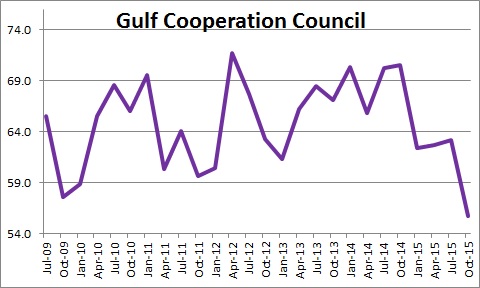
As evidence of the extent to which lower oil prices are affecting confidence in oil exporting countries the Young President’s Organization has a quarterly series on Global Confidence which is then broken into nine different regions. The Gulf Cooperation Council is an economic union of all Arab States in the Persian Gulf (except for Iraq) so its fortunes should be tied closely to oil. In the past year confidence in that region has fallen almost 15 points from 70.5 to 55.7. Having said that the level of the index is still at 55.7 which is indicative of moderate growth amongst those countries. However, confidence has swooned from the 65-70 range that has existed consistently since the inception of the survey in July 2009. The Middle East and North Africa may continue to expand, but at a much slower pace than in the past.
Technology has completely revamped the nature of the oil market and OPEC no longer has the influence that it used to have. For oil-exporting countries that is a serious problem, but for the oil importing countries which are mostly the developed countries – the U.S., Europe, and Japan, it is a significant positive event.
Stephen Slifer
NumberNomics
Charleston, SC
Follow Me