
October 28, 2011
Much of the stock market’s recent angst and the corresponding decline in consumer confidence were triggered by a fear of the consequences of a default by Greece, and a worry that the U.S. economy was on the brink of a renewed recession. Recent data and policy action put those worries to rest which will allow the economy to continue its expansion for the foreseeable future. However, an inability to generate a significant number of new jobs, the high unemployment rate, the drop in home prices, and uncertainty regarding future tax rates and health care costs will cap growth at 2.5% or so from now through 2012.
With regard to Europe, the 50% haircut on its debt outstanding provides Greece with some welcome debt relief. When combined with a renegotiated bailout package which enables Greece to borrow up to 100 billion Euros, Greece will avoid the possibility of a near-term default. Investors around the world have breathed a collective sigh of relief. But make no mistake, more needs to be done. EU leaders have effectively treated the symptoms and not the cause of the problem — the massive budget deficits being run by Greece, Italy and others. However, this week’s action buys time for these countries to address those issues which is a critical first step in the process.
Closer to home GDP grew 2.5% in the third quarter, but that growth rate understates the actual strength in the economy. Sales climbed at an impressive 3.6% pace in the third quarter, but because firms relied on inventories to satisfy part of that demand, production (or GDP) climbed by only 2.5%. However, inventories will be rebuilt in the quarters ahead which will boost GDP growth. Partly for this reason we have raised our projected fourth quarter GDP growth rate to 3.7%. These GDP growth figures for the third and fourth quarters take off the table any notion that the U.S. economy is on the cusp of recession. That is the good news.
Buried amongst the details of the GDP report is the bad news. Real disposable income – what is left from our paycheck after paying taxes and accounting for inflation — fell sharply in the third quarter for the first time since the recession.
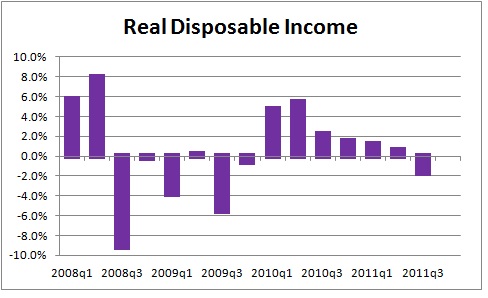
While it is welcome news that consumers continued to spend at a moderate pace in the third quarter, they had to rely on savings to do so. Indeed, the savings rate slowed from 5.3% in June to 3.6% in September. This is not a sustainable situation. Either the economy is going to have to produce more jobs and income in the months ahead, or consumers are going to have to slow their pace of spending. We are going to bet on more jobs for a variety of reasons.
First of all, CEO’s were far more confident in the third quarter than were consumers. For example, the recently released Young Presidents’ Organization measure of CEO confidence slipped in each of the past two quarters but, at 57.7, it indicates clearly that corporate executives believe the U.S. economy will continue to expand for at least another year. Meanwhile, consumer confidence plunged to levels last seen during the midst of the recession.
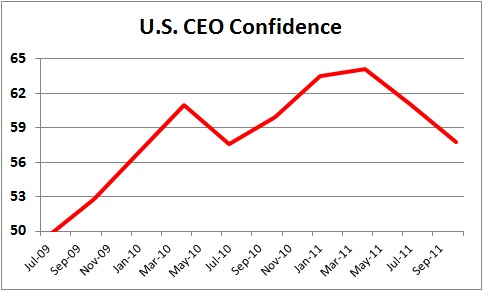
Second, corporate earnings and corporate cash are at record high levels, inventories are extremely lean, and firms have been very cautious about hiring new workers. No wonder corporate leaders feel relatively confident! If they no longer have any fear of a near-term default by Greece, and the U.S. economy has shrugged off its first half blues, it is likely that CEO confidence will rebound and corporate America will hire additional bodies.
Third, productivity growth has been slowing. While this is a normal event at this stage of the business cycle, it means that firms can no longer boost output by simply making existing workers more efficient. In the short term they might choose to work existing employees longer hours, but with enhanced confidence it won’t be long before they quicken their pace of hiring.

While the future will always be uncertain, two major pieces of uncertainly were removed this past week which should allow the economy to expand at a moderate pace for the next several quarters. But until such time as the economy begins to produce more jobs, the housing sector begins to turn upwards, and firms get more certainty about future tax rates and the cost of health care, it is unreasonable to expect the economy to expand much faster than about a 2.5% pace.
Stephen Slifer
NumberNomics
Charleston, SC
Follow Me