
May 24, 2013
A virtuous cycle of rising stock prices and more substantial employment gains is triggering a burst of new home sales. Builders were caught unprepared and have not been able to keep pace. As a result, the faster pace of sales has created substantial shortages of available homes which, in turn, has pushed new home prices sharply higher. The rising home prices attract additional buyers. And so it goes. All of this is consistent with our theme that GDP growth will quicken from 2.3% in the first half of this year to 2.9% in the second and 3.2% in 2014. See what you think.
The stock market eclipsed its pre-recession high back in March and has tacked on an additional 5% since then.
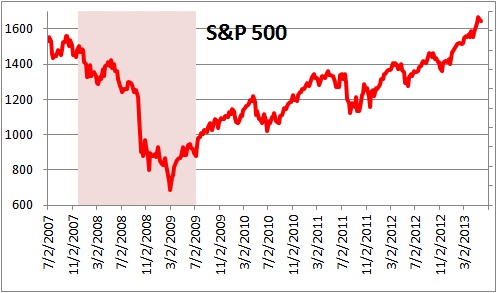
There can be little doubt that rising stock prices make us feel good as consumer sentiment has attained its highest level thus far in the cycle. At the same time consumer net worth almost certainly climbed to a new record high level in the first quarter.
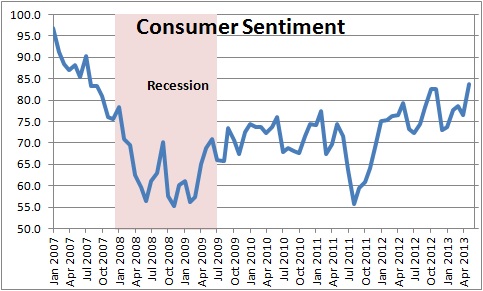
Combining these factors with record low 3.5% mortgage rates has proven attractive to potential new home buyers and sales have begun to climb, a process that seems to be gathering momentum with each passing month.
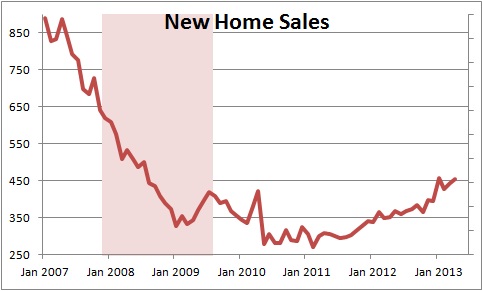
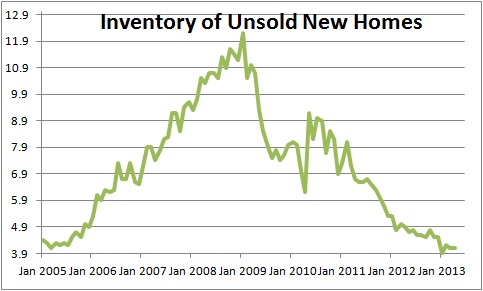
Builders have been rapidly boosting single-family home construction but, hampered by difficulty in attaining adequate financing, have been unable to keep pace. As a result, an acute shortage of available new homes has emerged. A 6-month supply of homes is generally regarded as the point where demand and supply are roughly in balance. Today there is a 4.1 month supply.
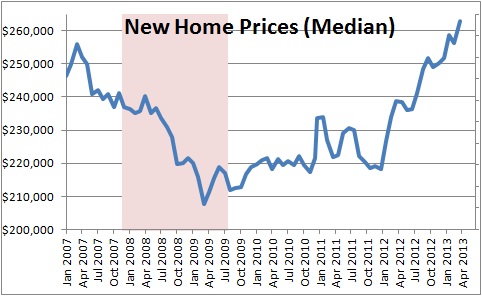
Perhaps as one might expect when demand far exceeds supply, prices start to rise. They began to climb rapidly beginning in January of last year and have been surging since. Indeed, in the past year prices have risen 10.1%. If someone purchases a home and makes a 20% down payment, then the 10% increase in price implies a 50% return on investment.
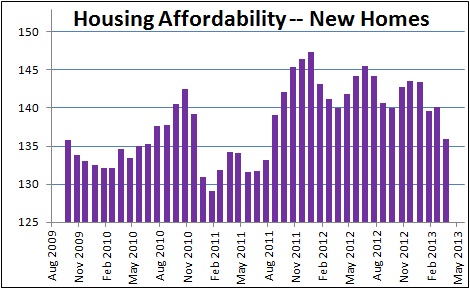
Meanwhile, other potential new home buyers see prices rising and rush to buy before they get priced out of the market. New homes are still affordable thanks to low mortgage rates, but they are less affordable than they were just a few short months ago. A median income wage earner today still has 36% more income than is necessary to qualify for a mortgage but that is down from 47% at the end of 2011. Thus, their fear of getting priced out is not without justification if prices continue to climb.
So what is next? Several thoughts come to mind. First, the solution to this problem is for builders to step up the pace of home construction. As the economy gathers momentum in the second half of this year, banks should be somewhat more willing to open their wallets and make credit more readily available to the housing industry.
Second, this process is likely to cause GDP growth to accelerate from 2.3% in the first half of this year, to 2.9% in the second half, and to roughly 3.2% in 2014. Remember, housing is about 15% of our economy. It includes not just the construction of the home, but purchases of furniture, appliances, and garden equipment as well. A healthy housing sector is critical to the overall pace of economic activity.
Finally, as this process unfolds there is a side benefit as the budget deficit shrinks rapidly. Based on data for the first seven months of the fiscal year, the 2013 deficit should be roughly $650 billion. To put this in context last year’s deficit was $1.1 trillion, and as recently as February the Congressional Budget Office anticipated a current year deficit of $845 billion. This improvement is attributable to both higher revenue caused in part by the increase in the payroll tax, and reduced expenditures at least some of which were triggered by the sequester. For the next five years the CBO currently estimates the annual deficits in a range of $400-500 billion. This does not imply that we do not have a longer-term budget problem. We still do because the deficits climb again beyond 2020 as more and more baby boomers retire, begin to draw Social Security, and become eligible for Medicare. But it does demonstrate the power of slightly more rapid GDP growth.
The pickup in housing is almost certainly boosting the economy onto a faster growth track.
Stephen Slifer
NumberNomics
Charleston, SC
Follow Me