October 16, 2026
The CPI surprised to the upside in September. It rose 0.6% when a gain of 0.5% had been expected as energy prices rose slightly more than economists projected. The core rate climbed by 0.3% versus the 0.2% increase that was anticipated. But that gain, too, was almost certainly oil-related as higher gasoline and diesel prices filtered into non-energy related goods like plastics, rubber, synthetic materials, household cleaners and beauty products. That bad news resulted in a drop of 1.1% in S&P 500 index on that day. The following day the PPI jumped 1.3% which reinforced the message that inflation was suddenly spiraling out of control. But why? The gains in both indexes were almost all energy-related. Going forward we expect crude oil prices to fluctuate in a range from $95-100 per barrel. Our assumption is that the war continues next year, but without a full scale resumption of hostilities. Maybe that is a correct assumption. Maybe not. But if it is, then energy prices are going to level off. Once that occurs the CPI should gradually shrink to a rate of perhaps 2.2% by the end of next year and approach the Fed’s 2.0% target. Our point is that markets do what markets do and react sharply to every tidbit of information. But often they overreact. Stay calm. The world is not very different today from what it was a week ago. AI is playing an important role in keeping the economy on track.
The CPI for September rose 0.6%. The energy component jumped 5.2%, It represents 7.5% over the overall index. This means that in the absence of the jump in gasoline and diesel prices the CPI increase for September would have been about 0.2%. And to the extent that gasoline and diesel prices boosted the prices of non-energy related goods like the ones described above, the September increase would have been even smaller.
The PPI jumped by 1.3% increase in September largely for energy-related reasons. There is a belief that changes in the PPI foreshadow changes in the CPI a few months later. But that connection is very loose. Consumer prices are largely driven by labor costs which are roughly two-thirds of a firm’s overall cost. And today labor costs are very much in check. For what it is worth, wages are currently climbing by 3.7% which should continue into next year. We expect an increase in productivity of 2.5%. That means that unit labor costs (the cost of labor adjusted for the change in productivity) should rise 1.2% in 2027 which is entirely consistent with the Fed’s 2.0% inflation target. Goods prices (energy prices in particular) are certainly an input into the CPI, but the driving factor is usually labor costs which in this case seem to be very much in control.
It seems to us that economists, market participants, and consumers are trying to find the dark side of any number that is released. We would suggest that to a large degree that negative sentiment is being driven by social media where influencers can say anything and it is accepted as gospel. And with the midterm elections approaching politics is also playing a role as each side highlights the outrageous (and often untrue) views held by the opposing candidate.
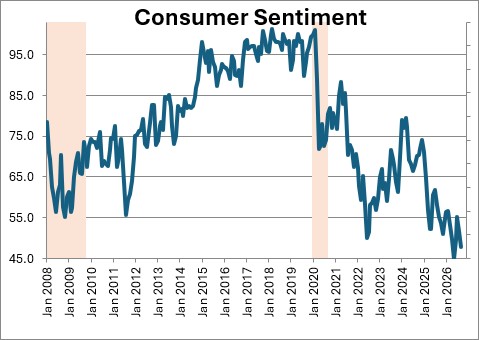
As shown below, sentiment is currently at a record low level. It is lower than it was at the bottom of the 2008-09 recession. That particular period was billed as “The Great Recession” because the GDP decline from top to bottom was the biggest, and the length of the recession was the longest, since the Great Depression in the 1930’s. At the depth of the 2008-09 recession the unemployment rate was 10.0%, Today it is 4.2%. Everybody who wants a job has one. Between May 2008 and March 2009 the S&P 500 index lost more than one-half of its value. Today it is at a record high level and steadily climbing. It makes no sense that consumer sentiment today is lower than it was at the low point of that earlier period. The degree of pessimism is totally out of whack with reality.
The economy, the stock market, and the unemployment rate are doing surprisingly well despite these two factors. That outperformance is to a large degree attributable to the impact of AI.
AI has boosted productivity growth from 1.2% prior to the 2020 COVID-related recession to 2.2%. As a result, our estimate of our economic speed limit (which economists call our potential growth rate) has climbed from 2.0% to 3.0%.
That means, in turn, that our standard of living can grow more quickly.
The increase in productivity is boosting corporate earnings which is propelling the stock market upwards.
The increase in the stock market has boosted consumer net worth to a record high level.
AI has made it easier and less costly to start a new business. Net business formation is at a record high level. These entrepreneurs are creating jobs which probably explains why the unemployment rate remains at 4.2%. Everybody who wants a job has one. And as those startups grow they will employ even more workers next year.
For those of you who are extremely pessimistic about the economic outlook we suggest that you at least consider the impact that AI is having on our economy. We are in the early stages of an evolutionary change in how our economy functions.
Stephen Slifer
NumberNomics
Charleston, S.C.
Follow Me