
June 22, 1012
Student loans have skyrocketed in the past three years. Students are graduating with unprecedented amounts of debt and are unable to make ends meet. First came the dot.com bubble in the 1990’s. Then came the housing bubble. Is this the beginning a student loan bubble?
Student loans guaranteed by the federal government have climbed from $100 at the end of 2008, to $450 billion today. Add in private sector loans and the figure climbs to $1 trillion which makes student loans far bigger than credit cards. This back-to-school movement is clearly a reflection of the weak economy. Students graduate from high school and can’t get a job so they head off to college. Others lose their job and take the opportunity to upgrade their skills by going back to school. They all have the best of intentions. The hope is that upon graduation in 2 years or 4 years time the job market will have improved, and the likelihood of getting a decent paying job will be much higher than in today’s environment. They may be right. Four years from now the unemployment rate is likely to be sub-6%, or relatively close to full employment, versus today’s level of 8.2%. While these graduates will still be burdened by student debt, their ability to pay it back should not be too daunting. If that is the case, student loans will have been a good investment for the country as well as for the individuals involved.
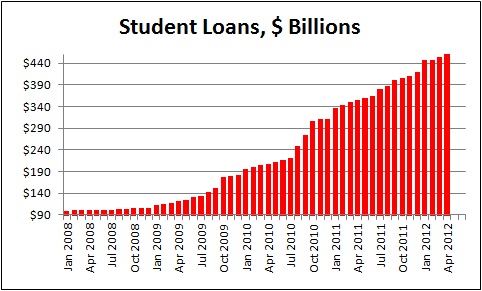
But for many others there is a less happy ending. Some are inadequately prepared for college, drop classes, and eventually flunk out or voluntarily choose to leave school. But once that happens, student loan repayment must begin. With job prospects little better than when they started, this pushes many over the edge into bankruptcy. For others the job market when they graduate is not what they had hoped. Those students who went back to school in late 2008 and are close to graduation today are finding it particularly difficult to land a good paying job.
The average undergraduate finishes school with an outstanding student loan of $24,000. Advanced degrees push the total far higher. Unfortunately, that is only the beginning. Those students will almost certainly have credit card debt of at least $5,000, and personal loans (perhaps including a car payment) of another $10,000. That pushes the total to almost $40,000 which is in sharp contrast to a generation ago when students graduated with virtually no debt.
As a result of this punishing debt burden students are forced to make serious adjustments to their lifestyle. Surveys indicate that roughly 25% have moved back in with their parents to cut costs. Another 20% have been forced to accept a job that they otherwise would not have taken because they need money to pay off their student debt. Others have chosen not to pursue advanced degrees because they already have so much debt. Home purchases have been postponed because they cannot afford it. Some have put off getting married or having children. Saving for the future is out of the question. It does not have to be like this.
The problem is excessive debt, of which a student loan is just one component. How did this happen? As is frequently the case, many players have contributed to the problem.
Federal Government. The overwhelming majority of students can qualify for a federal student loan. The amount they can get depends only on their education level (i.e., undergraduate or graduate), and whether they are a dependent (living with mom and dad), or independent. Their high school academic record does not matter. Their own income does not matter. Their parent’s income does not matter. Their credit history does not matter. Their expected future income does not matter. Students can be rejected only if they have previously defaulted on a federal student loan or been convicted of a drug-related offense.
This brings back sorrowful reminders of the sub-prime mortgage market a few years ago where money was essentially being handed out to potential home owners for free and the borrower’s ability to repay the loan was irrelevant.
Some changes must be implemented. Given the size of our federal budget deficit, we cannot afford to provide money to those students who barely made it through high school and have little chance of success at the college level. Some sort of means-testing should be implemented so that borrowing by students of wealthy parents is limited. Expected future income should be factored into the equation. . This is no different from a bank examining the earnings potential of a small business before deciding whether to extend a loan.
Colleges and Universities. Because of rapidly rising tuition costs, Congress occasionally raises the upper limit on student loans. Unfortunately, this then causes colleges and universities to believe that the student can now afford more, and they raise tuition to match. As a result, the student is no better able to fund the cost of each year’s tuition, and is now even deeper in debt. College presidents’ compensation packages, and sports programs which pay huge sums to football coaches, or choose to build shiny new athletic facilities, are coming under increasing scrutiny. Perhaps colleges should concentrate on particular curriculums and eliminate others. Does every college really need to offer an economics major?
Private Lenders. Those students who need funds beyond the amount provided by federal student loans, often turn to private lenders. Unfortunately, many universities steer student borrowers to so-called “preferred lenders” which often results in the student paying an excessively high interest rate. To achieve “preferred lender” status the lender often rewards university financial aid staff with kickbacks. It is also important to understand that, unlike credit card debt, student loans are not discharged during bankruptcy. The student cannot escape this particular obligation. For the” preferred lender” this means that student loans are risk free, but yet they charge an average interest rate of about 7.0%.
Students. Unfortunately, many of our younger people today are financially illiterate. Having been taught by their parents, they want what they want and they want it now – an iPad, the $5 latte from Starbucks, a new car, and a degree from a prestigious university. There is no thought given to how they can afford such luxuries. They might want to go to a prestigious college like Harvard, Princeton, or Yale, but a state university might do just as well at one-third the cost. They might consider a community college for the first two years to save money and then transfer to their college of choice. Students who choose to major in Russian history or American folklore have got to be made aware that their job prospects upon graduation and their expected income may be insufficient to repay their cumulative student debt. Even after making these adjustments, students will almost certainly not graduate debt free, but their debt burden could be cut in half.
Clearly, the current student loan program is spiraling out of control. It is especially troublesome for those recent graduates who are looking for a good paying job in what has been the worst job market since the Depression. But with some changes in current practices, future students can upon graduation end up with a manageable level of student debt and a sufficiently high paying job to be able to repay that debt without undue hardship.
Stephen Slifer
NumberNomics
Charleston, SC
Follow Me