
May 27, 2011
Recent data have all been softer than expected. There is no knockout punch, but the preponderance of evidence is pointing towards slower than expected growth in the second quarter. Accordingly, we are going to lower our second quarter GDP estimate from 4.0% to 3.0%. Growth is still accelerating from 1.8% in the first quarter to, presumably, a 3.0% pace in the second quarter — which is still reasonably robust. However, late last year we had been anticipating growth of 4.0% in both the first and second quarters. Clearly, the pace of economic activity has softened given rising oil prices and, presumably, parts shortages caused by the tsunami in Japan. However, it is likely that this first half moderation in growth represents another soft patch similar to what happened in the middle of last year in response to worries about the debt problems in Greece and elsewhere in Europe. It is inconceivable, in our opinion, that this represents the beginning of an extended period of slow growth.
First the negatives. Initial unemployment claims jumped in the second half of April from 385 thousand to 440 thousand. This reflected, in part, an inability of automobile manufacturers to get necessary parts from Japan following the earthquake/tsunami. But claims have remained on the high side for more than a month. Thus, employment growth in the second quarter might remain at about 225 thousand a month rather than steadily increasing. That is not bad, but it is not quite as robust as we had hoped.

Along the same lines we have seen orders data soften in the past several months for, presumably, the same reasons. They had been growing rapidly, but have now leveled off. Shown below is the chart for non-defense capital goods orders excluding aircraft which is a proxy for the pace of nonresidential investment spending. This has been the fastest growing sector of the economy for the past couple of years. But its recent behavior suggests that its growth has moderated — at least for the time being.

Finally, corporate profits remain at a record high level, but growth in profits has moderated. This reflects the fact that oil prices have been rising, but corporations have had difficulty in passing those higher costs along to their customers. Hence, profit margins have been trimmed. If growth in profits has fueled investment spending for the past couple of years, this more recent development may temporarily trim the pace of such spending.

And now the positives. The most important factor to keep in mind is that Fed policy is extraordinarily accommodative. The funds rate remains near zero percent. And now with slower than expected growth in the first half of the year, and some hint that the inflation rate will slow in the months ahead, the Fed will almost certainly remain on the sidelines through the spring of next year. The economy is not going to go into a tailspin until Fed policy has firmed by about four percentage points which would make Fed policy more “neutral”. That is probably not going to happen until 2014.

The economy has been creating significant numbers of new jobs as payroll employment gains have climbed to about 225 thousand. But now with GDP growth slowly accelerating and productivity growth moderating, the only way to satisfy that increase in demand is by additional hiring. We expect employment gains to continue at 225 thousand a month for the rest of this year, or even strengthen somewhat in the second half of the year.
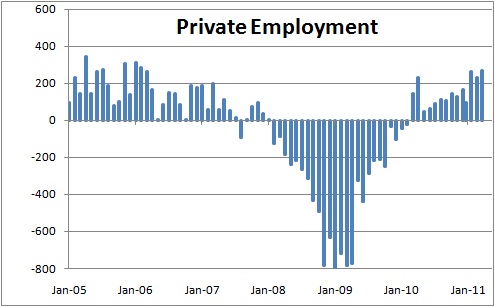
Those job gains will fuel growth in income. Real disposable income (after tax and after inflation) is currently growing at the fastest rate we have seen in years. If consumers have the income they are not about to stop spending. That would almost be un-American.

Then, there is debt. Consumers have paid off debt with a vengeance over the past couple of years at the same time that their income has been rising. As a result, the consumer debt burden has been reduced. And if consumers become more comfortable with their debt burden, they can now spend a larger share of their income instead of using some part of it to pay back debt. That, in turn, implies a faster pace of consumer spending in the months and quarters ahead.

Finally, corporations have unprecedented amounts of cash. During the recession firms laid off millions of workers at the same time that they invested heavily in technology. That combination resulted in extremely rapid growth in productivity which, in turn, sharply boosted profits. But with limited investment opportunities, much of that cash remains on corporate balance sheets in the form of cash. It will not stay there for long. Cash yields a return of only about 1.0%. Corporations need to put that cash into more profitable alternatives.

Thus, as we see it, the positives far outweigh the negatives. Thus, it is almost certain that growth will accelerate as we move into the second half of the year. The economy always grows in fits and starts. Presumably, we are currently experiencing one of its “fits”. It shouldn’t last long.
Stephen Slifer
NumberNomics
Charleston, SC
Follow Me