
January 28, 2001
Fourth quarter GDP growth came in at 3.2% which was a significant shortfall from the 5.0% growth rate we had anticipated. One might think we would be disappointed, but we really are not. Buried in the details are signs that the economy continues to gather momentum. We still expect GDP growth in 2011 to accelerate to a 4.0% pace.
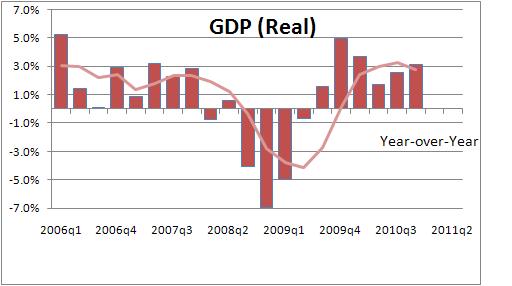
As shown, GDP expanded at a 3.2% pace in the fourth quarter and over the past year has climbed by 2.9%. While that is an acceptable pace, it is not sufficient to reduce the unemployment rate quickly. But digging deeper there is ample justification for believing that GDP growth will quicken in 2011.
You will recall that GDP consists of spending by consumers, businesses, the government, and trade. In Econ 101 that translates into the old equation GDP = C + I + G + (X – M). Let’s take a look at a couple of these components. First, consumption spending:
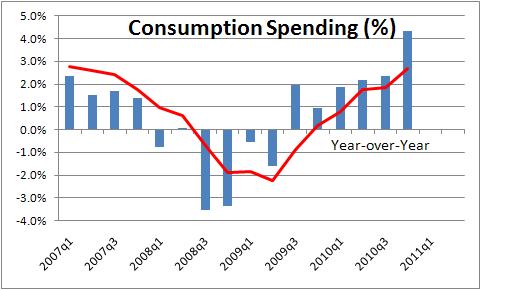
Consumer spending surged 4.4% in the fourth quarter which was roughly double the pace of the previous three quarters. It seems fairly clear that the extreme caution exhibited by consumers over the past couple of years is coming to an end. For the past two years, we have aggressively paid down debt and built up savings. So now our debt burden is far more comfortable, the rise in the stock market is helping us to restore wealth, the unemployment rate appears to have begun a slow, gradual descent and, as a result, we are just a bit less cautious.
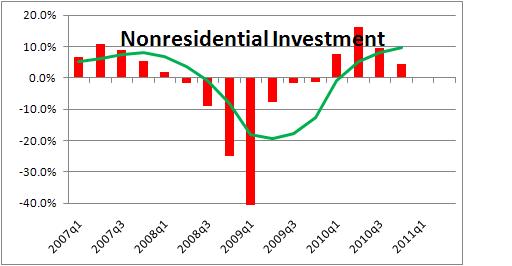
Then there is corporate America. Firms also spent quickly in the fourth quarter with nonresidential investment climbing at a 4.4% pace. Looking at the chart below that seems a bit anemic, but only because it is being compared to double digit rates in the two previous quarters. Over the course of the past couple of years businesses have laid off millions of workers in an attempt to cut costs. With that same objective in mind they have also spent tons of money on technology in an attempt to boost productivity. And that spending has paid off in spades. Corporate profits have surged, and businesses today are sitting on a mountain of cash. Given this success it is not surprising that they continue to spend money on technology. Indeed, spending on information technology and software surged 20.7% in the fourth quarter. Given the extent to which tech spending has bolstered profits, why would corporations want to reduce technology expenditures during 2011?
Then there is trade. When we sell goods overseas exports rise, which adds to GDP growth. When imports rise that means that some of our spending has actually been on goods that were purchased overseas, so it is subtracted from GDP. So what happened in the fourth quarter? Exports surged by 8.5%, while imports declined by 13.6%. When we look at net exports, or exports minus imports, both pieces added to GDP growth. Indeed, the net exports deficit narrowed by more than $100 billion in the fourth quarter which boosted GDP growth in that quarter by 3.4%.
So wait a minute! If consumption spending was rapid, investment spending grew quickly, and trade added so much to GDP, why in the world did GDP grow by just 3.2%? It is primarily because of the change in business inventories. In calculating GDP growth one needs to add the change in business inventories. Why? Think about it this way. GDP is a measure of how many goods and services were produced in any given quarter. If G.E. is the only company in our economy and it produces 100 refrigerators, then GDP should be 100. If it sells just 90, then the remaining 10 show up in inventories. When we calculate GDP we add up all the sales data which, in this example, would be 90. To get the right answer we have to add the change in business inventories which in this case is 10. Voila. GDP equals sales (90) plus the change in business inventories (10), or 100.
Let’s take this one step farther. If GE sells 100 but produces only 90, how does this work? In this example, to sell 100 refrigerators when it produced only 90, G.E. had to reduce its inventory level by 10. So, GDP equals sales (100) plus the change in business inventories (-10), or 90.
So enough theory. What happened to inventories in the fourth quarter? The change in business inventories in the quarter was -$114.2 billion. This change subtracted a whopping 3.9% from GDP growth.
One can see this more clearly by looking at final sales, which is GDP less the change in inventories.

Final sales surged 7.1% in the fourth quarter. Between consumers, businesses, the government, and exports, sales skyrocketed and grew at the fastest pace we have seen in any quarter since the second quarter of 1984. That is impressive! Because of this dramatic acceleration in sales, businesses were unable to boost their inventory levels, so when we add the change in business inventories of -$114.2, we end up with much more modest looking GDP growth in the fourth quarter of 3.2%.
So what does all this mean? Basically, it means that goods were flying off the shelf in the fourth quarter. Businesses could not keep up so they had to rely on inventories to satisfy a large portion of that demand. Thus, we had super strong sales data but only modest GDP growth. But now inventories are too lean in relation to sales and they need to be replenished. That implies, in turn, that inventories will do the reverse and add significantly to GDP growth in the first half of 2011. Given that inventories subtracted 3.9% from GDP growth in the fourth quarter, it is likely that inventories will add a roughly comparable amount to GDP growth in some combination of the first and second quarters. They may take away from growth in one quarter, but will add it right back in subsequent quarters.
We continue to look for 4.0% GDP growth in 2011.
Stephen Slifer
NumberNomics
Charleston, SC
Follow Me