
January 19, 2012
Clearly the economy is gathering momentum. At the end of next week we should learn that fourth quarter GDP growth came in at 3.8%, considerably faster than the 1.8% pace recorded in the previous quarter. The week after that we will see another jobs report. Our expectation is that private sector employment will once again climb by more than 200 thousand while the unemployment rate remains steady at 8.5% after having fallen 0.6% in just four months. Our expectation is that it will continue to fall to 7.6% by yearend. With the economy accelerating, job growth quickening, and the unemployment rate having begun a steady downtrend, should our policy makers back off and quit trying to stimulate the economy? Maybe. Or maybe not.
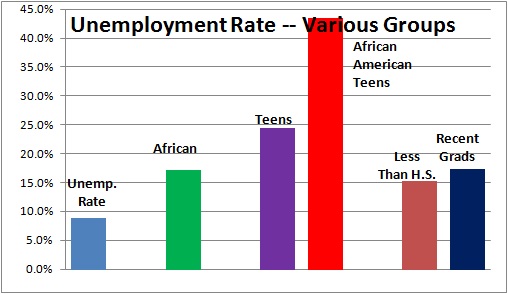
Even though the 8.5% unemployment rate may be heading lower, there are many groups of people in our economy that are receiving the brunt of the burden. The unemployment rate for African Americans is almost 16%. For teenagers it is 25% –for African American teens it is in excess of 40%. Those without a high school degree come in at 15%. Even recent college grads (being defined as those who graduated within the past year) are experiencing a 17% unemployment rate. It is these latter two groups that are particularly troublesome. They represent the youth of our country. Our country’s future. They did everything that mom and dad told them. They studied hard. Got into college. Got good grades. Graduated. And now what? Many are finding it difficult to land that first job. It is there that these people learn the skill set that will enable them to advance in their career and significantly boost their income. But many cannot get their foot in the door.
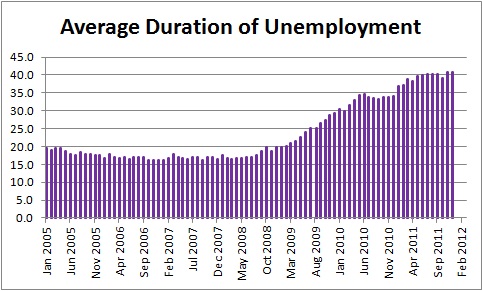
At the same time that the unemployment rate has fallen 0.6% in four months to its current level of 8.5%, the average duration of unemployment – the average amount of time these unemployed workers have been without a job — has continued to increase. It currently stands at 40.8 weeks, or roughly 9-1/2 months. It has not been this long since the Depression. Clearly, the people who are finding jobs are not coming from the ranks of the long-term unemployed. So why is that? Rightly or wrongly there seems to be a stigma that people who have been out of work for a year or so are not worthy candidates. Furthermore, in today’s market place employers are increasingly looking for people who are tech savvy. These long-term unemployed workers may no longer have the skill set that employers seek. There is a mismatch, between what employers want and what these long-term unemployed workers are able to offer. As a result, some of these people may become permanently unemployed.
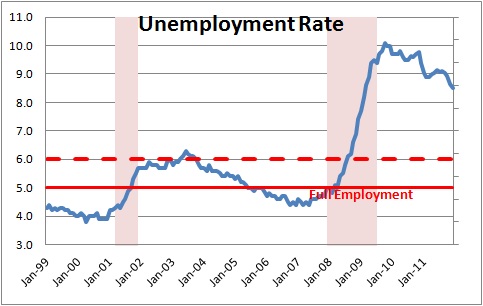
Currently, most economists believe that the full employment unemployment rate, i.e. the level at which everybody who wants a job has one, is about 5.0%. But if some of these long-term unemployed workers are truly unemployable, then that rate is going higher — to 6.0% or beyond. For years we in the U.S. used to scoff at those European countries that had unemployment rates between 8.0-10.0% while ours was about 5.0%. It is time to stop snickering.
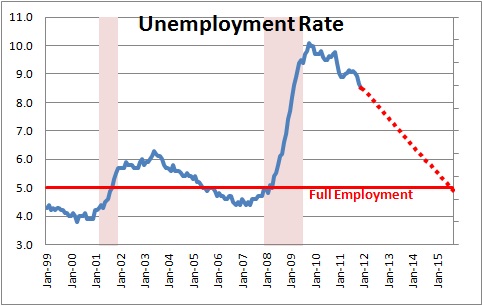
So while the economy has clearly gathered momentum, more jobs are being created, and the unemployment rate has begun to fall, it will take years – probably until 2015 — for it to get back to that full employment level, whatever that might be . And remember, our forecast for GDP growth and employment are more optimistic than most of our colleagues.
So, if one were inclined to take action to speed up the economy in order to reduce the unemployment rate more quickly, what might one do?
- The Fed could lower short-term interest rates. Unfortunately, the funds rate has been at 0% for the past three years. Can’t do that.
- The Fed could add more reserves to the banking system. But the banking system already has $1.6 trillion of surplus reserves that are not being used. Adding still more reserves makes no sense. Won’t do that.
- The Fed will sell some Treasury bills and buy more mortgage-backed securities in an attempt to push long-term interest rates lower. But mortgage rates are already at a record low level of 4.0%. Won’t help much.
- Lower tax rates. This is an election year. Nothing much is going to happen between now and November. The best we can hope for is that Congress keeps the current, lower payroll tax rates in place through yearend. They are currently scheduled to rise at the end of February. Won’t help much.
- Extend unemployment benefits. Like the payroll tax they are scheduled to revert back to a shorter time period at the end of February. Almost certainly the current benefit levels will be extended through yearend. Taking this action might alleviate some of the pain for those already unemployed. But it won’t create a single job.
- Build the Keystone oil pipeline which will stretch 1,600 miles from western Canada to oil refineries on the Texas coast. Obama just put the kibosh on that project this week. Even if it were to pass it would take 12-18 months for a full review. Furthermore, the estimates for job creation are typically in a range from 6-20 thousand. Won’t help much. Won’t help at all in 2012.
The point is obvious. The economy is on its own this year. There are no policy options that will cause the unemployment rate to fall much faster or beyond what we currently expect – which is 7.6% by yearend. Even if we want to help, there is not a lot we can do. The policy options are limited.
Stephen Slifer
NumberNomics
Charleston,SC
Follow Me