
October 15, 2010
The Fed has put itself firmly in the spotlight by openly talking about additional easing if the economy does not soon begin to grow more rapidly and the unemployment rate does not start to fall. Clearly they are frustrated, but will additional Fed stimulus help?
The goal of the Fed is to seek maximum sustainable output growth, full employment and stable prices. This means that they would like to see GDP growth of about 3.0%, inflation of 1.5-2.0%, and an unemployment rate of about 5.0%. They are falling short on both the GDP and unemployment rate objectives. Their best efforts have not yet produced robust growth, and the economy is having a tough time creating jobs. It is hard to sit back and do nothing – particularly with an election looming. As a result, numerous Fed officials have suggested that if the pace of economic activity does not soon quicken, they would be in favor of additional stimulus. Is this just political posturing? Or are they serious?
The problem is that the Fed has already exhausted their traditional method of stimulus. Short-term interest rates are already near zero percent. The only trick left is to buy more long-dated securities in an effort to push Treasury bond yields and mortgage rates lower.
But will additional stimulus really help? The problem in the economy is not that monetary policy is too tight. Excess reserves today are about $1 trillion. Those reserves represent funds that banks could lend if they were willing to do so and if they can find consumers or businesses that are willing to borrow. But for the most part those groups are more interested in paying down debt and de-leveraging.

Some of the folks who run macro-economic models suggest that if the Fed actually pulls the trigger on this so-called “quantitative easing” and adds another $1.0 trillion of reserves, as is widely expected, they might succeed in pushing down bond yields by 0.5% next year. That, in turn, might boost 2011 GDP growth by an additional 0.3%, and shave perhaps 0.3% from the unemployment rate from what it otherwise would have been. That would be a good thing, right? Why not just do it!
The problems arise once the economy begins to gather momentum and the Fed has to take away the punch bowl and drain all those surplus reserves. They are already in uncharted waters. In a high week excess reserves might be $2 billion. Indeed, the record level of excess reserves was $38 billion following 9/11. Today it is $1 trillion. Thus, the Fed’s job already is multiple times bigger than anything they have ever had to do before, and if they push excess reserves to $2 trillion their job obviously becomes twice as big. They have a game plan on how they might accomplish that, but neither they nor anybody else can be sure it will work.
To drain that volume of reserves the Fed will need to tighten aggressively, which carries with it the risk that they could dump the economy back into recession. If they do not tighten quickly enough, inflation could get out of hand. The Fed will need a very delicate touch to balance those two risks.
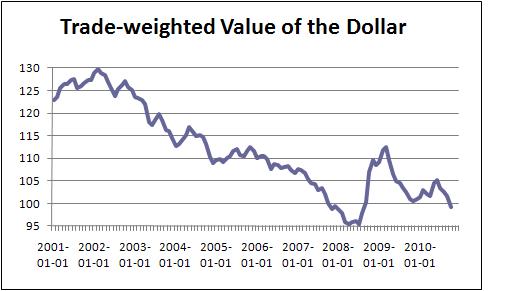
Then there is the issue of how foreign investors view their action. Could significant additional Fed easing be perceived as a sign of irresponsibly easy monetary policy? If so, the Fed’s action could send the dollar into a tailspin and, indeed, the dollar has already fallen 6% since reaching its mid-year high. A sharp dollar drop would both exacerbate the inflation problem, and perhaps make foreign investors less willing to purchase Treasury securities. But we need foreign investors to help finance our expected budget deficits.
If monetary policy in the U.S. was truly tight, then a Fed easing initiative would make sense. But that is simply not the case. Instead, the current weakness appears to be attributable to a desire by consumers and businesses to deleverage themselves, and uncertainty associated with future tax rates, the cost of health insurance, and the regulatory environment. Hopefully, in the months following the election some of that uncertainly will be reduced.
Stephen Slifer
NumberNomics
Charleston, SC
Follow Me