
May 30, 21014
One of the missing ingredients in the first five years of expansion is a willingness of banks to extend credit. But in recent months all categories of bank lending have accelerated which, if sustained, will contribute to a faster pace of economic expansion in upcoming quarters. A potential problem is that the Federal Reserve has provided so many surplus reserves to the banking system that bank lending get out of hand and eventually contribute to an upswing in inflation. It is not a problem yet but the situation bears watching because it could force the Fed to raise the funds rate sooner than the middle of next year.
For the first five years of expansion banks have generally been willing to lend to businesses. Commercial and industrial loans began to climb in early 2011 and have been rising steadily at a 10-13% pace for the past three years. Growth tapered off somewhat last year. However, perhaps in response to expectations of faster GDP growth this year, commercial and industrial loan growth has surged. Banks seem more willing to lend; firms seem more willing to borrow. Indeed, in the past three months growth in business loans has accelerated to an 18% pace. While still a relatively short period of time that is by far the fastest pace of lending thus far in the business cycle.

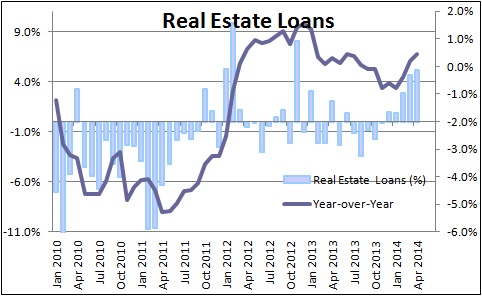
Mortgage lending has been virtually non-existent in the first five years of expansion. Outstanding real estate loans continued to slide during the first two years of expansion as foreclosures and short sales erased billions of dollars of such debt. The recession ended in June 2009; real estate loans did not hit bottom until September 2011. Since then they have been essentially unchanged.
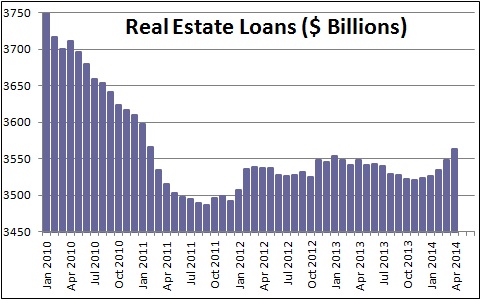
However, in the past few months something different seems to be happening. Mortgage loan growth in that three-month time period has climbed to a 4.2% pace. Once again, it is a relatively short time period but it is more than double the fastest pace thus far in the business cycle. Mortgage lending activity matters because banks have $3.6 trillion of such loans on their books which represents almost one half of total loans outstanding.
The same kind of phenomenon has been occurring with consumer installment lending. Following the recession consumer loans declined steadily until the spring of 2011 as consumers pared debt to a level more in line with their income. Consumer loans have climbed since then but at a relatively subdued rate of 2.0-3.0%.

However, growth of consumer loans has accelerated to a 5.7% pace in the past three months which is, like the other loan categoriees, the fastest pace thus far in the recovery.

This re-invigorated pace of bank lending is welcome news and will undoubtedly contribute to a more robust pace of economic expansion in the quarters ahead. Consumers and small businesses in particular have often cited an inability to access credit as a reason for subdued spending. Unfortunately, faster growth in bank lending brings with it a potential problem.
Since the collapse of Lehman Brothers in September 2008 the Federal Reserve has flooded the banking system with reserves. Indeed, excess reserves have climbed from about $2.0 billion prior to the demise of Lehman Brothers to an unprecedented $2.6 trillion today — and they continue to grow every month as the Fed purchases additional Treasury bonds and mortgages. These excess reserves represent the ability of the banking system to make loans to businesses and consumers. Thus, the Fed has provided the banking system with enough ammunition to fuel a spending spree that at some point could become inflationary. Eventually, the Fed needs to eliminate those excess reserves. It will do so by selling Treasury securities and raising the funds rate.
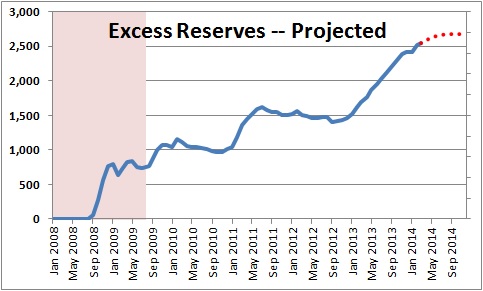
At the moment a faster pace of bank lending is a welcome development. But it needs to be monitored closely and if the pace of economic activity picks up more vigorously than expected, the remaining slack in the economy disappears, and leading indicators of inflation begin to rise, the Fed could be forced to raise the funds rate sooner than the middle of next year.
Stephen Slifer
NumberNomics
Charleston, SC
Follow Me