
September 14, 2012
Fed Chairman Bernanke and his colleagues have made it clear that they are going to do whatever they can to boost employment and bring down the unemployment rate. But will it work? Is the Fed playing politics? Will this action cause problems down the road?
On September 13 the Fed made several announcements. First, it intends to buy $40 per month of mortgage backed securities until such time as the unemployment rate has fallen to an acceptable level. Second, because the Fed wants to ensure that the economy is on solid ground it pledged not to raise interest rates prior to mid-2015.
Will it work? The Fed has a dual mandate. It is expected to keep the inflation rate in check and simultaneously keep the economy at full employment. With inflation at roughly the 2.0% mark it is succeeding on achieving its first objective. But with the unemployment rate currently at 8.1% rather than 5.5% it is not doing so well with the second. On numerous occasions Bernanke has indicated that he is not satisfied with the lack of jobs and the high level of the unemployment rate. This action by the Fed underscores that concern.
Bernanke believes more firmly than most other economists that the Fed’s unconventional monetary policy of buying bonds has been successful in lowering mortgage rates and turning the housing sector around. As a result, he is willing to keep pushing in the hopes of further stimulating the economy.
Most economists are less optimistic that this action will have the desired result. With mortgage rates currently at a record low level of 3.5% it is hard to imagine that lower mortgage rates will help all that much. Consumers need confidence that the economy is going to remain on a solid upward path before they are willing to take the plunge and buy a house. Furthermore, they need to find a banker willing to approve their mortgage application. While lower rates might help a bit, we probably should not overestimate their likely impact.
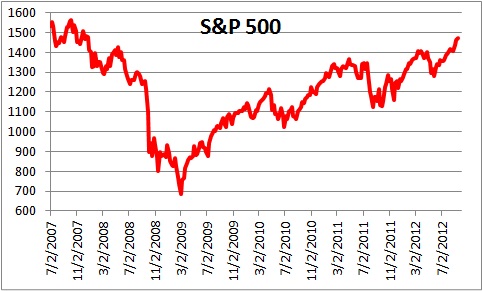
Having said that, in the days leading up to the FOMC meeting and the days immediately thereafter, the stock market rallied vigorously and the S&P 500 average is now at its highest level since December 2007.
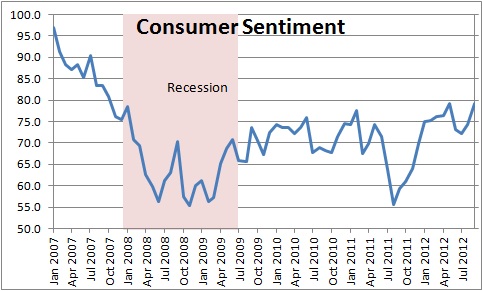
In part because of rising stock prices, consumer sentiment jumped five points in September and is now back to its highest level for the cycle. So while most economists are leery that recent Fed action will boost “animal spirits” and induce consumers to spend more freely, there is at least some evidence to the contrary.
The biggest near-term hurdle for the economy seems to be the fiscal cliff. A combination of tax hikes and government spending cuts scheduled to take effect at yearend run the risk of dumping the economy back into recession. Congress will almost certainly take action to mitigate these changes. However, no one knows what the final package might look like and the extent of the negative impact on growth in early 2013.
Is the Fed playing politics? With the November election less than two months away Republicans are crying foul. They claim the Fed is trying to stimulate the economy and boost President Obama’s reelection chances. Rubbish. First of all, any action by the Fed impacts the economy with a lag. Thus, recent Fed action will not affect economic growth until well after the election. Second, the problem in the economy today is not caused by the Fed. Rather, it is bloated budget deficits, excessive debt, and the fiscal cliff. Policy makers on both sides of the aisle could do far more to stimulate the economy by altering the course of our misguided fiscal policy than by taking aim at the Fed.
Will this action create problems down the road? Maybe. The banking system already has more reserves than it needs to satisfy the demand for loans by consumers and businesses for years to come. And now the Fed plans to increase those reserves balances by $40 billion per month for an unspecified period of time.
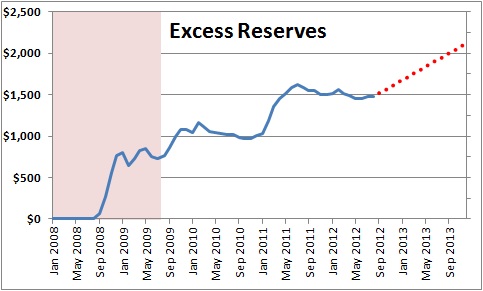
Once the economy gathers momentum and the unemployment rate has fallen close to its full employment level, the Fed will need to eliminate those surplus reserves. Two trillion dollars of excess reserves have the potential to finance a spending spree the likes of which we have never seen before. At that point the Fed must quickly remove those surplus reserves from the system to prevent an upswing in inflation. It says it will do just that, but rate hikes are always hard to initiate. Furthermore, it is not clear who will be Fed chairman at that time. Bernanke might be willing to take that action, but will his successor?
In short, recent Fed action has boosted the stock market and made consumers more optimistic, but will it bring about the desired changes in employment and the unemployment rate? Will the Fed be willing to take offsetting action when it becomes necessary? While the answers to these questions are unclear, the reality is that for the moment the Fed is the only game in town.
Stephen Slifer
NumberNomics
Charleston, SC
Follow Me