
June 28, 2013
A hint from the Fed that it might soon slow its pace of bond purchases sent the U.S. stock market into a tizzy. Bond yields and mortgage rates rose about 1.0%. Economic pessimists came out in droves. But since mid-June the economic indicators have been uniformly stronger than expected and it is clear that the economy is quickly gathering momentum. Even though interest rate levels will remain close to their current level for some time to come, they will be only a minor obstacle. By yearend the stock market will be considerably higher, and the economy will be stronger.
The S&P 500 index fell about 5.0% between late May and mid-June, but setbacks of that magnitude are common. Keep in mind that equity analysts equate a market “correction” with a price drop of 10%. Not even close. Further, the market has since recovered about half of what it lost. Why? Because the economy is gathering momentum.
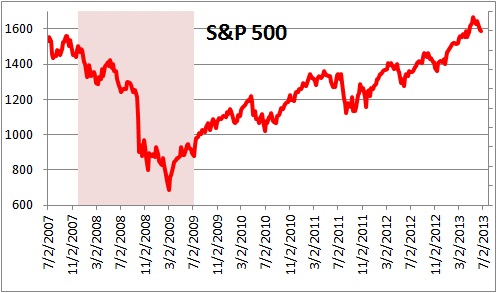
Equity markets worry about slower growth which will reduce earnings. Higher interest rates by the Fed are a legitimate worry. But keep in mind that the Fed has done nothing. Bernanke suggested that by yearend the Fed might slow its rate of bond purchases. Currently the Fed is buying $85 billion of Treasury securities and mortgages every month. That means that every month its monetary policy stance is becoming progressively easier. If the Fed cuts the rate of purchases from $85 billion to $50 billion, they are still easing but at a somewhat slower pace. Bernanke suggested that the purchases are unlikely to cease until mid-2014. That is a year away. Increases in the federal funds rate are two years away. This situation that should not generate undue alarm.
Meanwhile, the economic data are uniformly getting stronger. Led by the housing market the economy is rapidly accelerating. An acute shortage of available homes has produced double-digit gains in home prices over the past year. Rising home prices and the prospect of higher mortgage rates have forced fence-sitters into the market. Sales have surged. Builders, sensing an opportunity, are trying hard to step up the pace of production. They are more confident than they have been since early 2006.
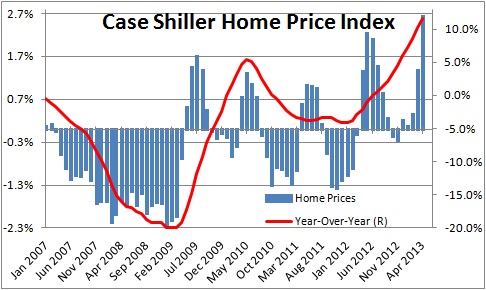
The combination of rising home prices and steady stock market gains has boosted consumer net worth to a record high level. Jobs are being created at a reasonable pace. The unemployment rate is steadily falling. Consumers are as confident as they have been since September 2007 – prior to the onset of recession. The data are uniformly robust and are pointing to a meaningful quickening of GDP growth in the second half of the year.
Chairman Bernanke’s comments also rattled the bond and mortgage markets where rates have risen by about 1.0%. We think these new rate levels are relatively appropriate.
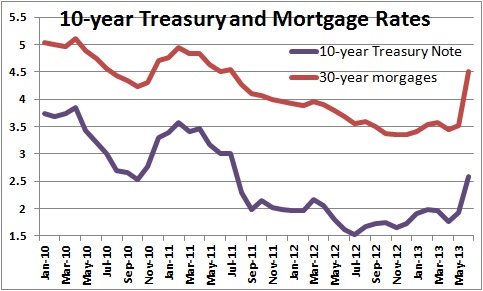
When the economy tanked the Fed quickly lowered the funds rate almost to 0%. The funds rate has been at that level since December 2008. But the economy was collapsing and in need of additional assistance. In an unprecedented response the Fed decided to buy Treasury bonds and mortgages in an effort to lower both long-term and mortgage interest rates. They were successful as the yield on the 10-year fell to 1.5% while mortgage rates fell to 3.5%, both record low levels. But those rates had been artificially lowered by Fed policy and at some point policy was going to change. Bernanke suggested that time may not be too far into the future. If so, what is an appropriate level of long-term interest rates? The answer can be determined by looking at the “yield curve”.
The “yield curve” is nothing more than the difference between long-term and short-term interest rates. The green line on the chart below shows the difference between the yield on the Treasury’s 10-year note (a long rate), and the funds rate (a short rate). The shape of the yield curve depends heavily on Fed policy – Is it tightening? Or easing?
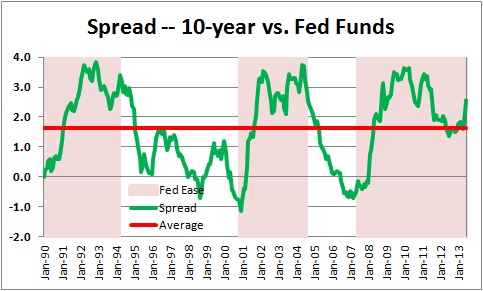
When the Fed is tightening, it raises the funds rate much more quickly than long-term rates climb so the “spread” narrows, which means that the “yield curve” is flattening. Indeed, if the Fed raises short rates high enough the spread can be negative which means that the yield curve has “inverted”. Typically when that happens the economy is on the cusp of a recession. The periods shown in white on the chart above roughly correspond to periods when the Fed was tightening. In the Fed’s most recent tightening period from July 2004 to July 2007 the yield curve flattened from 3.5% to -0.7%. Indeed, that modest inversion of the yield curve was a harbinger of recession (which started five months later).
When the Fed is easing, the opposite occurs. The funds rate declines far more quickly than long rates fall so the “spread” widens, which means that the “yield curve” is steeping. The periods shown in pink in the chart above roughly correspond to periods when the Fed was easing. Most recently the Fed began to ease in July 2007 and lowered the funds rate almost to 0% by December 2008. During that period of time the yield curve steepened from -0.7% to 3.5%.
But then when the Fed suddenly began to purchase bonds and mortgages in late 2010, long rates declined while short rates did not move. Hence, the yield curve flattened and at its low point got to 1.5%. Once the Fed stops buying, long- rates will move higher and the curve will steepen. But to what? In our view when the Fed eases aggressively and quickly lowers the funds rate the curve steepens quickly. Its recent high was 3.5%. But the Fed has not lowered the funds rate in more than four years. Its low point when Fed buying was at its peak was 1.5%. In our view something in middle seems relatively appropriate (give or take a small amount). Today the 10-year note yields 2.5%, the funds rate is roughly 0.1% so the yield curve currently is 2.4%. That is not far off from where it should be. Thus, higher bond yields and mortgage rates are here to stay. They will not move appreciably higher until the Fed begins to raise the funds rate which will not occur until mid-2015.
In short, Bernanke’s comments about a slower pace of bond purchases spooked the markets, but the stock market has figured out that it is not a big deal, and higher bond and mortgage rates should have minimal impact on the pace of economic activity.
Stephen Slifer
NumberNomics
Charleston, SC
Follow Me