
May 20, 2016
Hillary Clinton has indicated that if elected she will put Bill in charge of the economy. She wants us to believe that he will be able to replicate the 3.6% GDP growth rate that occurred while he was president. Sounds great, but it is not going to happen. He will be hard pressed to achieve growth beyond the 2.0% mark. By the way, this is not a political statement. Trump will be unable to do any better. The golden age of the 1990’s was caused by a number of good things coming together simultaneously — things that will never be duplicated.
First, the turbo-charged growth rate of the 1990’s was boosted by rapid expansion of the labor force. During the eight years of his presidency the labor force grew 1.3%. That growth rate was not caused by the baby boomers reaching employment age. Given that they were born between 1946 and 1964, the last of them would have reached the age of 25 and entered the labor force, by 1989 – a year before Clinton was elected. Instead, the labor force growth rate during his presidency was bolstered by the entry of women. During that eight year period of time labor force growth amongst men was 1.1%; for women it was an astonishing 1.7%.
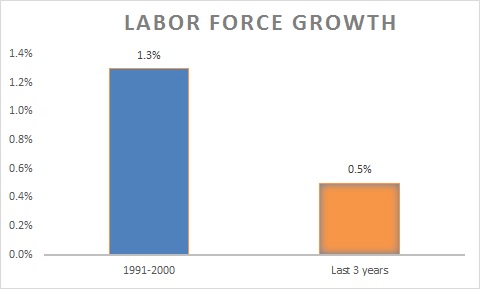
Today the labor force is growing by about 0.5% and it is roughly the same for men and women. Why so slow? Largely because the baby boomers are retiring. As noted above, they were born between 1946 and 1964. They will retire roughly 65 years later or between 2011 and 2029. This means that the current growth rate of 0.5% is likely to persist for the next eight years.
Second, the internet revolution began in the early 1990’s. E-mail became the accepted means of communication around the globe. Amazon was founded in 1994. E-Bay a year later. The internet revolution was underway. And as companies began to figure out how to use this new technology to streamline operations and cut costs, productivity growth soared. During the eight years of the Clinton presidency productivity growth averaged 2.3%.
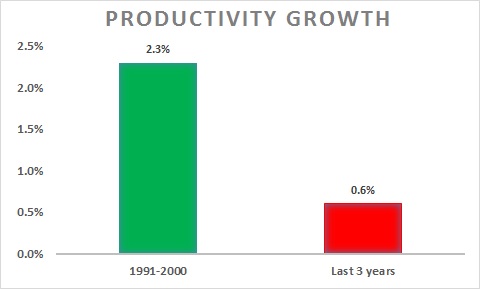
Unfortunately, that was then, this is now. During the past three years productivity growth has slipped to 0.6%. Nobody knows exactly why. Some argue that it is because nothing really revolutionary has come out in recent years. Others contend the stifling cost of government regulation is discouraging firms from investing in new technology. And still others contend productivity is not being measured correctly. Whatever the cause, productivity growth has stalled.
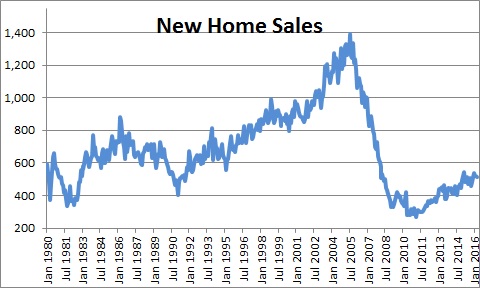
Third, the Federal Housing Enterprises Financial Safety and Soundness Act of 1992 (known colloquially as the Affordable Housing Act) required that 30% of the loans purchased by FNMA and Freddie Mac had to be made to low and moderate income borrowers. Down payments were reduced to 5% or less. Impaired credit ratings were ignored. New home sales doubled from 500 thousand to a then record pace of 1 million. Policy makers encouraged lenders to make increasingly risky loans. This lit the fuse on the greatest housing bubble this country has ever seen. It was also a significant contributor to the extraordinary GDP growth rate of the 1990’s. The next president will not receive any such legislative windfall.
Finally, Bill Clinton never encountered a recession during his eight years in office. In fact, the longest expansion on record was the decade long period of the 1990’s that stretched from March 1991 to March 2001. The next president will not be so lucky. In January of next year when the new president takes office the expansion will be seven and one-half years old. At the end of his (or her) first term it would be 11-1/2 years old. By the end of the second term it would be 15-1/2 years old – or 50% longer than the longest expansion on record. That is not going to happen.
During the eight years while Bill Clinton was president labor force growth averaged 1.3%, productivity expanded by 2.3% annually, Congressional legislation ignited a housing boom, and the economy avoided a recession. Not surprisingly, GDP growth averaged 3.6%e.
Even if one envisions productivity growth picking up from the snail’s pace of 0.6% during the last three years to 1.5%, as long as the labor force is going to climb by 0.5% it is hard to envision how GDP growth will exceed 2.0% in the next eight years regardless of who is elected president.
While Hillary might want us to think that hubby Bill can pull off another eight years of 3.6% GDP growth that is pure fantasy. Nobody will be able to re-create the good times of the 1990’s.
Stephen Slifer
NumberNomics
Charleston, SC


Stephen, I just read your Clinton prognostication on what can and cannot happen. This is one of the few times your future-cast is so somber. Who knows what might happen in the next 8 years? No one. I remain optimistic. The unexpected may come together to create a greater economic boom than the 90s. I know we and many others will be watching. …Darrel