
June 24, 2014
Stock markets around the globe have plunged in response to the U.K.’s decision to exit the E.U. The British pound, the Euro, and Yen have fallen sharply. Long-term U.S. interest rates have declined 17 basis points. These market reactions are understandable given the degree of uncertainly introduced by the British exit decision as investors seek the safety of dollar-denominated investments. However, the economic impact on the U.S. will be minimal. Indeed, the biggest economic casualty may be the U.K. itself.
The dispute between the U.K. and the E.U. is centered on trade, immigration, and a loss of sovereignty. The U.K. contributes about 13 billion pounds (or 0.7% of GDP) to the E.U. budget. The Brits feel they can spend that money more wisely at home. Also, the U.K. has opted out of the European immigration system and thereby avoided the flood of refugees from Eastern Europe. That has roiled politicians in Brussels. London Mayor Boris Johnson summarized the issue nicely. “I want a better deal for the people of this country: to save them money and take back control.”
A two-year negotiating process between the U.K. and the E.U. will not start until a new Prime Minister is in office and that may necessitate a general election. Hence, the British departure will not come until late 2018. That is a long period of uncertainty. Given that the U.K. has its own currency and its own monetary policy the exit negations will be focused on trade. What will any future trade agreement between the U.K. and Europe look like? Clearly, the ultimate agreement will not be favorable for British banks and manufacturing firms which currently benefit from free access to the European markets. Politicians in Brussels will not want any country on the outside to have the same favorable conditions as E.U. members. But while the E.U. may want to punish the Brits for choosing to leave and to discourage other countries from following in its footsteps, the British economy is the fifth largest in the world. It is inconceivable that Europe will want to lose access to a market of that size.
Having said that, the negotiations will be challenging. What happens to U.K. residents who currently reside in Europe? Will they be allowed to stay? Will they be required to get work permits? What about European residents living in the U.K.? The hospitality and retail industries in the U.K. rely heavily on foreign workers. Will those firms be forced to pay higher wages to attract the workers that they require? Europe is a major destination for goods produced by manufacturing firms in the U.K. More restricted access to European markets will be a major negative development. The E.U. agreement allows banks domiciled in any country in the E.U. to do business in any other member country. That will no longer be the case. Some multi-national lenders may choose to shift operations away from London to Frankfurt or Paris.
Given this situation stock markets around the globe have been crushed. Uncertainty reigns. These knee-jerk reactions happen all the time. When the dust settles traders will find that the world has not changed all that much. The U.K. and the E.U. are likely to trade less with each other, but both regions will try to boost trade with the U.S. and Asia. Keep in mind that as the British pound and the Euro decline in value their goods become cheaper and thereby more attractive for Americans and Asians to purchase. That should bolster exports and mitigate some of the negative economic impact. And throughout the process the Bank of England stands ready to provide liquidity and lower rates if needed.
The most immediate impact on the U.S. will be via financial market volatility. The uncertainly has already weakened the stock market, lowered interest rates and strengthened the dollar.
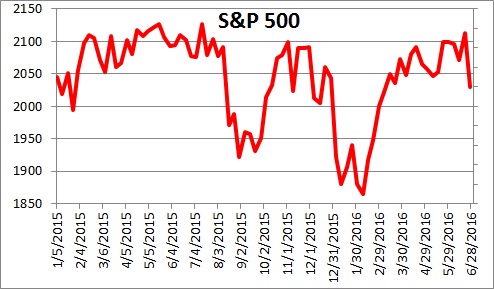
The S&P 500 index fell 64 points or 3.0% on Friday. But it had risen sharply on Thursday to within an eyelash of a record high level so it is still in good shape. The S&P had a far larger decline in August in response to the fear of a larger-than-expected slowdown in China. It had another dramatic decline in January in response to weaker-then-expected first quarter GDP growth. In both cases the market quickly rebounded. We expect the same thing to happen this time.
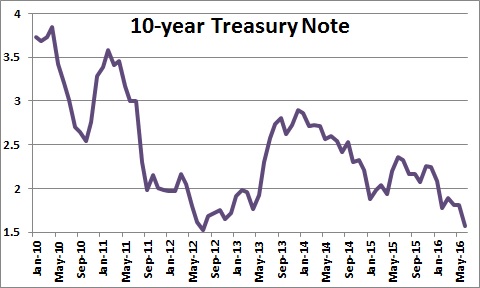
The yield on the 10-year Treasury note fell 18 basis points on Friday to 1.57%. Janet Yellen and her colleagues are hypersensitive to global economic risks and this situation will compound that concern. A Fed tightening is off the table until September at the earliest.
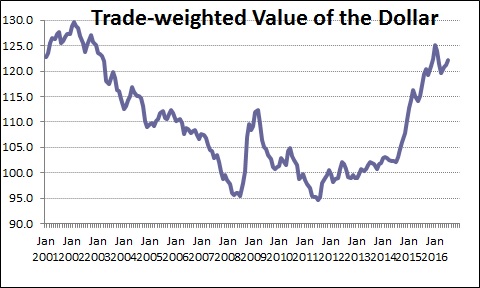
The British pound fell 11.0% on Friday from 1.55 pounds sterling to 1.38. The Euro fell 2.0%. The dollar rose by an equivalent amount. However, our biggest trading partners are Canada and Mexico. On a trade-weighted basis the increase in the dollar was less dramatic. When the dollar rose 20% between mid-2014 and the end of last year, U.S. goods became more expensive for foreigners to purchase and exports fell about 7%. Early this year the dollar declined about 4% but its recent rise has offset some of the earlier drop. The change in the dollar since the beginning of the year is very small. Furthermore, the trade sector in the U.S. is only 10% of GDP, and trade with the U.K. is 3% of the 10%. Any economic fallout on the U.S. economy from the British exit will be minimal. The impact on the U.K. economy will be more meaningful. The U.K. Treasury and the OECD expect the U.K. economy to be 3-6 percentage points smaller by 2030 by not being in the E.U. as capital expenditures and commercial property transactions shrink.
As we see it, second quarter U.S. GDP growth will rebound to 2.5%, and remain at roughly that same pace in the third and fourth quarters. So rest easy, the markets are jittery, but the economic situation on this side of the Atlantic has changed very little.
Stephen Slifer
NumberNomics
Charleston, SC


Stephen, Thanks for the update and putting it all in perspective. There is talk that the Brits may be much more inclined to give US firms perks and tax incentives to solidify their trading relationships. Maybe some good will come out of this for US trade.
Stephen, thank you for making sense out of the Brexit. It seemed like a foolish thing for them to do from my perspective. We have friends in England and talked to them today and they are not much worried about the exit from the EU. They think there will be some issues immediately, but in the long run it is good for the U.K.
I always greatly appreciate your perspective on financial affairs. Thank you for your valuable insight.
Darrel Staat
Hi Darrel,
There are people out there who share the view of your friends that, in the end, it will benefit the U.K. economy. At this point there is so much uncertainty about how Europe reacts, and how good a deal the U.K. can cut not just with Europe but with the U.S. (become a part of NAFTA?). When people talk about it being “good” for the U.K., do they mean that it will actually boost GDP (I have a hard time with that — but maybe)? Or do they think that now the U.K. gets to control its own destiny free from the influence of Brussels and, hence, it is a good think for the U.K.
I have a hard time thinking that Obama’s statement that the U.K. will go to the bottom of the list in terms of negotiating a trade agreement with the U.S. will hold water. That makes zero sense. The Brits have been our staunchest ally forever and now we are going to penalize them? What a way to treat your friends — and the U.S. seems to have fewer and fewer of them. That strikes me as being a dumb statement with the sole purpose of trying to influence British voters. Why did he feel compelled to interfere in a solely British decision. Aaargh!
At least this is fun to think about! If I were a trader I think I would be looking at today’s market and would view it as a buying opportunity.
All the best.
Steve
Hi Blake,
You could well be right. If the Brits are losing trade with Europe they will certainly have an incentive to boost trade elsewhere.
I recall Obama’s statement about moving the U.K. to the back of the bus when it comes to negotiating a trade agreement What rubbish! The Brits have been our friends forever and now we are going to stiff them because they are doing what they think is right for their own country? That seems like a pretty lousy way to treat a friend and, as we all know, the U.S. has fewer and fewer staunch allies. How about making the U.K. a part of NAFTA?
At the very least this will keep us all thinking and talking for some time to come. Thanks for sharing your thoughts.
Steve