
August 21, 2010
Everybody seems to be talking about the D’s these days – Double Dip and Deflation. But the economic outlook is not nearly as dire as the double-dip, deflation crowd suggests for a variety of reasons. Let’s examine the business community this week.
In case you have not noticed, corporate profits are booming. Why? Because over the course of the past year corporate America has been investing heavily in software and productivity- enhancing equipment. During that period of time such spending has risen 15%, and in the two most recent quarters growth has been at 19% and 20% annual rates so, if anything, businesses are accelerating their spending on anything which might boost productivity. It is worth noting that technology has been the fastest growing sector of our economy since the recession ended 14 months ago.
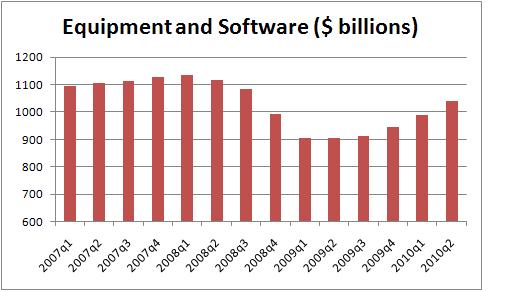
Combining this investment in technology with the layoff of hundreds of thousands of unproductive workers, corporations have successfully boosted productivity. Productivity had been growing at an impressive 6.0% pace, but it declined slightly in the second quarter which slowed its yearly gain to about 4.0%. However, production of productivity-enhancing equipment jumped sharply in July which suggests that not only will such spending continue to climb rapidly in the third quarter, but also that the second quarter drop in productivity was an aberration.
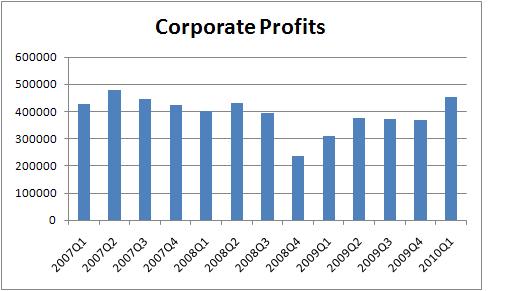
As a result of enhanced productivity, corporate profits have soared. They have jumped 50% in the past year, and at $450 billion they have returned to where they were prior to the recession. Corporate America is doing quite well, indeed.
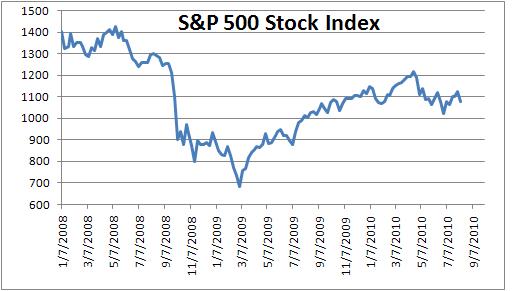
This improved outlook for corporate earnings explains why the stock market jumped 66% from its low point in March of last year to early March of this year. That is an astounding performance. And the fact that it has corrected somewhat during the past few months should not be viewed as either surprising or troubling.
As corporate profits have soared, firms have accumulated vast sums of cash. Corporate cash levels have jumped by nearly $400 billion or 25% during that period of time to a record level of $1.9 trillion.
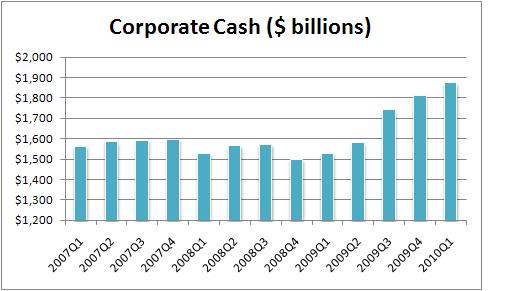
One might legitimately ask why businesses are sitting on such a pile of cash. Part of the answer is that they learned during the recession that higher cash levels are necessary to keep them afloat during the lean times. Hence, some of this increased desire for cash can almost certainly be viewed as defensive hoarding.
At the same time it is also a reflection of the highly uncertain economic and political environment. As everyone understands, the outlook for the economy is cloudy at best and many economists fear a double dip which would necessitate higher cash levels. There is additional uncertainty about the tax environment. Tax rates are scheduled to rise next year as the Bush tax cuts expire, which could adversely impact the willingness of consumers to spend. If that happens, firms are likely to need additional cash. Given the outlook for the budget deficit in the years ahead additional tax hikes are almost certain to follow. There is uncertainty about the cost of health care for current and future employees in the quarters and years ahead following the passage of ObamaCare. Finally, there is political uncertainty about the course of public policy if Democrats lose their majority in one or both houses of Congress in November.
While the business community faces a long list of headwinds, market participants and economists currently seem far too pessimistic. It is important for all of us to recognize that corporations in this country are doing well. They are investing in productivity-enhancing equipment, making money, and stockpiling enormous amounts of cash. At that point in time when the upcoming economic data confirm that the economy is not going to slip back into recession and business confidence improves, corporations will put some of that money to work. They might buy back some of their own stock. They might gobble up one or more of their competitors. Or they might even accelerate their spending on software and productivity-enhancing equipment in the final two quarters of this year. With all that cash on the sidelines something good is bound to happen. It is only a question of when.
Stephen Slifer
NumberNomics
Charleston, SC
Follow Me