
December 9, 2011
Corporate spending on investment has been the primary source of growth for the economy since the recession ended in mid-2009. With profits shrinking as consumers cut spending and paid down debt, the only way firms were going to survive in the longer term was to spend money on technology, become more productive and, hopefully, produce the same amount of goods with a smaller number of employees. While that was not good news for workers, many companies are in business today because they adopted that strategy.
As noted above, investment spending has been the fastest growing sector of the economy since the recession ended in mid-2009. Last summer following the debt ceiling debacle, consumer confidence plunged to its lowest level since the recession and many economists began to worry about the possibility of the economy falling back into recession. Unshaken, business leaders continued to invest and in the third quarter when the angst seemed to reach a peak, investment spending climbed at an impressive 14% pace.
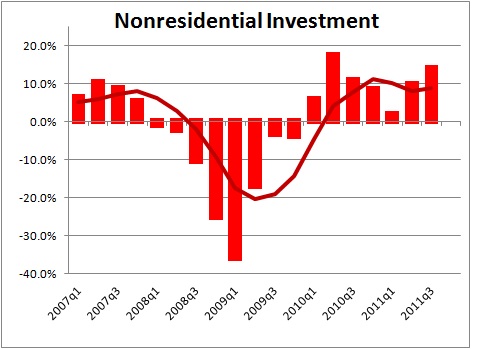
What are businesses buying? To a large extend it has been technology. Why? Because spending money on technology makes them more productive. By boosting productivity they can produce the same amount of goods with fewer workers which, in turn, enhances profitability. That strategy has paid off in spades. Corporate profits today are at a record high level.
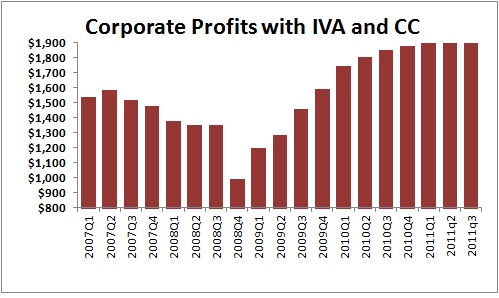
While it is true that earnings growth has slowed in the past couple of quarters, it is equally true that they are leveling off at a record high level. Some of these profits are still sitting around on corporate balance sheets in the form of cash.
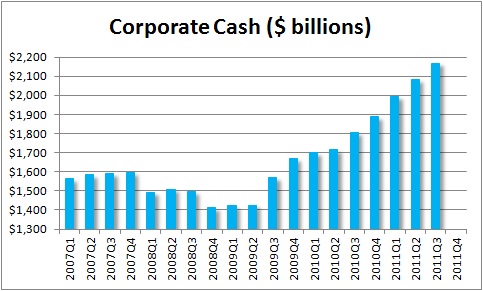
What is included in this cash category are corporate checking accounts, Treasury securities, municipal securities, and time deposits like CD’s. Clearly, some portion of this cash buildup is intentional given the possibility of default by Greece or some other country in Europe. The problem is that all of these instruments yield less than 1.0%. It is unlikely that a CEO or CFO can keep a significant portion of the firm’s assets in cash for long because investors did not buy that company’s stock to be content with a 1% return on investment. Most likely they are looking for at least an 8-10% return. Thus, it is almost certain that in the months and quarters ahead, some portion of these cash holdings will be spent. Business leaders might choose to spend more in technology – a decision which has paid off handsomely for the past couple of years. Or perhaps they will choose to invest in basic research and try to develop a new product. Or they might decide to buy the competition, buy back some of their own stock, or increase their dividend. That additional spending will bolster GDP growth during 2012.
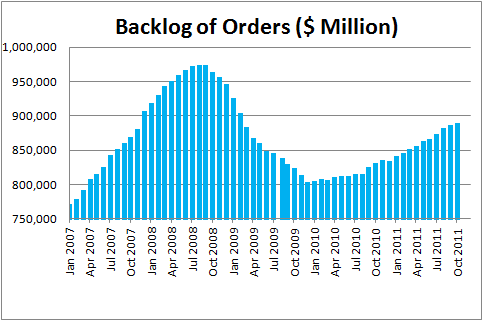
One other factor that bodes well for businesses in 2012 is that the backlog of orders continues to climb. Each month our nation’s factories receive orders. They then manufacture their product and ship it off to the buyer. If what is coming in the front door – orders – exceeds what is going out the back door – shipments – then the backlog of orders rises. If that stack of papers on the desk keeps getting bigger, it is a sure bet that firms will boost production which is exactly what GDP is all about.
There is no question that the economy had a bad time in 2011, particularly in the first half of the year when gasoline prices rose sharply and the tsunami in Japan interrupted the supply chain. Throughout the year there was considerable concern about the consequences of a possible default by Greece or Italy. But as the year comes to a close, the economy seems to be gathering momentum. Consumers appear to be comfortable with their debt load and are stepping up their pace of spending. The housing market is showing signs of emerging from the doldrums. Firms continue to make money and accumulate cash. The order book is building. As the economy gathers momentum they are increasingly willing to hire more bodies and the unemployment rate is falling. It may be that the economy is ready to shift into a higher gear during 2012.
Stephen D. Slifer
NumberNomics
Charleston, SC
Follow Me