
July 1, 2016
Last week the global markets were in disarray. This week many of those markets quickly reversed course and recovered much of what was lost during the Brexit bash. Many fear the U.K. economy will fall into recession as a result of the uncertainty triggered by the British decision. However, a weaker pound sterling combined with a sharp drop in interest rates will boost confidence, cushion the blow, and sow the seeds for faster growth in the months ahead. Any near term impact on the U.S. economy will be negligible. In the longer term, the U.K. and Europe will seek to counter lost trade opportunities with each other and be anxious to bolster exports to the U.S. and Asia. Therein lies an opportunity for U.S. firms.
It is important to remember that the British will not exit the E.U. until late 2018 at the earliest. Hence, significant changes in trade will not occur any time soon. The near-term economic problem will result from uncertainty and its impact on consumer and business confidence. Will European nationals in the U.K. be allowed to stay? What about U.K. nationals residing in Europe? Will European banks exit London in favor of Frankfurt or Paris? These legitimate questions will remain unresolved for some time to come. However, market movements in the past week suggest that the near term negative impact on confidence may be limited.
First of all, despite the political brouhaha surrounding the choice of the next prime minister, the U.K. stock market seems confident about the country’s ability to cope with a possible reduction in trade opportunities with Europe. For example, the FTSE 100 index is actually higher now than it was prior to the referendum. While a weaker currency and lower interest rates help bolster confidence, stock investors may also believe that unshackled from the crippling regulations imposed by policy makers in Brussels, U.K. firms can now operate more freely and boost corporate earnings.
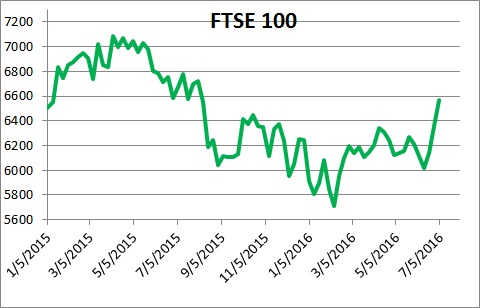
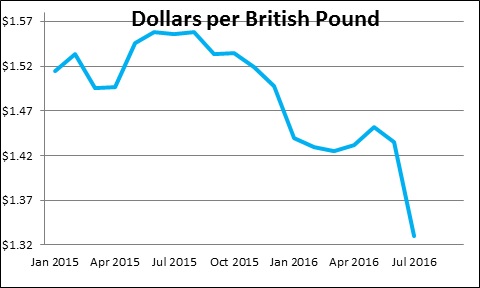
The argument is enhanced by the combination of both a weaker currency and lower long-term interest rates. Prior to the referendum the pound cost $1.45; it now costs $1.33. That is a 7.5% drop in the value of the pound during the course of a week which will make U.K. goods cheaper for Americans to purchase. The yield on the U.K. 10-year Treasury note had been 1.43%. It has subsequently declined to 0.89%. Both of these factors will help to stimulate economic activity in the U.K. in the months ahead. While the jury is still out on the ultimate impact on the British economy the early results are encouraging.
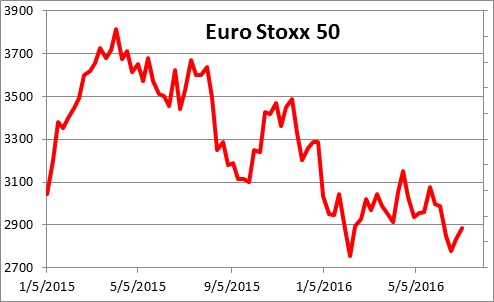
Meanwhile, in Europe, the stock market was hit hard for a couple of days but has rebounded and is roughly in line with where it was prior to the U.K. referendum. This suggests that European investors are also not too concerned about any near-term impact on growth or corporate earnings. While volatile for a brief period, the value of the Euro has also changed very little. Meanwhile, long-term interest rates have fallen sharply. The yield on the German 10-year Bund, for example, has declined one quarter point from a month ago and now stands at negative 0.13%.
The U.K. Treasury and the OECD expect the U.K. economy to be 3-6 percentage points smaller by 2030 by not being in the E.U. as capital expenditures and commercial property transactions shrink. That forecast may be unduly pessimistic. Whether those forecasts are accurate depends greatly upon the response by politicians primarily in the U.K. and Europe, but also in the U.S., China, and Japan. While there is currently a political vacuum in the U.K., that should not last long. What is clear is that the U.K. needs to strengthen economic ties between itself and the U.S. and Asia during the next two years and we believe they will do so. After all, the Brits are probably the world’s strongest proponent of free trade and their resolve should not be underestimated. As they see it U.K. exports to the rest of Europe have been declined steadily in recent years as growth in Europe has stagnated and unemployment has surged as the result of immigration. The Brexiteers believe the U.K. will be better off doing deals with growing economies rather than being shackled to the slow growing economies on the continent.
Europe, too, needs to bolster its trade now that the U.K. will no longer be part of the E.U. Politicians in Brussels have gotten a wakeup call that all is not well. Many countries are unhappy with the heavy-handedness by which Brussels imposes its policies on member countries. Most E.U. countries are dissatisfied with its immigration policy. Europe, too, is looking for a political leader to guide them going forward. For now that leadership role has fallen upon German Chancellor Angela Merkel. She has said on several occasions that the U.K. should not have the same benefits of free trade as an E.U. member country. Fair enough. But Germany exports $90 billion of goods and services to the U.K. which makes the U.K. its third largest export market behind only the U.S. and France. It has a trade surplus of $50 billion with the U.K. which means that the United Kingdom is far more important to Germany than vice versa. There is no chance that Germany will shut the U.K. out of a free trade agreement with the E.U. It is in the best interest of both Germany and Europe to have strong trade ties with the world’s fifth largest economy.
Then there is the U.S. It, too, is seeking leadership. Neither President Obama, Donald Trump, nor Hillary Clinton inspire confidence. President Obama has said that if the U.K. voted to leave the E.U. it would move to the back of the pack in terms of negotiating trade agreements with the U.S. We doubt that is going to happen. He would be better served to seize the opportunity and quickly secure a bilateral deal for free trade with the U.K. To enhance relations with the world’s fifth largest economy with which we share a common culture and language is an opportunity that should not be missed.
Donald Trump wants to back out of NAFTA, renegotiate the Trans-Pacific Partnership agreement, and impose stiff tariffs on many Chinese goods to pull jobs back into the U.S. That contention may have broad political appeal in hard hit factory towns, but would be a disaster from an economic viewpoint. It would sharply increase the price of imported products (and probably boost the prices of domestic goods which compete with those exports) and push inflation higher. That, in turn, would force the Fed to raise interest rates more rapidly than is currently expected. Such a development would almost certainly trigger the next recession. However, we do not envision that happening. There is a world of difference between running for office and governing. In our view, globalization is here to stay and countries – the U.S. included — need to figure out how to thrive in that environment.
Hillary Clinton says she is in favor of free trade but opposes the TPP claiming that it does not do enough to protect American workers. She also opposes the Central American Free Trade Agreement. So while she allegedly supports free trade there is little evidence to support that claim.
The bottom line is that there is no clear long-term path for how this new relationship between the U.K., Europe, and the rest of the world will evolve. But the markets have calmed down which should prevent a significant erosion of confidence in any region and give policy makers an opportunity to devise solutions. While politicians around the globe currently do not inspire confidence, we believe that it is in the best interest of all involved to find common ground. Thus we remain relatively upbeat. For the U.S. in particular there is a clear opportunity to expand our exports markets in the U.K. and Europe.
Stephen Slifer
NumberNomics
Charleston, SC


Stephen, I really appreciate your professional view of what may or may not happen as a result of the BREXIT. The pundits went wild, but reality and their guessing appear miles apart from each other. I have been watching the U.S. Stock Market and although it took a hit, the rebound was rapid and it appears to today that little has been lost. Maybe I am missing something, but the numbers are back it appears. Even my retirement funds are already back to what they were.
Thanks again for you insight and explanation of what is going on.
Darrel Staat