
August 14, 2014
The devaluation of the Chinese yuan has sent shock waves through currency, commodity, and stock markets around the globe. The doomsayers have emerged in droves. But, if you recall, the world was in a tizzy about Greece a couple of months ago and the global economy came through relatively unscathed. China is certainly a far more important player on the global stage than Greece but, once again, the markets are overreacting. Take a deep breath.
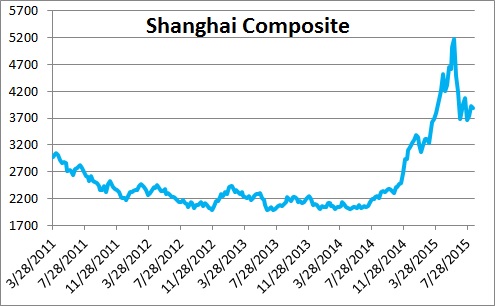
What set off this negative string of events was the precipitous slide in the Chinese stock market. It has dropped 35% since June and the boo-birds will point out that Chinese stocks are now in a “bear market”. But they conveniently fail to note that the market rose 135% between October of last year and June. As a result, the Shanghai Composite Index today is still 75% higher than it was in October.
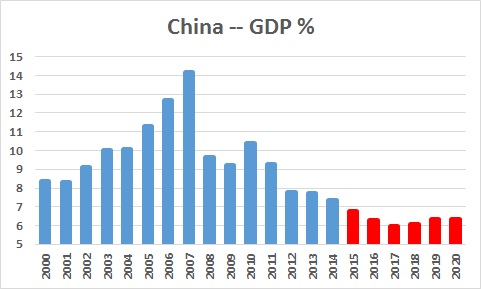
GDP growth in China is slowing down as government leaders try to convert from a manufacturing-based economy to a consumer-driven model. Since the end of the recession GDP growth has slowed gradually from 9-10% to 7.5%, and it is expected to slow further to 6.7% in 2015. While the recent decline in the stock market could be a harbinger of even slower growth in the second half of this year, we are not convinced that the stock market drop tells us much about the pace of economic activity.
The dramatic increase in Chinese stock prices late last year was largely attributable to government officials encouraging Chinese investors to load up on stock options in an attempt to capitalize on the dramatic increase in stock prices. But options trading is a new concept in China and many consumers jumped on board without a full understanding of how options work. When the market began to slide they got hit with margin calls and had to sell at the worst possible time. Thus, in our opinion the stock market rout is more related to options trading than it is a harbinger of slower growth in the Chinese economy. After all, GDP growth in the first half of the year was 6.5% which is close to the 6.7% projected growth rate for the year. So far, the economy seems largely on track.
Because options trading is so new, Chinese officials bungled their response and were unable to contain the slide. So they decided to stabilize the situation by taking aggressive action and devaluing the yuan. That caught everybody off guard– central banks, investors, consumers, and business people. The reality is that the yuan was devalued by a relatively small 3% from 6.20 yuan to the dollar to 6.40. Nevertheless, the howls began. It was going to undermine Obama’s highly touted TransPacific Partnership. The Chinese were beginning a series of competitive devaluations which would boost growth in China at the expense of its trading partners elsewhere in the region. Then Donald Trump chimed in – “They keep devaluing their currency until they get it right. They’re doing a big cut to the yuan and that’s going to be devastating for us.” Nothing could be farther from the truth. Let’s look at the facts.
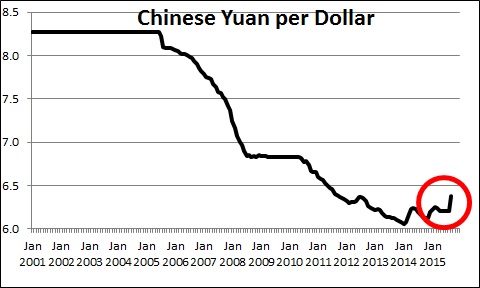
In sharp contrast to Trump’s remarks, in the past 10 years the yuan has appreciated 25% from 8.25 yuan to the dollar back in 2005 to 6.20 yuan just prior to the devaluation. When the yuan strengthens it means that Chinese exports become more expensive for foreigners to purchase, which implies less growth in exports. As exports shrink the trade deficit widens and becomes a drag on GDP growth. Recently released data showed exports in July had declined 8.3% from what they were in July of last year. Given that softness in exports it is not surprising that Chinese officials thought the yen might have become somewhat overvalued and they chose to devalue it by about 3%. Given the earlier run-up in the yuan this is not a particularly disturbing event.
With respect to the U.S., the devaluation of the yuan will make U.S. goods more expensive for the Chinese to purchase, so U.S. exports presumably will shrink. As this occurs the trade deficit will widen and become a drag on growth. Fair enough. But in the U.S. the trade component is 10% of the overall economy. And trade with China is just 18% of the 10%. Thus, trade with China amounts to about 1.8% of overall GDP. If GDP growth in China slows 1.0% this year, that would only knock about 0.2% off U.S. GDP growth for the year. What happens to China matters for the U.S., but we should not get carried away with the hysteria.

Stephen Slifer
NumberNomics
Charleston, S.C.


Steve, thank you for a realistic analysis of the China stock market situation. According to what I read in other interpretations, the sky was about to fall. It seems the pundits tend to react to the present only and do not give any credence to the facts over the long haul. Screaming “the sky is falling” does sell newspapers, but getting to the actual facts, as you always do, makes much more sense.
Thank you for your insight. I really do appreciate it.
…Darrel Staat
Steve, echoing Darrel’s comments, I appreciate the fresh insight here. I hadn’t read anywhere else about the options situation contributing to fall. And I hadn’t realized there was so much appreciation since October.
I’ve been a regular reader, but this is my first comment.
Thanks for the insight!
-Pat
Hi Pat. Thanks for taking the time to comment. I am always amazed how violently the markets can react to any piece of unexpected news. For traders it makes sense to react quickly. If they can get out before the majority of others do, then can avoid losses. Then they wait until they think the market has hit bottom and then jump back in to make more money. That is sometimes easier said than done. For the rest of us as investors most of the time the impact from these events is relatively short-lived. But to stay cool when the market is going down sharply is also hard. In this case, I tend to follow global stock markets fairly closely. When a market is up 135% in a matter of months something odd is happening. Markets don’t do that. Then I stumbled upon the options part which made sense to me. If this is difficult for us, think about the Chinese consumer. First he/she gets lured into the housing market only to have that bubble burst. Then they get sucked into options trading and, once again, get clobbered. It’s a tough world out there!
Steve