
January 8, 2016
Here we go again! For the second time in six months events in China have derailed stock markets around the globe. Should we worry more the second time around? We don’t think so. Nevertheless, we acknowledge that events in China can make life very uncomfortable for investors.
The initial problem in China began in June of last year. Between June and October the Shanghai Composite Index fell 40%. However, the same stock market index rose an astonishing 135% in the previous nine months. Clearly, some correction should have been expected. At its low point in August the index was still 40% higher than where it started. Thus, one should be very careful about interpreting the recent Chinese stock market decline as indicative of economic weakness. Interestingly, the initial ascent coincided with the introduction of options trading in China and investors rushed to buy stocks. But at the first sign of trouble when it appeared that GDP growth might fall short of expectations and the market began its slide, those same investors got hit with margin calls which exacerbated the decline. Thus, the movements in both directions are more related to stock market shenanigans in Shanghai than indicators of change in the pace of economic activity.
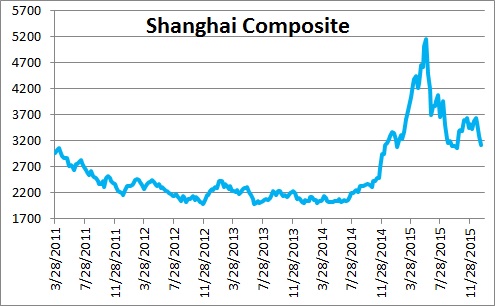
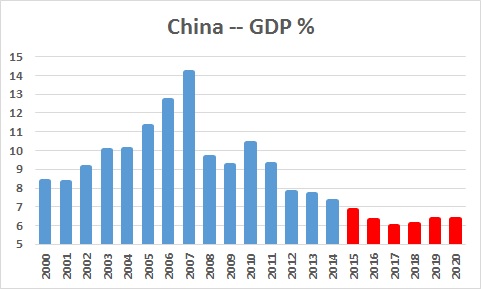
The market hit bottom by August and it appeared that all was well. But by Christmas the market resumed its slide, fell 14% in a week, and sent stock prices reeling around the globe. The catalyst this time was a weaker-than-expected reading on manufacturing activity in December. However, economists continue to expect 6.8% GDP growth in China during 2015, and the IMF expects GDP growth to slow to 6.3% in 2016. There is nothing inconsistent between the reported softness in manufacturing activity in China in December and the prospect of an additional 0.5% slowdown in GDP growth during 2016.
The Chinese equivalent of the SEC contributed to the most recent problem. It introduced a circuit breaker which would stop trading for the day once the market fell 7%, The morning of January 7 the market opened down about 3% and investors rushed for the door for fear that the circuit breaker would stop trading and they would get caught holding unwanted positions. In the U.S. those circuit breakers would not have kicked in until the market had fallen 20%. The bottom line is, be careful about reading too much into the stock market decline in China. Given that the China drop has triggered similar stock market shrinkage around the globe, one should also be cautious about interpreting recent stock action as an indicator of global economic weakness.
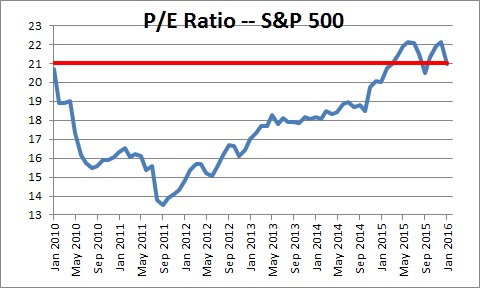
In the U.S. the S&P 500 index has fallen 6% since Christmas partly in response to China and partly to the further decline in oil prices. In both cases the market had gotten overvalued and the subsequent decline brought it back more into line with its historical average. Our sense is that the S&P 500 is very close to a bottom.

Nothing we have seen has changed our view that the economy will expand at a moderate 2.0% pace in the fourth quarter of 2015 (which we will see on January 29) and 2.6% in 2016. There can be little doubt that manufacturing and trade are suffering as the result of slower growth in China, falling oil prices, and the ongoing strength in the dollar. But three comments seem appropriate:
- In the case of China growth may slow further in 2016 but, as noted above, the bulk of the slowdown from the double-digit pace reported between 2005 and 2010 to 6.8% last year has already occurred. A further slowdown to 6.3% in 2016 is relatively tame.
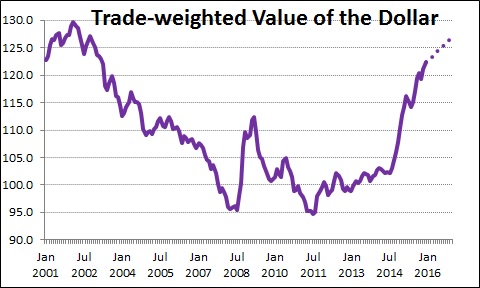
- The dollar will continue to rise in 2016 as GDP growth in the U.S. outstrips growth elsewhere, and as the Fed gradually increases short-term interest rates while the rest of the world continues to push rates lower. The increase in the value of the dollar reduced 2015 GDP growth by 0.8%. If its rate of ascent slows this year the dollar’s rise should reduce GDP growth by only about 0.3% in 2016
- Falling oil prices are an unambiguously positive factor for the U.S. economy. Every time oil prices decline the stock market falls because investors assume that the drop in gas prices is a sign of slower GDP growth. The stock market focuses on the oil patch which is negatively impacted by lower oil prices. But consumers, which represent two-thirds of the U.S. economy, benefit as we pay less to fill the car with gas and heat our homes. Auto dealers thrive. Airlines and truckers are better off as their cost of doing business declines.
The bottom line is that the stock market has gotten the New Year off to a rocky start, but that does not necessarily mean that the economy has done the same thing. Job gains in recent months suggest the economy remains on sound footing.
Stephen Slifer
NumberNomics
Charleston, SC
Follow Me