
January 7, 2011
Virtually every economic indicator released recently confirms that the economy is gathering momentum. Fourth quarter GDP growth should be about 5.0%. Expect 4.0% growth in 2011. Employment gains are getting bigger. The unemployment rate has begun to decline. Just as the economic outlook brightens and people are feeling more confident, I find myself wondering when the good times might end. Economists are always looking for the dark side. But in this case, the dark side is a long ways down the road. How does 2015 strike you?
The key ingredient in determining the next turning point for the economy is action by the Federal Reserve. Business cycles do not just end. They are caused. And the usual culprit is the Fed. At some point the economy shows sufficient vibrancy that the Fed decides it is time to take away the punch bowl and it starts to raise interest rates. Once they start they do not stop until rates become punishingly high and, eventually, the economy succumbs.
The Fed has told us repeatedly that the unemployment rate is so high that the economy needs additional stimulus. Because the federal funds rate is already at 0%, they cannot push it any lower. Instead, they have announced their intention to buy $600 billion of longer-dated Treasury securities between now and June. The idea is that this will push longer-term interest rates – bond yields and mortgage rates – lower. In recent testimony Chairman Bernanke has made it clear that nothing will derail this process other than a surprisingly rapid decline in the unemployment rate. While the unemployment rate fell sharply in December to 9.4%, economists do not believe it will fall below 8.5% by yearend. Given that full employment in the U.S. is generally regarded as about 5.0% — at which level everybody who wants a job has one – it is not going to decline rapidly enough to short circuit this additional easing by the Fed.
If the Fed is still easing through midyear, it is not going to reverse direction and start tightening immediately thereafter. That process is unlikely to begin until sometime in 2012. The other important point to keep in mind is that the first moves from a 0% funds rate to 0.25% and then to 0.5% are not going to derail the economy. Rates will still be extremely low. Those early tightening moves will simply remove some of the extraordinary stimulus that the Fed has provided since the recession began in December 2007. In their mind, the economy will have been growing rapidly enough, for a long enough period of time, that they afford to start “taking back” some of that stimulus.
If the Fed wants to see the economy grow at a 3.0% pace, and it wants inflation of about 2.0%, then it needs a funds rate of about 5.0% to be consistent with that. But the funds rate currently is 0%. Thus, monetary policy is wildly stimulative. Once it begins to tighten, the Fed is usually very methodical and tends to raise rates in 0.25% increments every time it meets which is every six weeks. At that pace it will take the Fed two years to raise the funds rate from 0% to the so-called “neutral” rate of 5.0%. If it starts to tighten in the spring of 2012, it will not get to a neutral stance until the spring of 2014. Once rates reach that level it takes an additional 6-9 months for the economy to respond. Thus, it is hard to see how the economy can turn down sooner than 2015.
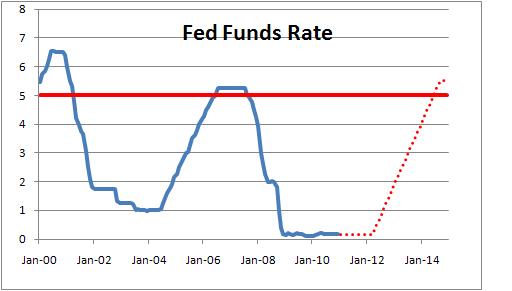
While economics is often known as the “dismal science”, this economist has just suggested that the expansion – which has already lasted 1-1/2 years, should keep going for another four years. That does not sound too dismal to me!
Yes, there are longer-run issues that need to be addressed. The housing market remains depressed, we are not creating enough jobs, the U.S. budget deficit is far too big, and there are credit problems in several European countries. But as long as the economy continues to grow at a reasonable clip, those “issues” will not become “problems”. The difficulty will arise once the Fed pushes interest rates to a point where they begin to bite. That is going to be a long time from now.
Enjoy the ride.
Stephen Slifer
NumberNomics
Charleston, SC
Follow Me