August 19, 2016
Last week we talked about Trump’s economic policy. This week Hillary Clinton’s economic policy is put under a microscope. We are not talking about the personalities of either candidate. We are discussing solely the economic policies they have proposed.
Government spending is already expected to rise dramatically during the next 25 years. As baby boomers continue to age, Social Security and Medicare payments will soar. The budget deficit will exceed $1 trillion by the end of this decade. Government spending as a percent of GDP will climb to an unprecedented level. The government sector, in our opinion, has already gotten far too big and in the process is diverting funds which could be used more effectively by the private sector. These projections do not include any of Clinton’s spending initiatives. What Hillary Clinton is proposing is the biggest expansion of the government sector since World War II.
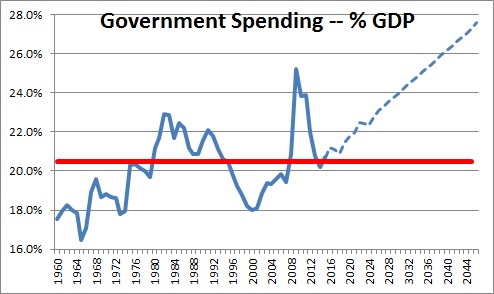
She says that in her first 100-days she will make the biggest investment in infrastructure since the construction of the interstate highway system in the 1960’s. She wants to repair roads and bridges, expand public transportation options, modernize our airports and dams, invest in clean energy, and ensure that all households have access to affordable broadband. In 100 days? Really? That is an ambitious program which will be extremely costly.
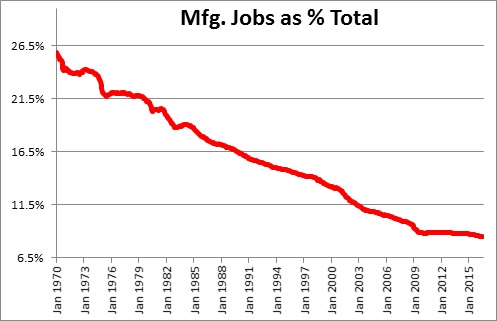
She is proposing a $10 billion “Make it in America” campaign. But factory jobs have been disappearing for 50 years. It started initially because unions boosted wages to a point where manufacturers in the U.S. could not compete with goods produced more cheaply in Asia. In more recent years technology has replaced many factory jobs with machines. Spending money to support manufacturing is not going to reverse this trend.
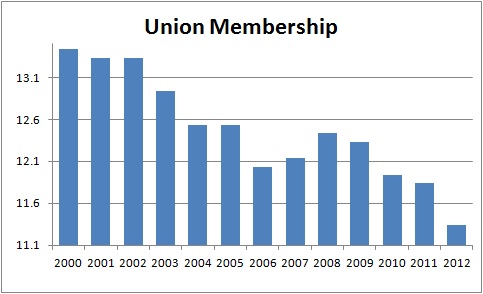
She will fight for unions and strengthen collective bargaining. “When unions are strong, families are strong and America is strong”. But union representation of workers has been on a steady decline since World War II when one-third of American workers were represented by a union. Today that percentage is 11% and half of them are in the public sector. American workers have concluded that they are not getting their money’s worth from union representation. And many corporations as well as state and local governments have found that the pension benefits that unions have managed to secure are not affordable. Encouraging union representation is fighting a trend that has been in place for more than half a century.
She wants to make debt free college available to all Americans. Families making less than $85,000 a year will pay no tuition at in-state four year public colleges and universities. All community colleges will offer free tuition. She expects the federal government to make a major new investment to make this possible. States will have to step up their investment in higher education. Colleges and universities will have to not only find ways to cut costs, but simultaneously provide more assistance to students with disadvantaged backgrounds.
All college debt should be forgiven after 20 years, 10 years if you work as a teacher in a high needs area or in an area where there are teacher shortages. Payments will be limited to 10% of monthly income. All student loans can be refinanced at current rates.
She wants to raise the minimum wage from $7.25 to $12 and encourage states to go even higher. Her slogan is “Fight for $15”. At $7.25 per hour Americans who work 40 hours a week make $15,080 per year which is below the poverty threshold for a family of two. She makes a point. But the money to pay for those higher wages has to come from somewhere. Firms that hire large numbers of minimum wage workers will respond by reducing hours, laying off workers, and/or raising prices. This is a huge adjustment and there are costs associated with doing so however noble the cause. Raising the minimum wage is not going to boost hiring or stimulate the pace of economic activity.
Clinton wants to expand Social Security to widows whose benefits have declined sharply following the death of their spouse, and to workers who took time out of the workforce to raise children or ailing family members. Another a noble cause. But the Social Security Trust Fund reports that benefits will exceed payroll tax contributions by 2019. The trust fund assets will be completely depleted by 2034. Something has to give. She does not intend to increase the retirement age, reduce the annual cost-of-living adjustments or reduce benefits – changes that many economists support. Instead, she plans to raise the maximum amount of earnings on which we pay Social Security taxes from its current level of $118,500. Her plan to fix the Social Security solvency issue falls exclusively on wealthy Americans.
Currently, people age 65 or older are eligible for Medicare benefits. Clinton supports a “public-option insurance plan” to provide a major expansion of Medicare benefits to those 55 years of age or older.
Finally, she re-affirms her support for the Affordable Care Act and wants to give Americans in every state the choice of a public-option insurance plan. But private insurers like UnitedHealthcare, Humana, and Aetna have recently dropped out of the Obamacare exchanges for 2017 or sharply reduced the number of counties in which they are willing to offer coverage. For the most part the insurance companies are enrolling only those people who have pre-existing conditions which drives up the cost of insurance. Given this experience a public-option insurance plan will be very costly.
Virtually all of these programs – investment in infrastructure, free college tuition, debt forgiveness for student debt, expansion of Social Security, Medicare, and Obamacare – will be extraordinarily expensive. How does she plan to pay for all this additional government spending?
She said that she will “Make sure the wealthy, Wall Street, and corporations pay their fair share in taxes.”
She intends to levy a surcharge on the earnings of multi-millionaires and billionaires to ensure that the wealthiest Americans do not pay a lower tax rate than hardworking middle class families. She will close loopholes that wealthy Americans use to reduce their taxes. Then she will ensure that multi-million-dollar estates pay their fair share of taxes. In short, she plans to increase taxes of all types for wealthy Americans.
But, in our view, this is not a large enough group of individuals to offset the additional spending she proposes. For example, IRS data show that only 0.4% of all taxpayers earned more than $1 million but they earned 15% of total taxable income. It is hard to imagine this relatively small group of individuals footing a large portion of the bill for the additional spending she proposes. If the group is expanded to include taxpayers earning more than $200,000, the combined group represents 6.0% of all taxpayers and they earn 39% of all income.
Clinton is also talking about a “middle income” tax cut so the burden on wealthy taxpayers will be even greater. It will make an already progressive income tax into something that is progressive to an extreme.
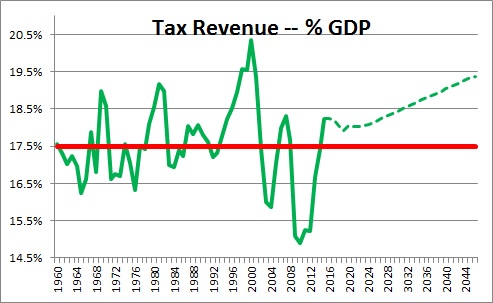
Tax revenues as a percent of GDP today are already high relative to their historical average and are projected to climb for the next 25 years. Clearly, tax revenues are going to rise much more sharply to finance the additional spending Clinton advocates. And given the proposed middle income tax cut, the burden will fall exclusively on wealthy individuals,
She also wants corporations to pay their fair share. But the highest marginal corporate tax rate in the U.S. today is 38% which is far higher than the 23% marginal tax rate overseas. This is why corporations today are opting for “corporate inversions” and choosing to move their operations overseas. And she wants to increase that rate? Most economists have argued strongly that this rate should be lowered to 15-20%. She also wants to penalize companies that choose a corporate inversion. In our opinion, raising an already high corporate tax rate is not going to create jobs. It will do the opposite. That is not a recipe for faster growth.
The bottom line is that Hillary Clinton wants to vastly increase the size of the federal government. It will be “Big Government” to an extreme. Do we as a country really want to move into a world where the government intrudes into every segment of our society and wealthy Americans and corporations foot the bill? In our opinion, that ensures slow growth for years to come.
Stephen Slifer
NumberNomics
Charleston, SC
Follow Me