
February 16, 2018
The Federal Reserve Bank of New York recently released its quarterly report on household debt and credit. It noted that household debt balances increased last year and are at a record high level. That is an eye-catching headline and is factually correct. However, it is grossly misleading. By any metric consumers can easily afford this higher level of debt. Debt in relation to income is far below its historical average. Stock market gains and rising home prices in recent years have boosted consumer net worth. And delinquency rates on consumer debt are the lowest they have been in a decade.
The New York Fed report accurately noted that consumer debt outstanding climbed last year to a record high level.

This debt is highly concentrated. Mortgage loans are by far the biggest category and account for $8.9 trillion – or almost 70% — of $13.1 trillion of consumer debt outstanding.

Rather than focus on the amount of debt outstanding it is more appropriate to focus on its growth rate which last year was 4.5%, only marginally faster than in other recent years. Consumers have not suddenly become spendthrifts. Can consumers afford this higher, record amount of debt? Absolutely!

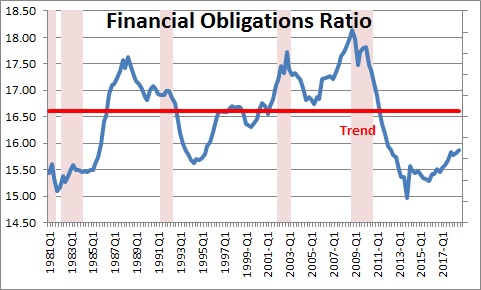
The New York Fed does not point out that while consumer indebtedness has been climbing, steady job gains have also boosted consumer income. As a result, debt in relation to income remains quite low. The financial obligations ratio shown below measures consumer payments on mortgage and consumer loans, auto lease payments, rent, homeowners’ insurance, and property taxes in relation to income. That ratio has been gradually rising for the past two years but, at 15.9%, it is not only below its long-term average of 16.5%, it is essentially where it was back in the mid-1990’s. It will take several years for this ratio to return to its trendline, and even longer for it to reach an uncomfortable level.
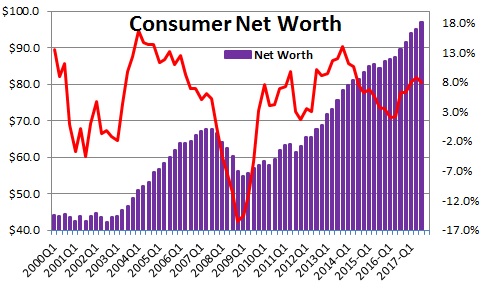
Furthermore, the stock market has been on a steady uptrend since the recession ended in June 2009. Stock market gains combined with rising home prices have boosted consumer net worth for the past eight years. It is currently climbing at an 8.0% pace. As a result, consumers feel good about their financial position and are more willing to spend a bit more freely.
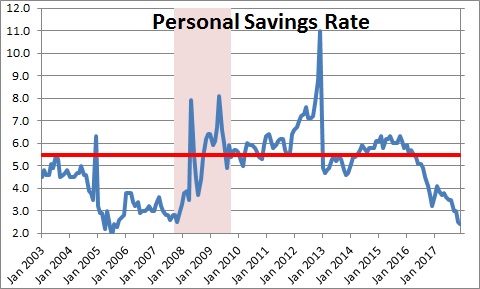
Some economists have noted that the savings rate has fallen to a historically low level of 2.4% which is far below the 5.5% average rate for the past 15 years. They further suggest that consumers will have to cut back their spending in the months ahead to boost savings. We disagree. Given what has been happening to their net worth, consumers do not have a compelling need to save as much of their paycheck as in the past. That is certainly an understandable reaction. Remember, the consumer is not dipping into savings. Rather, he or she is simply saving 2.4% of their paycheck today rather than tucking away the more normal portion of 5.5%. Note, too, that prior to the most recent recession the savings rate stayed at a comparable level for about three years before the economy finally slipped into recession. A low savings rate is not a harbinger of slower growth any time soon.
The real proof of the pudding is in delinquency rates. The percent of consumer loans 90 days or more delinquent has been steadily falling since the recession ended and is now at its lowest level in a decade.

As shown below, delinquency rates have been falling for all types of consumer debt, mortgages and credit cards in particular.

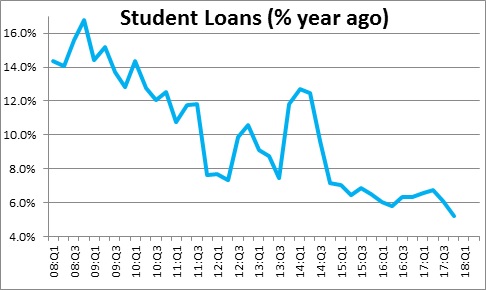
As an aside, whenever the discussion turns to delinquency rates on consumer debt, student loans quickly come to mind. Two points are worth noting. First the growth rate of student loans has been steadily slowing from a 15% pace shortly after the end of the recession to about 5.0% currently. Second, as shown in red on the chart above, the delinquency rate on student debt, while high at 11.0%, has not changed in the past five years.
The important point to note is that consumer debt continues to climb, but steadily rising consumer income and net worth ensure that this higher level of debt is affordable. There is nothing in the consumer’s financial position today that should warrant concern.
Stephen Slifer
NumberNomics
Charleston, S.C.


Stephen,
Thank you for eye opening explanations of what is going on. I greatly appreciate your insight.
Darrel
It’s good to see consumer debt under control. One source of skepticism is a suspicion that those with rising net worth because of the bull stock market are probably not the people with the most non-mortgage consumer debt burden. Ownership of financial assets is highly concentrated within the top 10% of households and consumer debt is concentrated in the bottom half of the income/wealth distribution, as I understand it.
Thanks Steve. I appreciate your insight.
Thanks Darrel. Good to hear from you.
Steve
Hi Kerry,
Your point is valid. But if consumers are getting themselves in trouble with mortgage and auto debt wouldn’t we some sense of that from rising default rates? That doesn’t seem to be the case.
Thanks Bill. So far, so good.