
May 27, 2016
After rising 0.8% in the first quarter, second quarter GDP seems likely to climb by 2.2% with growth in the final two quarters of the year expected to be even more robust. The apparent pickup in the pace of economic activity should be comforting to the Fed and allow it to raise rates another 0.25% in June.
The acceleration in GDP growth has been fueled by a pickup in the pace of consumer spending – on housing in particular. The question is, can consumers afford to spend more quickly? The answer is unequivocally yes.
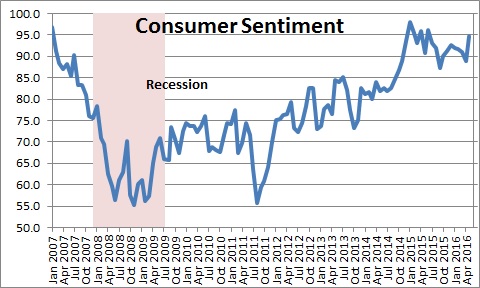
Consumer sentiment surged upwards by 5.7 points in May to the highest level since April of last year. That pickup in confidence is presumably being supported by jobs growth which continues at 200 thousand per month. That boosts consumer income. Mortgage rates are near an historic low. The Fed has pledged to raise rates super slowly in the months ahead. And the stock market is within a whisker of another record high level. No wonder consumers feel good. Not only that they are picking up their pace of spending.
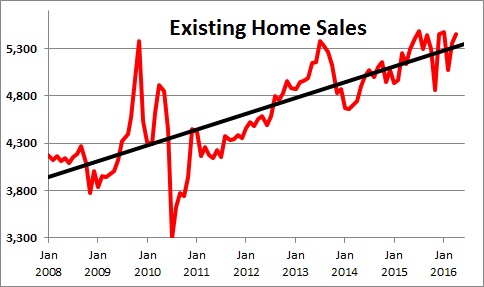
Home sales have surged this spring. Existing home sales are at the fastest pace thus far in the cycle and pending home sales suggest that existing home sales will be even more robust in May. The acceleration in new home sales is even more impressive. Suddenly consumer spending has come to life.
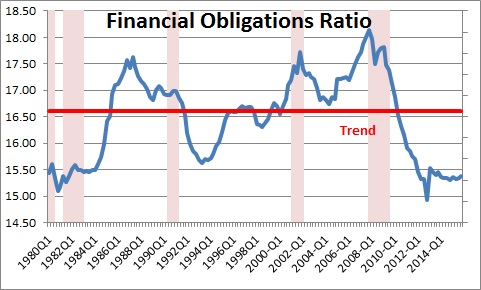
But how can the consumer afford to suddenly pick up his pace of spending? That’s easy for two reasons. First, real disposable income, which is what is left after inflation and taxes, is growing at a substantial 3.3% pace which easily supports the current 2.7% — or even faster — pace of consumer spending. Second, consumer debt in relation to income is at a 35-year low. A faster pace of consumer spending is not a problem if the consumer chooses to do so and, apparently, that is the case.
The Federal Reserve Bank of New York recently released its quarterly report on household debt. It shows that delinquency rates and the overall quality of consumer debt outstanding continue to improve.
Total consumer credit outstanding climbed $136 billion in the first quarter which is one of the largest increases since deleveraging ended. The bulk of that increase was associated with a $120 billion increase in mortgages.
Typically these reports focus on student loans because they have been growing so quickly and because delinquency rates on student debt have been steadily rising. But this report contained some positive news with respect to student loans.
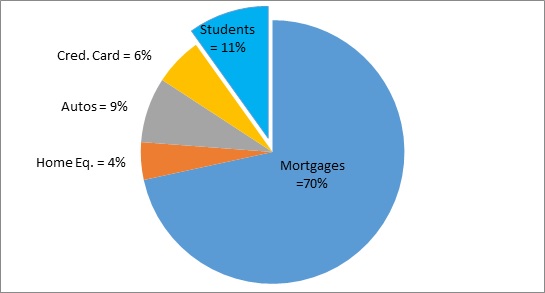
Student loans have more than doubled in the past eight years and now stand at $1.25 trillion. But even so they still represent only about 11% of all consumer credit outstanding. Consumer debt is dominated by mortgages which make up 70% of the total. Student loans are the second biggest category of consumer debt. Autos, credit cards, and home equity lines of credit are all smaller.
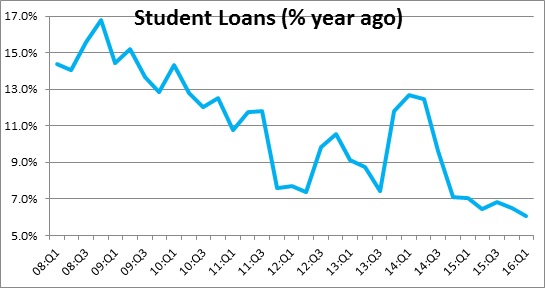
More importantly, the rate of growth of student loans has been slowing down. A few years ago student debt was climbing at a double digit pace. But it has been steadily slowing and in the past year rose 6.1% which is the slowest rate of expansion since this series began back to 2004 – twelve years ago.
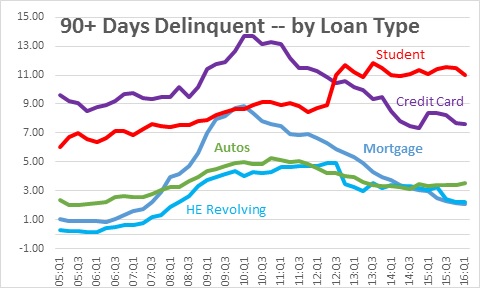
Some economists worry about the delinquency rate on student debt. The latest data from the NY Fed indicate that 11% of student loans outstanding were 90 days or more in arrears. While that is the worst performance for any type of consumer borrowing, the reality is that the delinquency rate on student debt has been steady at about that same level for the past three years. It has not deteriorated. Meanwhile, the delinquency status for other types of credit continues to improve.
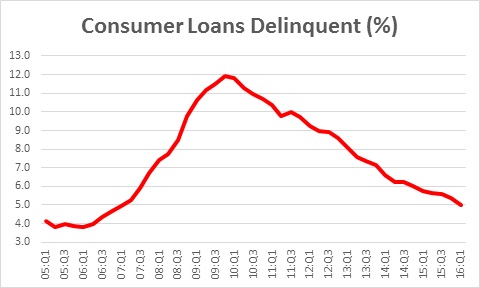
For consumer loans as a whole the delinquency rate has slipped to 5.0% which is the lowest since the first quarter of 2007 – nine years ago. That improvement is largely attributable to the drop in the delinquency status of mortgage loans which has fallen steadily since the recession ended.
If consumers step up their pace of spending but add to their debt slowly and keep their debt/income ratio fairly steady, and if the Fed raises rates as slowly as it is currently suggesting, this business cycle could easily surpass the decade of the 1990’s and become the longest expansion on record.
Stephen Slifer
NumberNomics
Charleston, SC
Follow Me