
May 25, 2012
The stock market continues to be buffeted almost daily by news about Greece, the possibility that it might have to withdraw from the monetary union, and the unpredictable consequences that might follow. Indeed, the S&P 500 index has fallen about 6% from the peak level it achieved in late March. If stock investors get nervous, consumers might be similarly affected. If confidence is shaken and consumers cut back on their pace of spending, employers could be less willing to hire. Thus, recent events in Europe could have potentially serious adverse consequences in the United States. Having said that, it has been and continues to be our contention that the U.S. economy is on solid ground and any impact from Europe should be reasonably well contained.
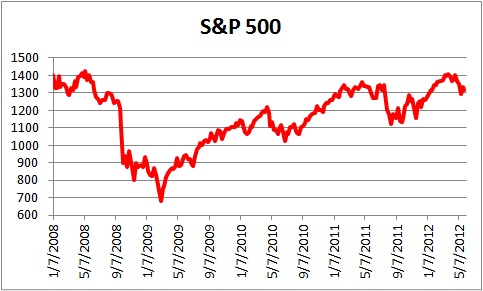
First of all, the economy is generating about 200 thousand jobs per month.
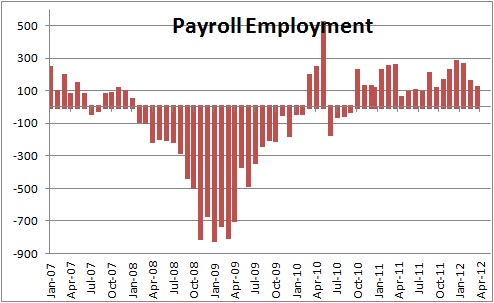
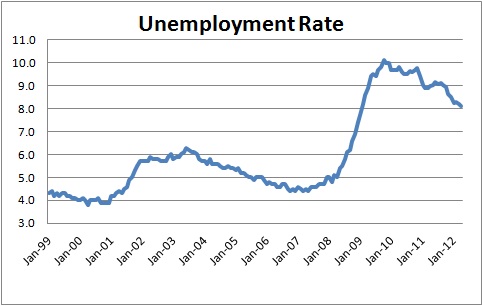
The unemployment rate has fallen 1.0% in eight months which is far more quickly than anyone had expected.
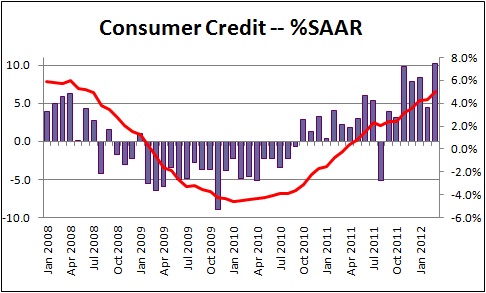
The consumer is borrowing rapidly which means that credit is readily attainable for almost any purpose (although, admittedly, mortgage loans are less easily attainable).
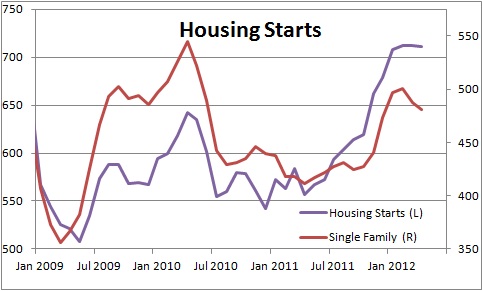
The housing sector is rebounding quickly and should stimulate GDP growth in coming quarters.
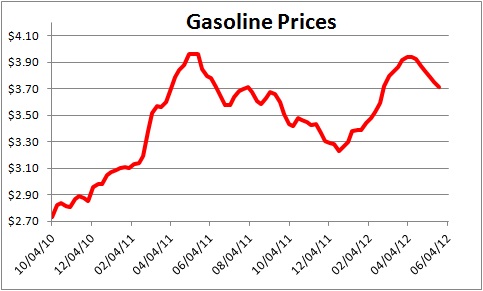
And oil prices have begun a rapid descent and should soon approach the lows for last year, which means that a former headwind is now becoming a tailwind.
For all of these reasons we think that the economy is actually gathering momentum and may well expand at a 3.0% or faster pace in the second half of this year.
But events outside our borders can alter this outcome. Last year, for example, we had the earthquake/tsunami combination in Japan which temporarily reduced growth in the U.S. Debt problems in Europe in mid-2011 had a similar temporary negative impact. Thus, renewed debt woes in Europe this year are potentially problematical. But, for all the reasons outlined above, the economy is doing relatively well, and our sense is that the impact here will be reasonably well contained. But that does not mean there will be no impact on the U.S. economy. Any time the stock market swoons it creates the potential for a problem. One transmission mechanism could be via a negative impact on consumer confidence. However, the early evidence is encouraging.
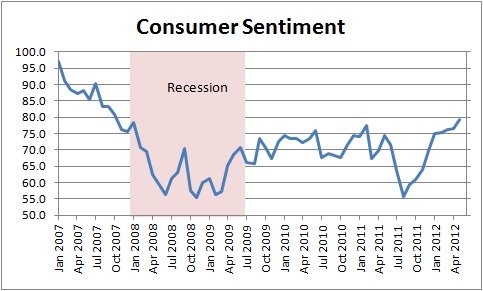
The University of Michigan measure of consumer confidence for May climbed to 79.3 versus 76.4 in April. That represents the highest level of confidence since October 2007 – prior to the onset of recession. Earlier this month we got a preliminary reading on sentiment for May of 77.8 based on responses received in the first half of the month. For the final measure to have climbed to 79.3 implies that responses in the second half of the month surged to 80.8. The stock market selloff actually began in late March but gathered momentum in the second half of May following the elections in France and Greece on May 6. The consumer has had ample opportunity to react but, thus far at least, consumers are unfazed.
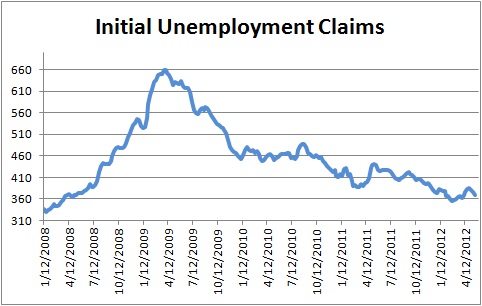
The second place where signs of impending weakness might materialize is in the weekly measure of layoffs known as “initial unemployment claims”. As is the case with any weekly series, claims can be quite volatile. But in recent weeks it has settled in at about 370 thousand which is slightly above its low point for the cycle of roughly 355 thousand attained in late February. But this can hardly be construed as a sign of “weakness” in the labor market. Instead, it seems to be suggesting that monthly payroll gains might (at least for a while) level off at about 200 thousand which is a perfectly acceptable pace and one that is sufficiently rapid to allow the unemployment rate to continue its gradual descent. But keep in mind that we were expecting employment gains to average 225-250 thousand per month in 2012. So if claims remain at their current level for long, we might eventually have to lower slightly our GDP forecast for the year.
As is always the case we will keep watching the stock market, and both consumer confidence and initial unemployment claims, but thus far at least the evidence suggests that any negative fallout from Europe on the U.S. economy will be modest. This coming week we will see revised GDP data for the first quarter on Thursday which seems likely to revise downwards to about 2.0% from 2.2% initially. And on Friday we will get the employment report for April which we expect to show a gain in payroll employment of about 200 thousand, and no change in the unemployment rate at 8.1%.
Unfortunately, we are probably not done with negative news flashes from Europe. The next event to watch out of Europe is the Greek election on Sunday, June 17. Further gains by the Radical Left party, Syriza, would intensify worries about an eventual Greek exit from the European monetary union and the fear factor would re-surface.
Stephen Slifer
NumberNomics
Charleston, SC
Follow Me