
August 29, 2014
At a recent central bank gathering in Jackson Hole, Fed Chairman Janet Yellen refused to commit the Fed to a timetable for the long-awaited first rate hike. That is a good thing. The debate is currently focused on the degree of slack in the labor market which is not entirely obvious. But two things are clear. First, the time for higher rates is not now. Second, extremely low interest rates are not going to be around much longer.
Somehow we expect the Fed to tell us exactly what indicators it is using to decide when to change policy, the specific levels for those indicators that would induce it to change, and precisely when all that is going to occur. That is not going to happen. The economy is very complex and cannot be explained accurately in a few sound bites. Each economic indicator provides information about a tiny piece of the puzzle. The Fed, appropriately, needs to examine the entire spectrum of indicators to determine when it is time to change policy. And while it is fairly good at predicting the future it is not infallible, which means it cannot know today whether the time for higher rates will arrive in March, June or September of next year.
Right now the Fed is trying to figure out how much slack remains in the labor market. In the past economists believed that “full employment” was achieved when the unemployment rate dipped to about 5.5%. Today it is 6.2%. Given its recent downward trajectory it should get to 5.5% sometime in the early part of next year. But is the full employment threshold still 5.5%?
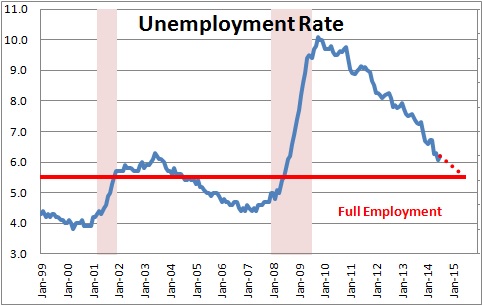
The economy underwent wrenching changes during the recession. Millions of people lost their jobs. Many remain unemployed years later. Those long-term unemployed workers may not have the technical skills required by today’s employers. That means that many will be permanently unemployed in which case the full employment threshold could be higher, perhaps 6.0%, and the economy might be closer to full employment than we think.
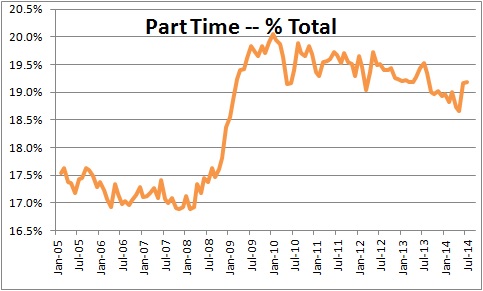
But Ms. Yellen quickly points out, correctly, that other labor market indicators suggest there is still considerable slack in the labor market. For example, many part time workers say they would like full time employment.
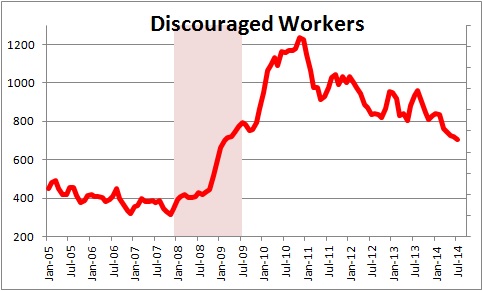
Other unemployed workers have become discouraged about the likelihood of employment and have given up looking for a job.
Ms. Yellen’s conclusion is that the economy is not yet at full employment but is headed in the right direction. She does not want to raise rates until the slack in the labor market has largely disappeared. But which labor market indicator or indicators will tell her when that has occurred?
Presumably when the economy is approaching full employment wages will begin to climb as employers bid more aggressively to attract the skilled workers that they need so they offer higher wages. As they pass the higher labor costs through to their customers in the form of higher prices inflation accelerates.
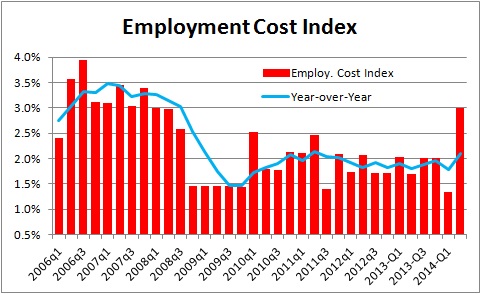
So what has been happening to wages and inflation? Once again, the answer is murky. Average hourly earnings have been remarkably steady, but the employment cost index which includes wages and benefits has begun to creep upwards.
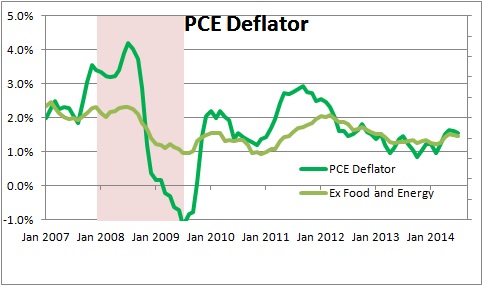
Inflation measures like the CPI and the personal consumption expenditures deflator give slightly different answers about the current level of inflation but it is somewhere between 1.5-2.0%,. Unfortunately, all of these inflation indicators have begun to edge upwards in recent months.
The bottom line is that nobody thinks the Fed should raise rates now. There is still too much evidence of slack in the labor market. We believe the Fed is doing exactly what it should be doing and looking at a broad array of indicators to determine when the time for higher rates has arrived. If the economy rolls along at a pace similar to what we experienced in the second quarter, the time for Fed action will arrive sooner than expected. If growth stumbles, as it has in each of the past several years, that time will be farther into the future. Nobody can predict precisely when that might occur and we should not expect the Fed to provide us with a precise timetable, but it is clear is that the time for the Fed to begin raising interest rates is within sight.
Stephen Slifer
NumberNomics
Charleston, SC
Follow Me