
July 15, 2011
We remain confident that an agreement to cut the budget deficit by $4 trillion or so over the next decade, and increase the debt limit, will be passed prior to the August 2 deadline. Investors seem to share that lack of concern.
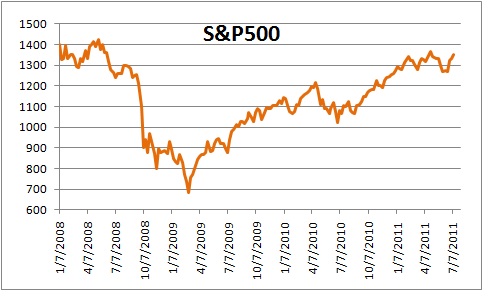
It is clear that the stock market does not believe in the default scenario. The S&P 500 index, for example, has regained almost all of the ground it lost prior to the recession. If stock investors were truly worried about a default by the U.S. Treasury, stock prices would be far lower. You will recall that at this time last year the S&P 500 index dropped 15% in response to debt problems in Greece and several other small European nations. The U.S. is not Greece. This would be far worse, but nobody seems to care.
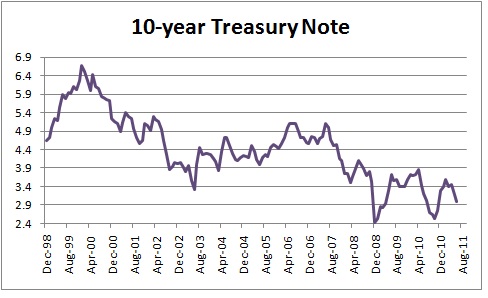
Similarly, bond market investors are unperturbed by the possibility of default. The 10-year Treasury note, for example, is currently trading at a near-record low level of 3.0%. If the Treasury defaults, holders of Treasury securities around the globe — notably the Chinese and the Japanese — will question their ability to get repaid. Prices of these securities will fall sharply and rates will rise.
Why aren’t investors more worried? One scenario is that the Treasury will have sufficient revenue coming in to make interest payments on the public debt, and pay Social Security, Medicare and Medicaid recipients. In August, for example, individual and corporate tax receipts should be about $175 billion. Thus, the Treasury can spend $175 without having to issue more debt. Interest payments on the public debt will be about $35 billion, Social Security payments are roughly $65 billion, Medicare and Medicaid payments are approximately $75 billion. Those payments happen to total $175, so there is no problem. Right?
Wrong. First, there is a timing issue. Those tax revenues will flow in over the course of the month. Social Security payments must be made on August 3. Thus, the Treasury will not have enough money in the till on August 3 to make that payment. Ever wonder why the drop dead date was set for August 2? Now you know.
Second, the Treasury makes many more payments than just the ones noted above. Without this debt ceiling constraint, Treasury spending for August would be $275 billion or $100 billion more than what it takes in from taxes. A budget deficit for the month of $100 is roughly consistent with our expected budget deficit for the current fiscal year of $1.5 trillion. Who is going to be the grand arbiter of who gets paid and who doesn’t? As we see it, even if the Treasury makes its interest payments on the debt, this is a real live default. Obligations incurred by the U.S. government – by our Congressmen, our Senators, and the President – are not being honored.
A more likely reason why investors are not more worried is because we have been down this road before. Numerous times. In fact, according to the Treasury, the debt ceiling has been raised successfully 78 times since 1960. Why should this time be different? Carolyn Baum of Bloomberg News expects the scenario to play out something like this:
Act 1. Republicans and Democrats play chicken with each other. Both agree that budget cuts of $4 trillion or so are necessary, but Republicans want it all through cuts in spending. Democrats want to increase taxes on the wealthy. Nobody budges. Tempers flare. The President storms out of the room.
Act 2. The President tells the American people that Social Security recipients are not going to get paid on August 3 which, as Carolyn so aptly stated in her column, puts seniors “in the position of eating dog food or starving.”
Act 3. All hell breaks loose.
Act 4. One minute before midnight on August 1 our congressional leaders and the president reach an agreement and the republic is spared from a disaster of epic proportions. Everybody claims victory.
Act 5. Go back to Act 1 and start over again next year.
Do yourself a favor. Do not read another word about the budget negotiations for the next two weeks. It is all political posturing. The real action will take place behind closed doors. Then, on August 2 read all about the happy ending.
Stephen Slifer
NumberNomics
Charleston, SC
Follow Me