
October 7, 2011
Debt concerns both in the U.S. and a number of European countries are weighing on the stock market. The wild stock market volatility is having a significant dampening effect on consumer confidence, which makes it hard to envision the economy returning to its longer-term growth trajectory of about 3.5% any time soon. If, instead, GDP growth going forward is 2.5% the labor market is not going to improve quickly and the unemployment rate will not return to its full employment level of 5.0% for a decade. The only way out of the box is for politicians here and abroad to adopt meaningful debt reduction measures. Such action is hard to envision.
The economy got whacked early in the year by the combination of rising oil prices, and supply shortages triggered by the tsunami in Japan. As a result, GDP growth rates in the first two quarters of the year were particularly anemic at 0.4% and 1.3%, respectively. But now the supply shortages are history and gasoline prices are quickly declining towards where they were at the beginning of the year. As a result, third quarter GDP growth should rebound to 2.3%, and we expect a roughly comparable growth rate in the fourth quarter.
A return to more respectable GDP growth is not surprising given that consumers have paid down enormous amounts of debt in the past couple of years and now have a seemingly manageable debt burden. Jobs are being created, albeit at a moderate pace, which is boosting consumer income. Corporate profits are at record high levels and firms are sitting on unprecedented amounts of cash. So what is the problem?
The problem is that for the first time ever, Americans are worried about the ability of the federal government to repay its debt. Budget deficits are expected to remain elevated for years to come which with each passing year will boost debt outstanding. If the economy should slip into recession at any point the debt woes will increase dramatically. Furthermore, we have seen what happens to countries like Greece and Italy that are perceived to have too much debt .
It is abundantly clear that debt concerns caused the recent decline in the stock market and dramatically increased volatility. The stock market decline began in late July. At that time debt problems in Greece resurfaced, U.S. politicians struggled to resolve the debt ceiling, and Standard and Poor’s downgraded Treasury debt. In the five trading days between August 2 and August 8 the S&P declined 13%. In the 42 trading days since then the S&P has changed by 2% or more on 18 occasions or 43% of the time. That translates into daily changes in the Dow Jones Industrial average in excess of 200 points. Even though the market has actually risen slightly since its low point on August 8, the excessive volatility makes it feel like the overall decline has been far larger.

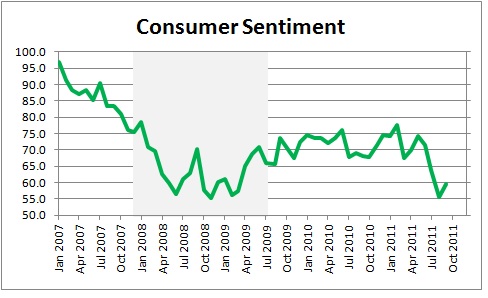
Consumers have been unnerved by these wild stock market gyrations. Consumer sentiment has fallen to a level last seen at the bottom of the 2008-2009 recession. While the pace of economic activity has slowed, it is not even remotely similar to what existed in the midst of the recession. Sentiment has fallen so sharply presumably because consumers now have to worry about the impact of budget deficits and debt in addition to the usual combination of economic factors.
Unfortunately, there is no quick fix to these debt woes. It is hard to raise taxes when economic activity is sluggish. Trimming expenses implies meaningful cuts in entitlements such as Social Security, Medicare, and Medicaid, which means lower income for older citizens and those in need. With no quick solution in sight the stock market will continue to be buffeted by every debt-related news item. While consumers may continue to spend, they will do so at a moderate pace. Businesses may continue to hire, but very cautiously. It is hard to envision a return to 3.5% GDP growth any time soon.
If, instead, GDP growth in the quarters ahead averages 2.5%, the unemployment rate will not easily decline. When we expected 3.5% GDP growth we thought the unemployment rate would return to its full employment level of 5.0% by 2015. But if GDP growth is 2.5% the unemployment rate may not return to the 5% mark for a decade. That is a completely unacceptable outcome.

To avoid this situation, policy makers both in Washington and in Europe, have to find ways to meaningfully reduce budget deficits and debt outstanding relative. It is hard to see how they can do it.
Stephen Slifer
NumberNomics
Charleston, SC
Follow Me