
January 10, 2014
In the case of the December employment report beauty is in the eye of the beholder. On the one side, private sector employment rose 87 thousand in December which was far smaller than the 210 thousand increase that had been anticipated which suggests the economy might have been fairly soft in that month. On the other side, the unemployment rate fell 0.3% to 6.7% to its lowest level since October 2008 which suggests that the economy might have been relatively robust during December. So which is it? The only thing one can say about the report is that it is confusing for both the markets and the Federal Reserve. It is impossible to determine the significance of this report in the absence of additional data. Thus, the Fed will not alter its monetary policy stance in any way until it gets the January employment report in early February.
Private sector employment rose 87 thousand in December which was far smaller than the 210 thousand increase that had been anticipated. Some have suggested that the miniscule employment gain could have been attributable to the very cold/snowy weather conditions that paralyzed much of the country in that month. That is certainly plausible and is the most likely cause of the reported employment weakness. If that is the case, then we will see an outsized gain in January of perhaps 300 thousand.
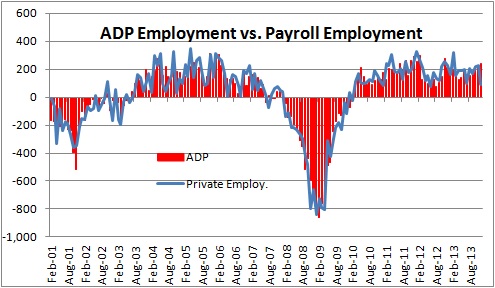
A major reason for disbelieving the soft employment results in the Labor Department data is because they do not square with other employment indicators. For example, the ADP report reported an enormous 237 thousand increase in private sector employment in December versus the increase in private sector employment reported by the BLS of 87 thousand. These two series track very closely, but can get out of sync from time to time on a monthly basis. Probably in January the ADP data will revise downwards, and the small December increase in private employment will get revised upwards and be followed by a sizable January gain.
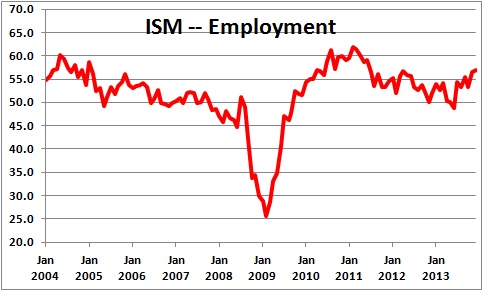
Similarly, the December employment index for the manufacturing sector reported by the Institute for Supply Management rose from 56.5 to 56.9 which is the highest that series has been since June 2011.
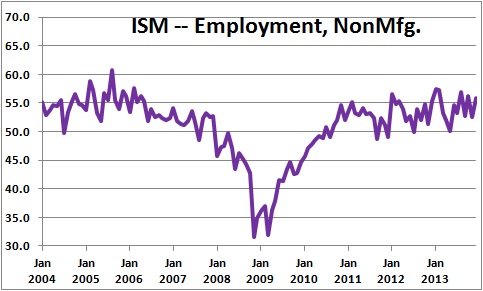
The December employment index for the service sector reported jumped from 52.5 to 55.8 which is close to the highest level thus far in the business cycle.
In short, the miniscule private sector employment increase in December does not seem to square with anything else we know about the labor market. But to determine exactly what is going on we will need to wait for another month.
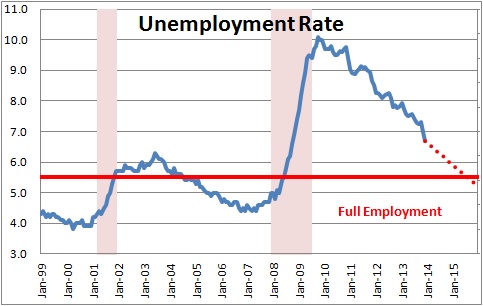
Then there was the 0.3% drop in the unemployment rate in December from 7.0% to 6.7% which follows a drop of 0.2% in November. The unemployment rate has fallen much more rapidly than anyone had expected. What does this mean?
Some economists contend that the unemployment rate has been declining because the labor force has been declining. That is true, over the past year the labor force has fallen on average 46 thousand per month.
They then suggest that this drop in the labor force reflects workers who have been out of a job for so long that they have given up looking. But this makes no sense. The Labor Department reports that there were 917 thousand “discouraged workers” in December 2013 compared with 1,068 thousand of them in December of 2012. Thus, the number of discouraged workers has been gradually shrinking. Given that the economy has been growing at a moderate pace over the course of the past year and is currently showing signs of accelerating, it is hard to believe that people would simply quit looking for a job. Rather, they seem more likely to intensify their job search.
A more likely cause of the drop in the labor force is that the baby boomers are retiring. They were born between 1946 and 1964 and will become 65 years of age between 2011 and 2029. As they retire they drop out of the labor force. Thus, the more-rapid-than expected drop in the unemployment rate is being assisted by demographics.
While these developments are confusing for all of us, how is the Fed likely to respond? It decided to slow their pace of bond purchases from $85 billion per month to $75 billion per month at the mid-December meeting. They will get the January employment report prior to their next gathering in mid-February which will, hopefully, clarify the employment situation. That will be Janet Yellen’s first meeting as Fed Chairwoman. At the moment we think the Fed will further taper their purchases to $65 billion per month at that meeting.
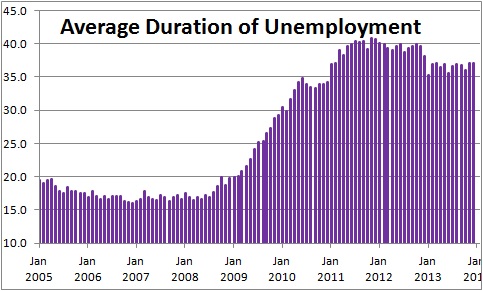
They drop in the unemployment rate is equally important for the Fed because it will be the trigger for the time when they want to increase the funds rate. They have told us that they intend to keep the funds rate at 0% until “well past” the time that the unemployment rate declines below 6.5%. If 6.0% is the threshold, given its current rate of descent that could happen by the end of 2014. We thought, and still think, that the Fed will not raise the funds rate until mid-2015. But to do that they need to shift the focus to something else. Perhaps they could focus on the average duration of unemployment. While the unemployment rate has fallen by 2.4% since August 2011 from 9.1% to 6.7%, the average duration of unemployment has hardly budged. The people that are getting hired are not coming from the ranks of the long-term unemployed. Perhaps employers believe that these people do not have the skills required in today’s competitive economic environment in which case their ranks will continue to decline slowly.
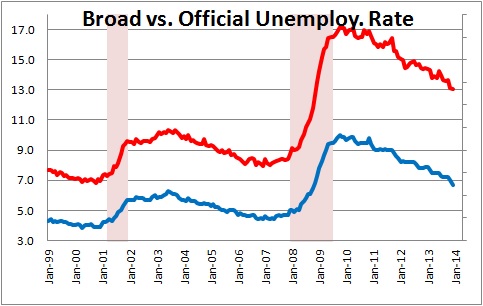
Or perhaps the Fed will talk about broader measures of unemployment. The broadest measure, U-6, is currently 13.1% compared to about 9.0% at the beginning of the recession. This measure not only includes the so-called discouraged workers, but also people who are working part time but would like full time positions. The Fed could choose to wait until this broader measure of unemployment falls to its pre-recession level.
The bottom line is that the employment report for December was clearly confusing. Employment is almost certainly far stronger than what the payroll employment data suggest. And the unemployment rate is legitimately falling more quickly than expected. Given the unexpected nature of these developments, the Fed is going to sit tight and wait for the January employment report before considering any change in its game plan.
Stephen Slifer
NumberNomics
Charleston, SC
Follow Me