
March 27, 2015
First quarter GDP growth will be released at the end of April. It will be less robust than most economists had expected a couple of months ago. But the softening appears to be attributable to temporary factors that will be reversed in the months ahead – work stoppages by dockworkers on the West Coast, bitter cold weather, and a sharp contraction in oil drilling activity. It feels like a mini version of last year when the economy contracted 2.1% in the first quarter, but came roaring back with 4.6% and 5.0% rates of expansion in subsequent quarters. In our view the U.S. economy is likely to expand at a rate in excess of 3.0% until such time as the Federal Reserve raises rates sufficiently to knock it off track – an event that is still several years away.
Work stoppages by West Coast dockworkers have created problems for manufacturers and retailers who have been forced to wait for goods that remain on ships at anchor unable to unload. Honda, for example, had to curtail production at six plants in the U.S. due to parts shortages. The good news is that the labor dispute has been resolved, however it will take several months to clear the congestion that accumulated during three months of union slowdowns.
Dangerously cold winter weather in the central and eastern U.S. caused by a frigid air mass that originated in Siberia negatively impacted GDP growth in the first quarter. NOAA reported that February was the coldest month in more than 20 years. Nobody is going to go house shopping under such conditions or venture off to the mall. But eventually spring arrives and most of the lost sales will be recovered as the weather improves.
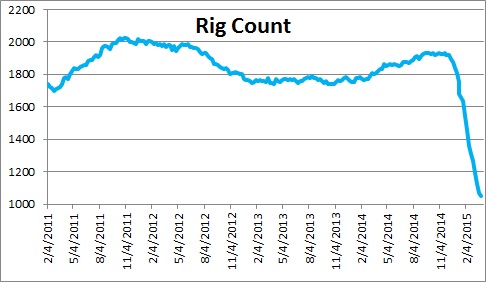
The 50% drop in oil prices has caused drillers to shutter 45% of the wells that were in operation at the end of September. But, surprisingly, production and oil stocks continue to climb which means that more rigs will need to be capped in the weeks ahead. Eventually production and inventory levels will fall and, at that point, oil prices will begin to climb. The Department of Energy expects oil prices to reach about $60 per barrel by the end of this year and $70 in 2016. If that is the case, many of the recently shuttered rigs will once again become profitable and resume operation. Hence, our expectation is that at least some of the recent curtailment in drilling activity will be reversed later this year.
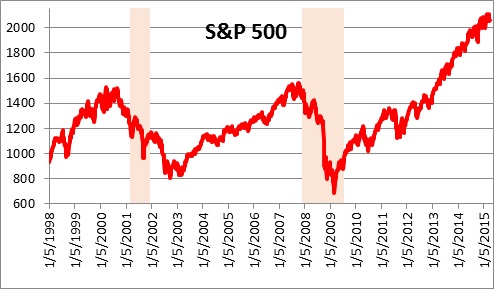
Investors have gotten slightly nervous in the face of weak economic statistics, but the S&P 500 index is only about 2.5% below its peak level set in mid-February. That is nothing more than the normal volatility in this series and, as has been the case so often already in this expansion, the modest decline will be quickly reversed once better news arrives.
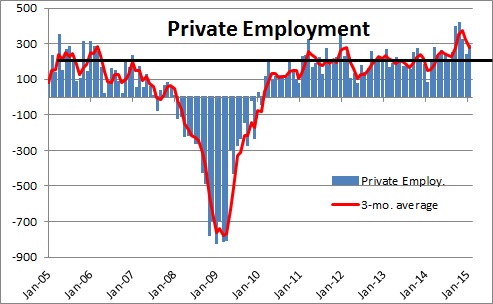
Perhaps the most important indicators to confirm the temporary nature of the recent slowdown is that employment and hours worked remain solid. Firms presumably believe that the factors depressing growth in the first quarter will not exist for long. That suggests, in turn, that whatever we lose to weather and work stoppages in the first quarter will be recouped in the quarters ahead. Residential construction will snap back strongly as projects sidelined by bad weather are brought back on line. Manufacturing and retail activity idled by the problem at West Coast ports will resume once ships are unloaded and the goods finally arrive at their destination.
For the past six years we have maintained our belief that the economy would continue to expand at a moderate rate for the foreseeable future. Growth has been whacked by a lengthy series of one-off events during that period of time – oil spills, the Arab Spring, the earthquake in Japan, the debt ceiling debacle, financial woes in Europe, Superstorm Sandy, the fiscal cliff, bad weather, and labor disputes. But, in our view, every one of those unanticipated events represented a temporary setback. To produce an economic reversal of longer duration requires higher interest rates. Given that the Fed will not even embark on that path until midyear and intends to proceed at a glacial pace thereafter, a more permanent growth slowdown appears to be several years down the road. Maintain the faith!
Stephen Slifer
NumberNomics
Charleston, SC


Stephen, It is simply amazing how you always see light when others see only doom and gloom. You need a talk show to spread your interpretations of what is going on to ameliorate the conservative (reactionary actually) points of view that are spewed over the networks daily. People need to hear good, common sense interpretations in addition to the extreme craziness that is out there.
Talk show. Think about it. And, please continue to write your thoughts as you have done. You are first class! …Darrel Staat