
August 30, 2013
We expect GDP growth to accelerate in the second half of the year. However, the threat of military action in the Middle East could substantially alter this fundamentally rosy economic outlook. Furthermore, there is lingering concern about when and at what speed the Fed will begin to push interest rates higher. Finally, a variety of economic indicators – employment, housing, and orders were surprisingly weak in July. In each case the weakness appears to be temporary. However, July is the first month of the third quarter which means that GDP growth in that quarter will continue to be moderate. The elusive growth pickup continues to be in the future – not the present.
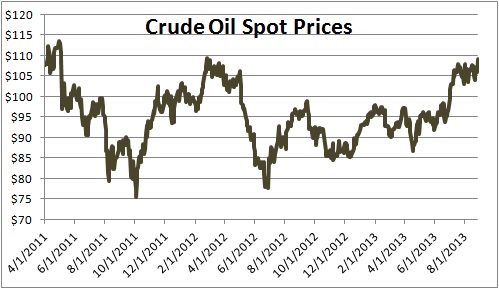
Without doubt the most worrisome factor is the situation in Syria. If the U.S. and other countries conduct some sort of military action, suddenly there are far more questions than answers. What is the scope of that action? How long will it last? How will Syria respond? Israel is, of course, its neighbor to the South. How will Syria’s ally, Iran, respond? Could oil flows from major oil producers like Saudi Arabia, Iran, and Iraq be curtailed if Iran tries to impede traffic through the Persian Gulf? What happens to oil flows through the Suez Canal? Could they get interrupted? A spike in oil prices triggered by military action could fundamentally change the economic outlook for the second half of this year.
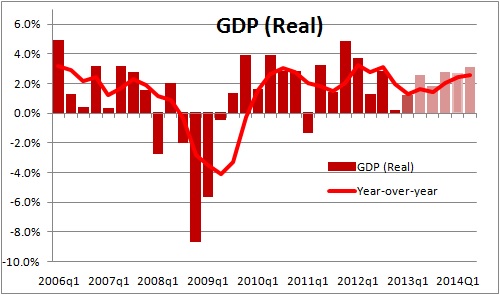
The Federal Reserve intends to alter the course of monetary policy and begin to push interest rates higher. The initial step will be to trim its monthly purchases of Treasury and mortgage-backed securities from $85 billion per month to something less, perhaps $50 billion as a first step. But when will that process begin? Most economists believe it will occur at the FOMC meeting on September 17-18. But the Fed has told us the change will be data dependent. If the economy does not accelerate to the extent the Fed expects, such cutbacks could be postponed. While second quarter GDP growth revised upwards from 1.7% to 2.5%, some July data were weaker-than-expected. As a result, it is difficult to see GDP growth this quarter more than 1.5-2.0%. Is that weak enough for the Fed to postpone action to trim its asset purchases? What about the threat of higher oil prices and their potential negative impact on the economy? Is this the time to take the first step of a major change in Fed policy? We tend to think asset purchases will not be reduced at the September meeting. But the Fed has made it clear they will be cut in the relatively near future, probably before yearend.
And, of course, amongst all this angst, the market continues to fret over who will be the next Fed Chairman. Right now the betting is on Larry Summers. If that is the case, rates will presumably climb faster than if Janet Yellen were appointed. As Vice Chairman, she has been an avid supporter of Ben Bernanke’s easy money policy and would, as Chairman, be unlikely to raise rates as quickly as Summers.
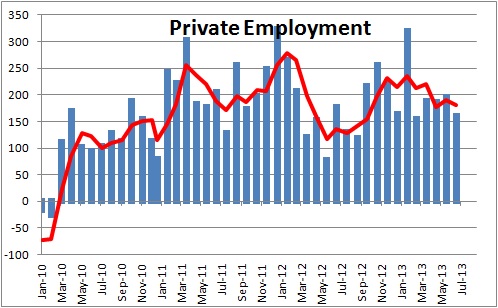
Then there are the economic data for July which have been surprisingly weak. First, private sector employment climbed by 161 thousand in July compared to an average of 190 thousand in the previous three months. Does it matter? Probably not given that initial unemployment claims, a measure of layoffs, continue to decline. If the labor market were weakening we would expect to see more layoffs, not fewer.
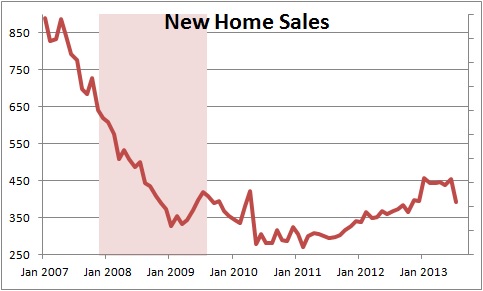
Second, new home sales plunged in July. But new home sales are reported at the time of closing. The contracts on these homes were signed in May – when fears of tighter Fed policy and higher mortgage rates began to emerge. Thus, the drop could represent an initial response to the possibility of higher mortgage rates. However, traffic through the builders’ model homes remained brisk through August. Furthermore, the drop in new home sales stands in sharp contrast to existing home sales (reported when the contract is signed) which surged in that month as buyers raced to buy before home prices and mortgage rates climbed higher. It is hard to imagine the July drop in new home sales is anything but temporary.
Finally, durable goods orders plunged 7.3% in July. The drop was largely attributable to the very volatile transportation category as aircraft orders collapsed. Typically, a huge drop (or increase) in orders in one month is largely reversed the following month. While we think that will once again be the case, we will not know for sure until we get data for August.
Thus, the situation in the Middle East is troublesome. Higher interest rates are worrisome. And while employment, home sales and orders were all anemic in July, the declines should prove to be temporary. But given that July is the first month of the third quarter the math indicates clearly that third quarter GDP growth will continue to be modest. Our expectation is for growth of 1.8%. That suggests that our anticipated quickening in the pace of economic expansion remains in the future — not the present. We cling to our assessment of more rapid future growth but have to admit that third quarter GDP growth rate is a disappointment.
Stephen Slifer
NumberNomics
Charleston, S.C.
Follow Me