
July 8, 2011
We have been bothered recently by a number of frequently made comments that are just factually incorrect.
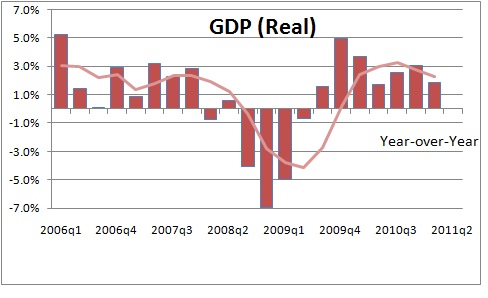
Myth #1. The Economy Is Still in a Recession. Many people continue to talk about “the current recession”. While it is true that the pace of recovery has been somewhat tepid by historical standards, the reality is that the economy has been growing for two full years. The National Bureau of Economic Research dated the end of the recession in June 2009. GDP has risen every single quarter since then with an average growth rate in those seven quarters of 2.8%. It has weathered the debt crisis in Europe in 2010, political unrest in North Africa and the Mideast which pushed gasoline prices sharply higher in early 2011, and then in March an earthquake/ tsunami in Japan which sharply curtailed the ability of manufacturers in the U.S.to get parts that they needed for production. Under the circumstances the economy has not done all that badly. Furthermore, the headwinds experienced earlier this year are now being reversed. Oil prices have already begun to fall and will soon reverse a significant portion of their earlier run-up. Japanese production will return to normal by August. To the extent these factors acted as a brake on growth earlier, they will now add to growth in the final two quarters of this year.
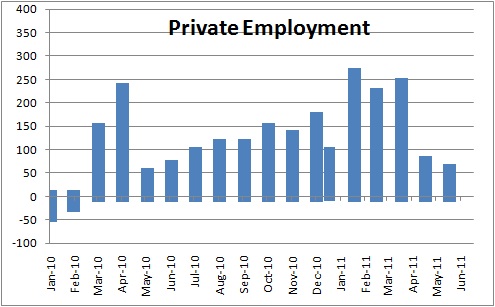
Myth #2. This Has Been a Jobless Recovery. That has also not been the case. While the economy hit bottom in June 2009, the labor market did not turn upwards until March 2010. In the 15 months since then the economy has created 2.2 million new jobs. That works out to 136 new jobs on average every month. Once again, it is far less than might typically be created in the early stages of a business cycle but, given the headwinds noted earlier, it is perhaps not all that bad. Jobs have been created, and a faster pace of job creation is in store in the second half of this year.
In the process of creating these jobs the unemployment rate has fallen from its peak of 10.1% in October 2009 to 9.2% in June 2011. Yes, the rate is far higher than desired, but it seems that people are focusing exclusively on the 0.4% backup in the unemployment rate in the past three months, and have completely lost sight of the 1.3% drop that occurred earlier. Remember how we all marveled that the rate fell 0.8% between December of last year and January of 2011? How easily we forget.

Myth #3. Small Businesses Are Not Participating in the Recovery. The general sense from many small business people is that the recovery has not yet begun for them. While that is undoubtedly the case for some small firms, it is not true on several levels for most.
First, since the various stock market indicators turned upwards in the early part of 2009, the Russell 2000 index has far surpassed the performance of the S&P 500. The Russell 20000 measures the performance of 2,000 small cap firms. In the past year and one-half the Russell 2000 has climbed from 481 to 860 – an increase of 79%. The S&P 500, meanwhile, which measures the performance of 500 large cap firms, has risen from 890 to 1,351 – an increase of 52%. Rather than lagging the market, it appears that small firms are leading the way.

Second, many seem to feel that the jobs being created are primarily by large firms, and that we will not see any significant job creation until small firms become sufficiently comfortable with the economic outlook and the tax environment that they become willing to hire. But the data tell a different story. Automatic Data Processing (ADP) produces a monthly survey that closely mimics the behavior of the private sector employment statistics produced by the Bureau of Labor Statistics. For example, since January 2010 the BLS data indicate that 2.2 million jobs have been created; the ADP data show a gain of 1.8 million. Thus, the two series are not perfect substitutes, but they are close. THE ADP data conveniently split those jobs into three categories – firms with 1-49 employees, 50-499, and more than 499. As shown on the chart below medium-sized firms have been creating more jobs than any other size category, followed closely by small firms. In the past 18 months large firm employment has hardly budged. This means that of the 1,813 jobs created during that period of time, small firms have created 902 thousand of them, medium-sized firms 890 thousand, and large firms just 23 thousand.
So as we see it, small firms have been doing fine. They are making money, their stock price is rising rapidly, and they are actively hiring. That is not the image that has been created in the press.

Sometimes unsubstantiated stories get told over and over, and pretty soon they are accepted as conventional wisdom. But upon closer inspection some of those ideas simply do not stand up to scrutiny. In this case, the economy is not in recession and has not been for two years. We are creating a significant number of new jobs (although not as many as we might like). And many of those jobs are being created by small firms. By almost any metric, small firms have led the economy out of recession. They are making money, their stock price is rising rapidly, and they are hiring at a robust pace.
Stephen Slifer
NumberNomics
Charleston, SC
Follow Me