
July 15, 2016
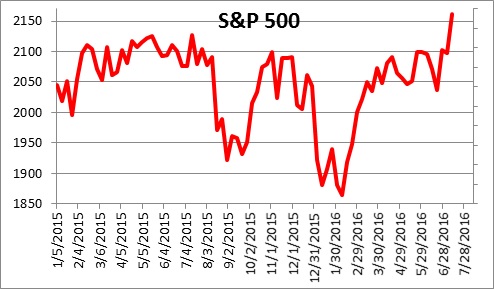
Market jitters triggered by the U.K. decision to leave the E.U. have faded quickly. In the past couple of weeks the stock markets has rebounded and stands at a record high level. Consumers are spending freely and may be stepping up the pace. The long-awaited pickup in inflation appears to be at hand. These developments bolster the case for additional rate hikes between now and yearend, but the first one will probably not come until September.
At its last meeting in mid-June Fed Chair Yellen indicated that the Brexit vote was a factor in the Fed’s decision to leave rates unchanged. “It is a decision that could have consequences for economic and financial conditions in global financial markets.” She was right. The unexpected decision by the U.K. shook financial markets around the globe. But as quickly as stock markets sold off they recovered and, in the case of the U.S., climbed to a record high level. The stock market gain not only bolsters consumer and business confidence, it creates wealth which should enhance consumers’ willingness to spend in the months ahead.
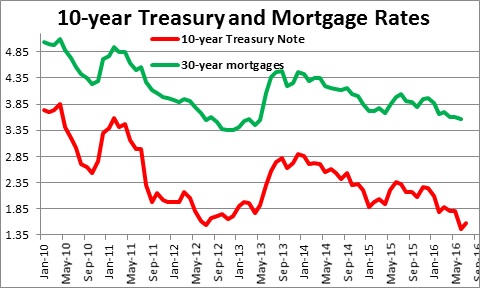
In the midst of global uncertainty investors flocked to the safety of dollar-denominated investments, particularly the U.S. Treasury market. The yield on the 10-year note fell to a record low of 1.37% before rebounding to its current level of 1.58% which is still about one-quarter percentage point lower than it was two months ago.
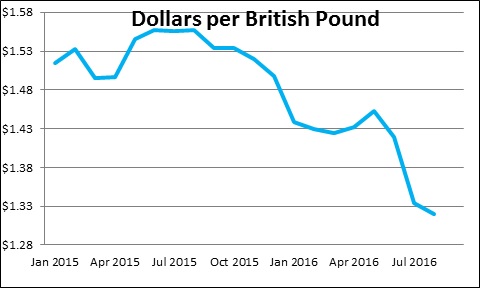
There was a concern that the Brexit vote would strengthen the dollar and that U.S. exports would suffer. That is not going to happen. The dollar increased with respect to the pound from $1.45 per pound to $1.32. However, the Brits are a relatively small trading partner. Far more important is what happens with our neighbors Canada and Mexico and in those two cases the dollar has changed very little. On a trade-weighted basis the dollar was steady between June and July. Hence, any impact on the trade sector will be unmeasurable.
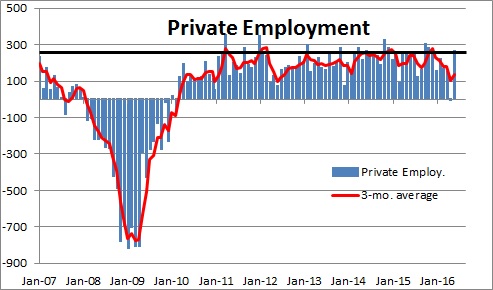
With respect to the real economy we have seen considerably stronger data in recent months. The labor market followed a miniscule 11 thousand increase in jobs in May with a resounding gain of 287 thousand in June. Any fear that the labor market could be signaling some emerging economic weakness quickly disappeared.
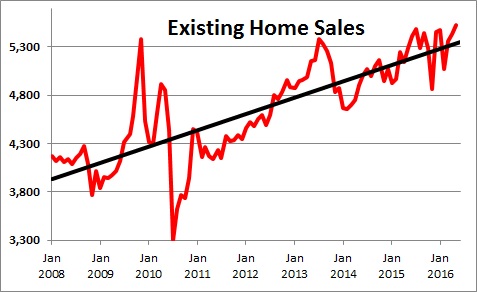
The housing sector continues on a roll. In response to sizable job gains, rising income, and record low mortgage rates, home sales have surged in recent months and would be even stronger if more homes were available for sale.
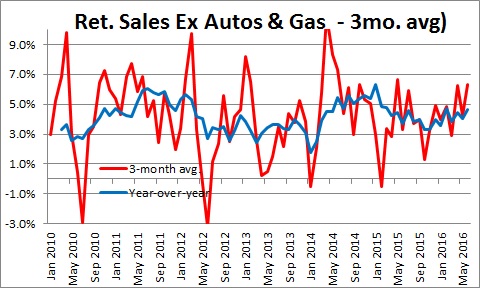
Given the factors cited above, consumers are opening their wallets and spending more freely. Car sales and gasoline prices are always quite volatile, so to get a sense of the trend economists focus on sales excluding these two categories. In the past year such sales have risen at a 4.6% pace. In the past three months they have climbed at an even more impressive 5.6% pace.
These factors make it increasingly likely that second quarter GDP growth will be 2.5% versus a 1.1% pace in the first quarter. We will get our first look at that figure at the end of this month. This is important not only because the consumer is continuing to spend at a solid pace, but the drag on GDP growth in the past year caused by the combination of shrinkage in the oil patch (triggered by the dramatic drop in oil prices) and falling growth in exports (caused by the dramatic increase in the value of the dollar) has come to a halt.
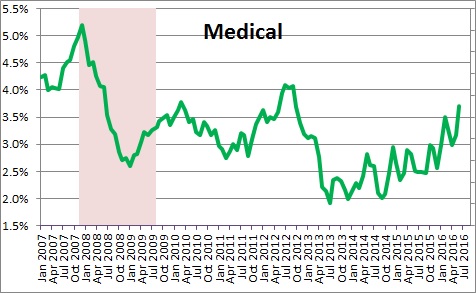
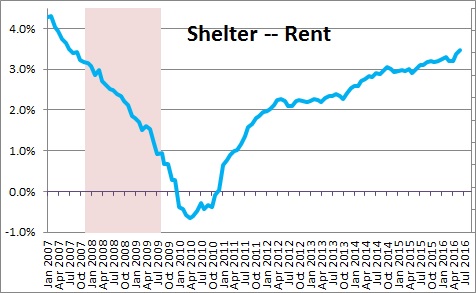
Finally, the long-awaited pickup in inflation is at hand. It is not dramatic. But it is evident. The so-called core CPI has been steadily climbing to 2.3% and given what has been happening to rents and medical costs it is destined to move higher. In the past year medical costs have been steadily accelerating and now stand at 3.7%. The shortage of available housing has boosted the cost of shelter. It has risen 3.5% in the past year. Neither of these two factors are going away any time soon. We expect the core CPI to climb by 2.5% this year.
Against this background, the Fed will soon have to contemplate higher interest rates. The economy is very close to or at full employment any way one wants to look at it. As a result, wage pressures are beginning to climb. The inflation rate is no longer being held down by falling oil prices. The fear that the Brexit decision could roil the markets has largely disappeared. The Fed is quickly running out of excuses for postponing the next rate hike. Having said that, it meets on July 26-27. Second quarter GDP will be released on July 29. At that point the Fed will be able to say unequivocally that the economy is back on track. Thus, in our mind the next rate hike will come in September with another one occurring in December. Higher rates are necessary so that the Fed can get itself in better position to counter the next economic downturn — whenever that might occur.
Stephen Slifer
NumberNomics
Charleston, SC


Whew! Brilliant metric analysis.