
November 4, 2016
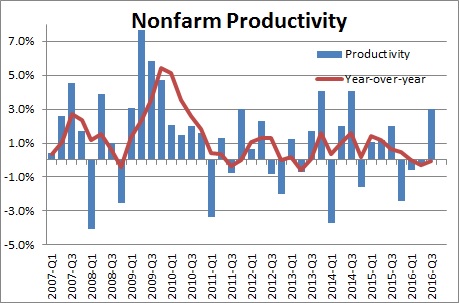
Third quarter GDP growth accelerated to 2.9% which was a pleasant surprise. The Atlanta Fed tracking model suggests that growth will be 3.1% in the fourth quarter. Has growth suddenly taken off? One reason why third quarter growth was larger than expected is because it benefited from a jump in productivity growth which surged to 3.0% in that quarter. All of this is great, but the obvious question is whether it will last and what impact it might have on the Fed’s pace of rate hikes.
Third quarter GDP growth came in at 2.9% which beat the expectation by a wide margin. Following growth of 0.8% in the first quarter and 1.4% in the second 2.9% growth is welcome news. However, the pace was boosted by inventory accumulation which added 0.6% to the growth rate and by trade. A 10% jump in exports narrowed the trade gap in that quarter which added another 0.9% to the GDP growth rate. Without those two components growth would have been 1.4% rather than the published estimate of 2.9%. That particular figure is known as “final sales to domestic purchasers” and represents sales of goods and services purchased by U.S. residents. In the past four quarters that particular index has risen 1.7%. Thus, one has to be cautious about reading too much into the faster-than-expected overall GDP growth rate for the third quarter. There is less there than meets the eye.
As noted, the Atlanta Fed’s GDP NOW estimate suggests that fourth quarter GDP growth will be 3.1%. But, once again, caution is warranted. Some data for October are available but nothing for November and December. For whatever it is worth we are expecting GDP growth of 2.2% in the fourth quarter. That figure will be released at the end of January. Depending upon which estimate might be right, GDP growth for 2016 as a whole will be between 1.8-2.1%. All-in-all we continue to believe that the economy will chug along at a 2.2% pace in 2017.

The other surprising piece of news was that productivity growth jumped 3.0% in the third quarter. That was the largest increase in productivity in three years. Nobody quite knows why productivity growth has slumped for such a protracted period of time. Some economists believe that we are not accurately measuring productivity in the service sector (where it is more difficult to measure). The problem with that explanation is that productivity in the manufacturing sector, where we presumably can measure it more accurately, has also virtually disappeared. Others suggest that the drop-off in productivity has to do with the retirement of baby boomers. Presumably someone who has been doing a job for 40 years is pretty efficient at doing it. When they retire and are replaced by someone with less experience productivity takes a hit. The bottom line is, nobody has come up with an explanation that is entirely plausible. So why couldn’t productivity re-accelerate just as it mysteriously disappeared three years ago?
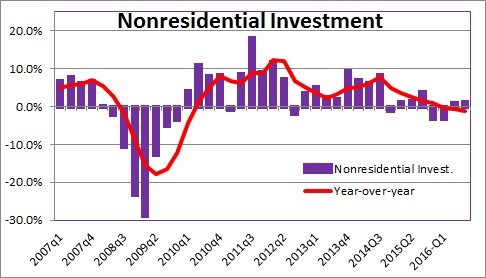
In our opinion, productivity growth is largely determined by the pace of investment spending. The more money businesses sink into new technology and/or refurbishing their assembly line, the more efficient those companies should be. Unfortunately, investment spending has barely grown for the past couple of years. And nothing in the third quarter GDP data suggest that businesses have begun to loosen their purse strings. Nonresidential investment in that quarter climbed by an anemic 1.2%.
It is important to remember that the economy is essentially at full employment. That means that essentially everyone who wants a job has one, and that our factories are humming along at a steady pace close to peak capacity. Right now economists believe that potential growth rate is about 1.8% consisting of roughly 0.8% growth in the labor force combined with 1.0% growth in productivity. With the economy at full employment that is how quickly it can grow over any protracted period of time. We could boost that potential growth pace if productivity growth were to re-accelerate. Because we do not yet see businesses willing to boost their pace of investment spending, it is difficult to see how productivity growth can quicken. The first thing we need to see is a pickup in investment spending. Faster productivity growth will follow.
This means that GDP growth is going to grow at a pace roughly in line with its potential growth rate. Some quarters will be faster than that, some slower. Recent developments are welcome news, but they most likely represent only short term improvement. Economic growth is steady — not surging.
As far as the Fed is concerned these data will encourage them to raise the funds rate in December to 0.5%. But they were going to do that anyway. At the moment we are not revising our estimate of two more rate hikes next year which would boost the funds rate to 1.0%. For the Fed to speed up the pace they are going to have to see evidence that inflation is really beginning to accelerate. It is willing to let the economy run “hot”, which means that it will tolerate an inflation rate above 2.0%. But it has not been specific about exactly what that pace might be. For now, slow but steady rate hikes are the best bet.
Stephen Slifer
NumberNomics
Charleston, SC
Follow Me