
May 5, 2017
First quarter GDP growth of 0.7% was disappointing but the unanticipated shortfall came from two-factors – a sharp slowdown in the past of consumer spending, and a surprisingly small increase in inventories. Neither factor should be long-lasting. Furthermore, the employment report for April with a solid jobs gain and a further decline in the employment rate provides additional evidence that second quarter GDP growth will rebound to at least 3.0%. Given this background the Fed will continue on a path of gradual rate hikes with the next increase expected in June
GDP growth always zigs and zags and first quarter growth of 0.7% was the slowest in five years. but does it have any long-term implications? The answer is unequivocally no.
The first part of the report that was surprisingly weak was consumer spending which edged upwards by 0.3% in the first quarter. That was the slowest pace of consumer spending since the recession. Given the consistency of consumption growth for almost a decade could the first quarter result could be a harbinger of a more subdued pace of spending in the months ahead? We do not believe so.
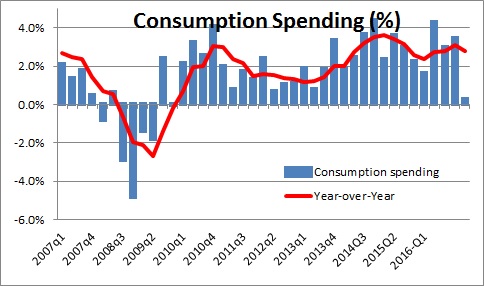
Consumer spending is driven by a combination of factors. First, steady employment gains boost income which provides the fuel for individuals to continue their pace of spending.
The prospect of individual income tax cuts later this year has propelled the stock market to a steady series of record high levels. As the stock market climbs consumer net worth rises.
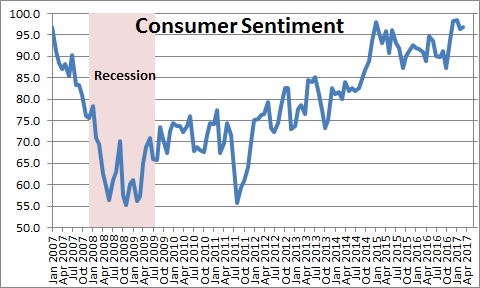
The rising stock market has boosted confidence to its highest level in more than a decade.
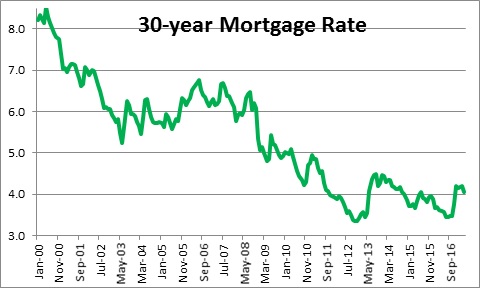
Interest rates remain low. After surging immediately after the election as Americans concluded that Trump’s proposed policy changes could significantly boost GDP growth in 2017, mortgage rates surged to 4.2%. But as time has passed it is clear that the impact of those policy changes in the near term will be more muted. Accordingly, mortgage rates have settled back to the 4.0% mark which remains low by any historical perspective.
The second source of first quarter GDP softness was business inventories which rose by $10.3 billion after having climbed $49.6 billion in the fourth quarter of last year. As a result, this volatile category subtracted 1.0% from GDP growth in the first quarter. As inventories rebound in the second quarter we expect this particular category to add at least 0.5% to the pace of expansion.
Even the Fed acknowledges that the first quarter slowdown should be temporary. In its most recent statement it said, “Household spending slowed, but the fundamentals underlying the continued growth of consumption remain solid.”
The employment report for April provides further evidence that the first quarter slowdown will not be long lasting. Not only did the economy generate 211 thousand new jobs in April, the unemployment rate fell by 0.1% to 4.4% its lowest level since May 2007. That is the third consecutive decline in this rate which stood at 4.8% in January. Janet Yellen prefers a broader measure of unemployment. It has also declined for three consecutive months from 9.2% in January to 8.5% in April. Both levels are below the ”full employment” threshold which basically means that everyone who wants a job has one. Both rates will continue to decline as the year progresses.

If the economy is allegedly at “full employment” where are employers finding the bodies to hire? Two places. First, the steady pace of economic expansion continues to entice so-called “discouraged workers” back into the labor force.

Second, employers are searching within their own firms to find hard-working, reliable, part-time workers who indicate they would like to have a full-time position.

For all of these reasons it is virtually certain that the economy will rebound in the second quarter. The Atlanta Fed expects second quarter GDP growth to snap back to 4.2%. We are more cautious and currently peg it at the 3.0-% mark. Either outcome suggests that the economy remains on solid footing after stumbling in the first quarter.
Against this background the Fed is almost certain to continue on its path of gradual increases in short-term interest rates. The next FOMC meeting will be held on June 13-14 which strikes us as the date for the next rate hike which would lift the funds rate to the 1.0% mark.
It is important to remember that the economy does not grow on a steady upward trajectory. Rather, it moves in fits and starts. It had a “fit” in the first quarter, but should rebound with a “start” in the current quarter. However, whenever something unexpected happens economists must honestly examine the data and review their outlook. In this case, we conclude that there is nothing to worry about. The time for concern will eventually come, but that time is not now.
Stephen Slifer
NumberNomics
Charleston, S.C.
Follow Me