
September 2, 2016
There have been several articles recently critical of the Fed’s handling of the economy. The criticism seems to reflect frustration that GDP growth has been stuck at about 2.0% rather than the 3.5% pace that many believe is the norm. Monetary policy is a very powerful tool for regulating the pace of economic activity, but it is not the only tool. Fiscal policy can help. But fiscal policy today is handcuffed by the combination of gridlock in Congress and growing budget deficits as the baby boomers continue to retire. Further, some factors are beyond the Fed’s control. In our opinion, the cause of the economy’s slowdown for the most part does, indeed, lie in Washington — but not at the Fed.
Why has growth been so slow? The economy’s speed limit is determined by two factors. The growth rate of the labor force and the growth rate of productivity. If we know how many people are working and how productive they are, we should be able to estimate how many goods they can produce. Take the growth rates for these two factors, add them up, and you will get what economists call “potential growth” which is essentially the economy’s longer-term speed limit.
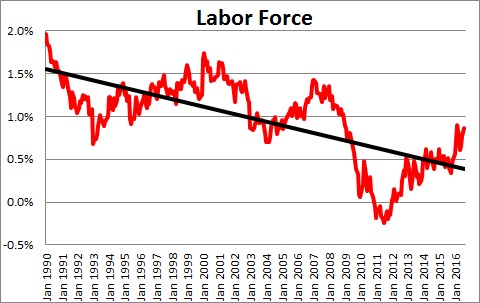
Growth in the labor force has slowed from about 1.5% prior to the recession to about 0.8%. To a large extent this reflects the baby boomers retiring. They were born between 1946 and 1964. They will retire between 2011 and 2029. When they retire they drop out of the labor force. Thus, the bulk of the slowdown in the labor force is attributable to demographics. The Fed does not control demographics.
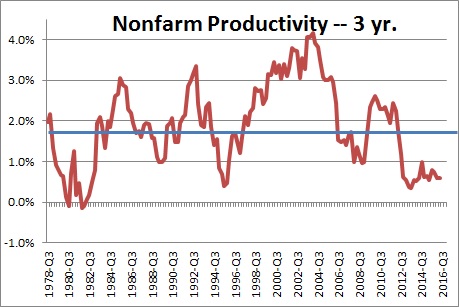
Productivity growth has slowed from 2.0% prior to the recession to 1.2%. Productivity reflects business owner’s decisions to upgrade equipment or technology and build new factories, offices, and retail stores. Their lack of willingness to invest is a no confidence vote about the ability of our political leaders’ ability to address the economy’s problems. The Fed does not control the decisions that business leaders make.
Given slower growth rates for both the labor force and productivity, potential GDP growth has slowed from 3.5% in the 1990’s to about 2.0%. Slower growth is frustrating, but it is not the result of tight monetary policy. The Fed not only pushed the funds rate to 0.0% for six years, it bought U.S. Treasury securities and flooded the banking system with $2.0 trillion more reserves than it needed. While growth has undeniably slowed, it is hard to hang this outcome on the Fed.

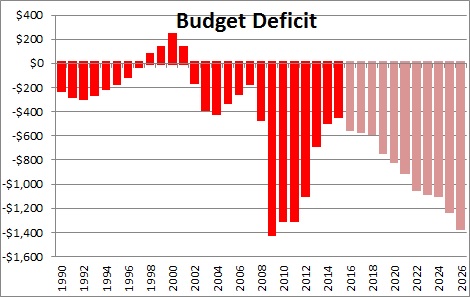
There is another lever that can be pushed to stimulate the pace of economic activity – fiscal policy. When the economy slows down our policy makers in Washington have the ability to cut taxes and/or increase government spending. But the budget deficit is expected to climb steadily for the next 10 years as the baby boomers retire. As those deficits accumulate the amount of Treasury debt outstanding will continue to climb. Thus, fiscal policy is also constrained in its ability to stimulate GDP growth. So what can be done if both policy tools are effectively impotent?
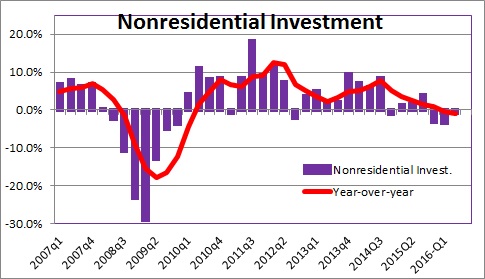
The problem in our economy today is centered on the lack of business investment. Consumers continue to spend at about a 3.0% pace and show no sign of slowing down. But investment spending has largely disappeared. Businesses are voting with their wallets. Our sense is that they are increasingly frustrated by the gridlock in Washington. Political gain seems more important than the good of the country. Our health care system is teetering on the brink of collapse. The marginal U.S. corporate tax rate at 35% is higher than elsewhere around the world. Corporations are swimming in a sea of red tape. Governmental regulations are often unnecessary, conflicting, and confusing. The federal register has mushroomed to more than 80,000 pages. No wonder corporate leaders are discouraged.
The November election has the ability to alter this prevailing pessimism. Unfortunately, our corporate leaders’ concern appears to be justified. But rather than blame the Fed for the current slow growth environment our political leaders should look closer to home. The solutions for what ails our economy clearly lie in Washington — but on Capitol Hill, not at 20th and Constitution Avenue.
Stephen Slifer
NumberNomics
Charleston, S.C.


Great article Stephen. This makes a lot of sense and I have not read about this interpretation from anybody else. Thanks!