
August 7, 2014
Payroll employment rose 215 thousand in July. Over the last three months employment has risen on average 235 thousand per month. But gains of that magnitude may not continue for long.
Employers can find new works from one of two places — new entrants into the labor force, or the ranks of unemployed workers. When the unemployment rate is high there are a large number of unemployed workers looking for jobs. It is easy for employers to boost hiring. But as the unemployment rate falls it becomes progressively more difficult for employers to find bodies to fill vacant position. At “full employment”, which occurs when the unemployment rate has fallen to about 5.5%, unemployed workers are no longer a source of hiring because, by definition, at that level everybody who wants a job has one.
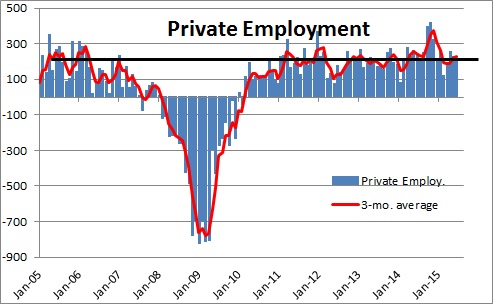
As a result, hiring managers need to look a bit harder to find the necessary workers. They may try to poach them from other firms by offering higher wages and more attractive benefits. They could look internally and perhaps find some hard-working, qualified, part-time employees and offer them full time jobs. They might be on the lookout for some long-term unemployed workers (who are not included in the official unemployment statistics) and offer them an apprenticeship or on-the-job training to acquire the necessary skills. The point is that once the unemployment rate has fallen to its current level of 5.3%, it is much harder for hiring managers to find 235 thousand qualified workers each month.
Thus, going forward we do not expect to see 235 thousand new jobs being created every month. It could easily slip to 175-200 thousand. But that is OK because the labor force is currently growing slowly. Indeed, labor force growth is increasing by only about 100 thousand new entrants each month.
If the economy cranks out 100 thousand new jobs a month the unemployment rate holds steady. If it generates 235 thousand jobs per month the unemployment rate will decline rapidly. Indeed, that has been the case for the past five years. The unemployment rate has fallen far more quickly than what the Fed and most economists expected. If employment gains slow to 175-200 thousand per month going forward, the unemployment rate will continue to decline, but not quite as rapidly as had been the case earlier.
If the monthly increases slow, some economists will conclude that the Fed should postpone the first rate hike beyond September and perhaps increase rates even more slowly than expected next year and beyond. We doubt that. There is only one employment report left between now and the September FOMC meeting. Even if the increase in payroll employment for August is relatively small it would reflect an inability to find an adequate number of qualified workers, and not be a sign of less robust economic activity. That is because the economy appears to be starting the third quarter on a high note.
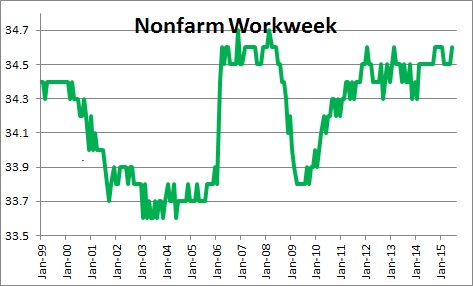
Keep in mind that the workweek rose to a near-record high level of 34.6 hours in July. Firms need to boost output, and because new workers are hard to find they work existing employees longer hours. Layoffs are at a 15 year low. Businesses cannot afford to fire anyone. The housing market is on a roll as the demand for homes and apartments continues to outpace supply. Currently, GDP growth is poised to accelerate to a 3.0% pace in the third quarter. The economy is NOT slowing down so a smaller-then-expected increase in payroll employment should not be regarded as a sign of emerging weakness.
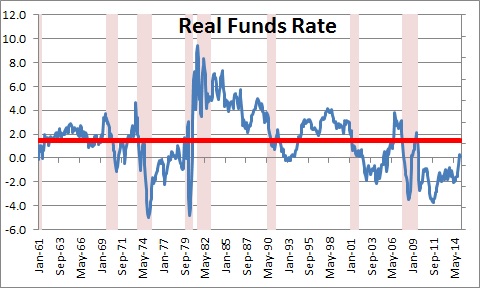
Historically, in good times and in recessions, the funds rate varies but has averaged 1.3% higher than the inflation rate. Thus, a 1.3% “real” funds rate should be regarded as relatively close to “neutral”. If the Fed has an inflation target of 2.0%, then a “neutral” funds rate would probably be something around 3.3%. But it is not at 3.3% it is wildly stimulative at 0.0%. With no remaining slack in the economy, inflation edging its way higher, and the economy growing at a 3.0% rate — well in excess of its 1.5% potential growth path — the Fed’s fear will be that inflation may soon begin to emerge – perhaps to a faster pace than it would like. There is no reason for the Fed to hesitate. An increase in the funds rate to 0.25% is long overdue and would still leave the funds rate at a very stimulative level.
Stephen Slifer
NumberNomics
Charleston, SC
Follow Me