
February 7, 2014
The employment data for December and January undoubtedly reflect bad weather but still managed to record moderate gains. Meanwhile the unemployment rate declined to 6.6%. It has fallen 0.6% during the past three months. While not always pretty the labor market continues to improve with each passing month. Once the weather returns to normal we should see payroll employment gains return to 200 thousand or more and the unemployment rate continue its slide to 6.0% by yearend.
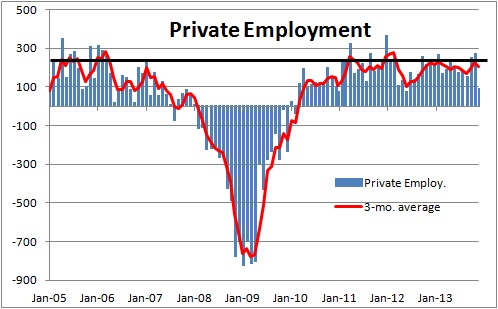
Private employment climbed by 89 thousand in December and 142 thousand in January. That compares to an average monthly increase of 224 thousand in the three-month period ending in November. Almost certainly adverse weather conditions trimmed the December and January gains. If that is the case, we should see a return to monthly employment increases of 200 thousand or more in the months ahead once the weather improves.
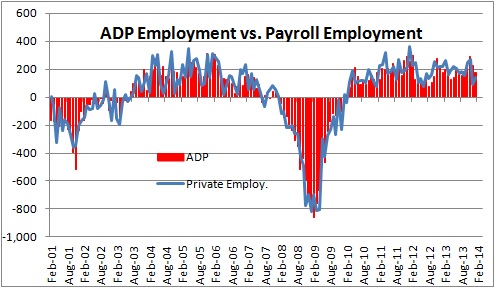
Most other labor market indicators have been fairly steady which suggests that the weakness in the payroll data is probably misleading.. ADP employment, for example, rose 227 thousand in December and another 175 thousand in January for an average gain of 201 thousand in that two-month period. The ADP data and the private sector employment data track very closely together.
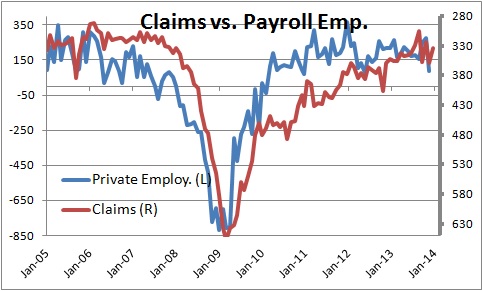
Initial unemployment gains are a measure of layoffs. They continue to average 330 thousand which suggests private sector employment going forward should be about 190 thousand per month.
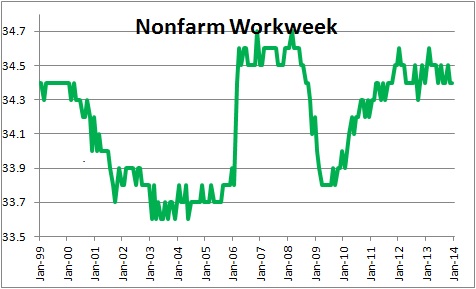
If the economy slows the first thing employers do is cut hours worked. However, the nonfarm workweek remains very solid at 34.4 hours. If the economy expands at 3.0% this year firms will soon need to hire additional bodies.
Finally, civilian employment, which is derived from the household survey and is used in the calculation of the unemployment rate, rose 143 thousand in December and 638 thousand in January for a two-month average of 391 thousand. This measure of employment has increased 154 thousand per month during the past year; payroll employment has risen 154 thousand. Because the two series track closely together, the large increases in household employment in December and January suggest that the payroll data are probably not an accurate barometer of the labor market in those months.
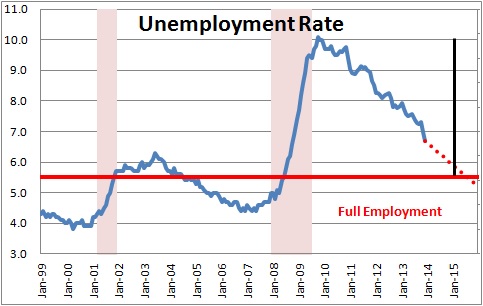
While all of this has been going on the unemployment rate fell 0.1% in January to 6.6% and has now dropped 0.6% in the past three months. Pessimists suggest that the unemployment rate has been falling only because the labor force has been declining. That is simply not accurate. During the course of the past year the labor force has fallen by 20 thousand per month, household employment has risen by 153 thousand, which means the number of unemployed workers has dropped by 173 thousand. Thus, the bulk of the drop in the unemployment rate is the result of more jobs, but it has been assisted by the reduced size of the labor force.
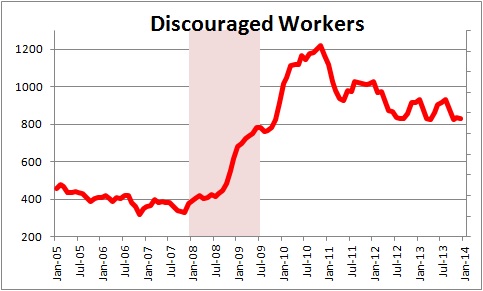
The drop in the labor force is not the result of people giving up their job search and simply dropping out. In fact the number of discouraged workers in January 2014 of 837 thousand is little different from the 804 thousand in January of last year. We contend that the reduction in the labor force is primarily the result of retiring baby boomers. They were born between 1946 and 1964. Add 65 to each of those figures and we should expect the boomers to retire between 2011 and 2129. Thus, the recent decline in the labor force is largely attributable to jobs creation but with a little help from demographics. This labor market shrinkage will continue for another 15 years.
The Fed has told us that it intends to keep the funds rate at 0% until “well past” the time the unemployment rate falls to 6.5%. While though the unemployment rate is currently at 6.6% there is no danger that the Fed is going to raise short-term interest rates any time soon because they have told us that they also intend to watch other labor market indicators.
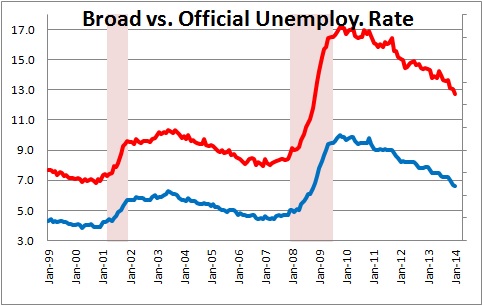
One of those other indicators is the broadest measure of unemployment which is currently 12.7%. Prior to the recession it was below 9.0%. It will not return to that level for some time to come.
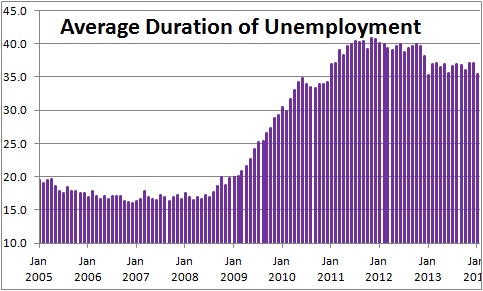
Similarly, the average duration of unemployment is currently 35.4 weeks. Prior to the recession it was 17.5 weeks. Clearly, the workers who are getting hired are not coming from the ranks of the long-term unemployed. While they presumably want jobs they apparently do not have the skill set required by employers in today’s market place.
Finally, actual inflation and inflation expectations remain very much in check.
So while the Fed has mentioned the 6.5% level of the unemployment rate there is nothing magic about it. There is no way the Fed is going to raise short rates any time soon. We continue to look for the Fed to trim its bond purchase by $10 billion at each FOMC meeting this year, and begin to raise the funds rate sometime around the middle of next year.
Stephen Slifer
NumberNomics
Charleston, SC
Follow Me