
January 6, 2017
Consumers and business people are convinced that the combined effect of President-elect Trump’s proposed individual and corporate income tax cuts, the ability to re-patriate overseas earnings to the U.S. at a favorable tax rate, and expected relief from a currently-stifling regulatory environment will stimulate GDP growth in 2017. Virtually every economic indicator released since the election reflects that new-found enthusiasm.
The S&P 500 stock market index, for example, has jumped 5.0% since the election to a record high level of 2,281.

The surging stock market has certainly been one factor that has propelled consumer confidence to a 12-year high. In addition, steady jobs growth of 170 per month, a very low unemployment rate of 4.7%, and the likelihood of tax cuts later this year are making consumers feel almost giddy.
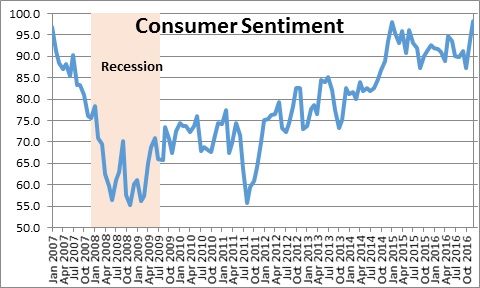
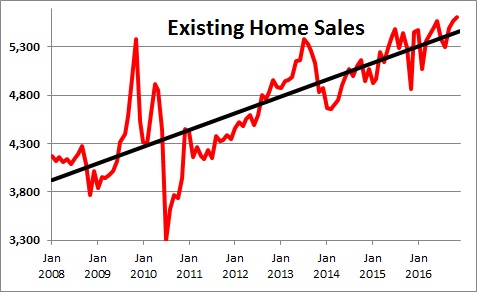
As confidence soars consumers are buying cars and houses at the fastest rates thus far in the cycle. That is enormously important because cars and houses are the two biggest ticket items in any consumers’ budget. When consumers get nervous the pullback in spending is most quickly apparent in these two categories.

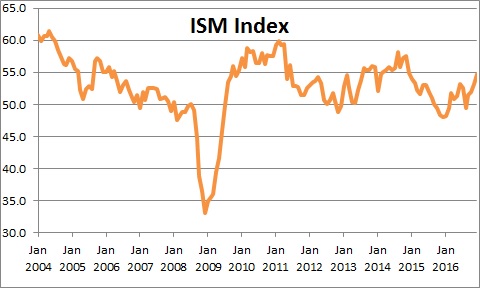
It is not just consumers that are bubbling over with enthusiasm. Business people have joined the party. The ISM Index for the manufacturing sector, a measure of confidence for corporate leaders in that sector, jumped to a 2-year high in December. Factory bosses are seeing a resurgence of new orders as firms gear up for a faster pace of sales in 2017.
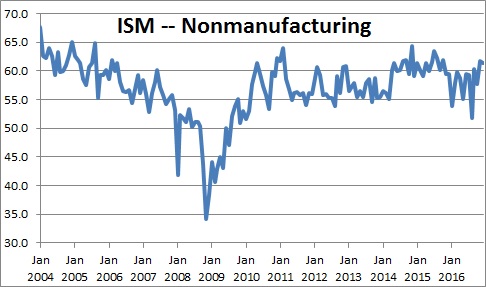
Firms in the service sector are reporting a similar pickup in confidence. The current surge in orders in both the manufacturing and service sectors will lead to a pickup in production which will, in turn, generate further gains in employment.
All of these developments are encouraging but, thus far, they reflect an expectation that Trump’s proposed policy changes will stimulate GDP growth. Once he takes office on January 20 he will need to translate those desired policy changes into legislation. While Republicans control both the House and the Senate, not all Republicans are the same. There will be struggles, even within his own party, about how best to revamp the tax codes, which regulations to discard, which need to be revised, what the replacement for Obamacare should look. Immigration policy and trade policy will generate further heated discussions. The Democrats will throw in as many obstacles as they can.
There will undoubtedly be bumps along the way and today’s euphoria will soon be tempered by the reality that implementing policy is difficult and requires compromise. As those hiccoughs occur the markets and confidence will sag but, in the end, we believe that the Republicans will be able to implement much – but certainly not all – of Trump’s agenda. For that reason we expect only a moderate (not dramatic) pickup in GDP growth from 2.0% last year to 2.3% in 2017.
At the same time faster GDP growth implies upward pressure on inflation. As the labor markets continue to tighten wages will grow more quickly. The December employment report confirms that wages have begun to accelerate. They climbed at a 2.0% rate for a long time but have begun to accelerate and the pace has climbed to 2.9%. Given that wages represent roughly two-thirds of a firms overall cost that will create an upward bias to inflation. However, if the pickup in GDP growth is largely focused on a faster rate of growth in investment spending, there should also be a commensurate pickup in productivity growth which will mitigate the need for business people to raise prices. Thus, we expect the core CPI (i.e., the CPI excluding the volatile food and energy categories) to accelerate only slightly from 2.3% this past year to 2.7% in 2017.

A moderate pickup in GDP growth and a slightly faster rate of inflation will not alarm the Fed. They currently anticipate three increases in the funds rate in 2017 which would bring it to 1.25% by the end of the year. But the Fed overestimated the number of rate hikes last year, so just because they anticipate three rate hikes this year does not mean that will actually occur
There is an old market saying, “Buy the rumor. Sell the fact.” The recent increases in the stock market and in both consumer and business confidence reflect the “rumor” part of this old adage. Once Trump takes office on January 20 the “fact” part of the equation will come into play as reality sets in. This will be the first of undoubtedly many bumps in the road to a faster rate of growth for the economy. But do not get discouraged when those bumps materialize. Economic activity is picking up, inflation will rise slightly, and rates will increase very slowly. All systems remain go.
Stephen D. Slifer
NumberNomics
Charleston, SC
Follow Me