
April 24, 2015
Growth in Europe and Asia is projected to be relatively anemic this year. But these regions are receiving considerable stimulus from a variety of sources and growth could turn out to be more robust than is generally anticipated.
Europe
First, in January European Central Bank President Mario Draghi announced a quantitative easing strategy similar to the one adopted by the Federal Reserve. The ECB intends to purchase securities amounting to 60 billion Euros per month through the end of September 2016 or until it sees a sustained upward adjustment in the path of inflation. That means the package will amount to at least 1.1 trillion Euros. This aggressive action by the European Central Bank sent a strong message about the ECB’s determination to address the challenges that have been stalking the continent.
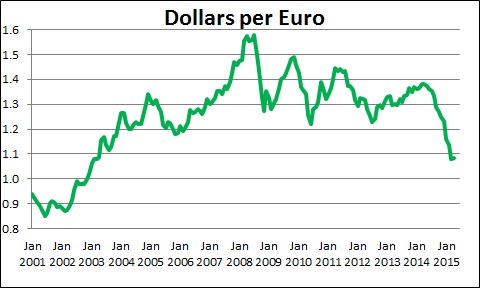
Second, the quantitative easing program has also weakened the Euro. In fact the Euro has fallen 22% in the past year from $1.38 per Euro to $1.08. This means that European goods are now cheaper for Americans to buy which will, hopefully, stimulate demand for European exports and provide further stimulus for the region’s economy.
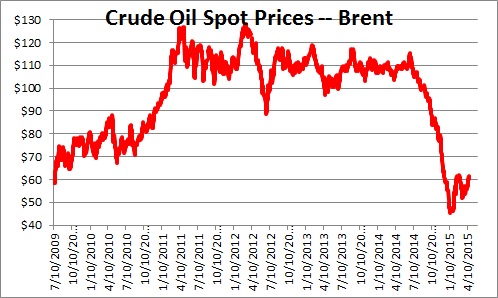
Finally, Europe is an oil-importing region which means that, like the U.S., European consumers now pay less to fill their car’s tank with gas. The cost of Brent crude declined 60% from a high of $113 per gallon in September of last year to $45 by mid-January before rebounding to about $60 currently. With crude oil storage facilities around the globe near capacity prices will remain low for the foreseeable future.
In response to this combination of events European stock markets are surging. The Euro Stoxx 50 has climbed 10.0% in three months as investors put their stamp of approval on the program. The German stock market, the DAX, jumped 15% in the same period of time.

Asia
The story for Asia depends to a large extent on what happens to China on one side and Japan on the other — the world’s second and third largest economies.
In China GDP growth is slowing down as government officials orchestrate a shift from an industrial-based economy to more consumer driven growth. Growth has slowed from a double-digit pace in 2010 and 2011 to 7.4% last year, and is expected to slide further be 6.8% this year. But the Hang Seng stock market index in Hong Kong has risen 17% in the past three months to its highest level thus far in the cycle. If growth is sputtering, why are stocks doing so well?

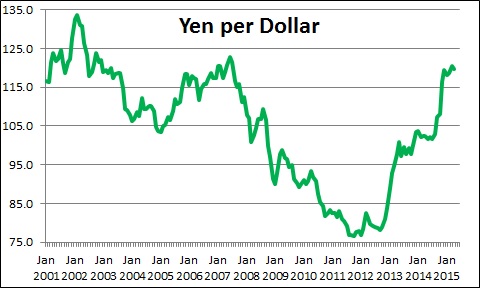
Japan’s story is quite different. Like the U.S. and Europe the Bank of Japan is pursuing a quantitative easing strategy. This program has caused the yen to weaken 55% from 77 yen per dollar at the end of 2012 to 120 yen currently. That will, hopefully, make Japanese goods more attractive to foreign buyers and stimulate growth in exports.
Like the U.S. and Europe, Japan is an oil-importing nation and benefits from the dramatic drop in oil prices that has occurred since September.
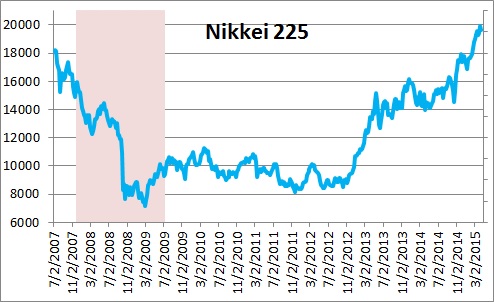
The prospect of more robust economic activity triggered by the dramatic shift in monetary policy, a weaker currency, and lower oil prices, has lifted the Japanese stock market 34% during the past year to the highest level since the mid-1990’s. Japanese investors seem to think that this combination of events could actually work.
Our sense is that economists are unduly pessimistic about GDP growth prospects outside of the U.S. Quantitative easing programs in Europe and Japan ensure that extremely low interest rates will prevail at least through the end of next year. Those same quantitative easing programs have significantly weakened the Euro and the yen and boosted the value of the dollar. That has the impact of shifting GDP growth from the U.S. (where growth is relatively robust) to Europe and Japan (where GDP growth is more modest). A re-balancing of world growth is not a bad thing. Finally, the drop in oil prices will stimulate growth in almost all developed countries. This combo of events should provide a welcome boost to GDP growth in Europe and Asia in particular.
Stephen Slifer
NumberNomics
Charleston, SC


Stephen,
What great news for the economy internationally. Six years ago what we are seeing today was merely a dream in the midst of an extreme nightmare. Thank you for your insightful interpretation of the economy in both the U.S. and the international scene.
…Darrel