
September 16, 2011
The European Central Bank recently announced that it, in conjunction with other central banks – the Federal Reserve, the Bank of England, the Bank of Japan, and the Swiss National Bank — will provide unlimited dollar funding to European banks that are encountering funding difficulties as a result of the debt crisis in Europe. This action clearly highlights the gravity of the financial problem in Europe caused by the debt difficulties in Greece, Spain, Ireland, Portugal and Italy. But, more importantly, it takes off the table the possibility of global contagion caused by the failure of one or more large European commercial banks.
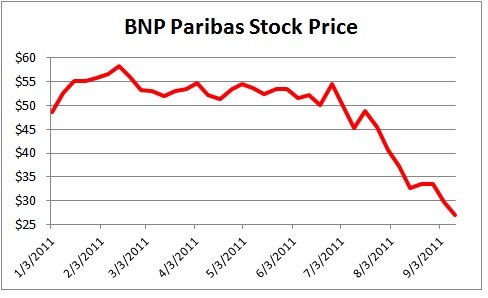
The European debt crisis intensified during the summer as Greece and later Italy struggled to contain their bloated budget deficits and reduce debt. The markets became increasingly worried about the exposure of commercial banks in Europe – particular the large French banks – to the possibility of a default by Greece. As the problem intensified all of the major French banks – BNP Paribas, Society Generale, and Credit Agricole – found that other banks were increasingly unwilling to lend to them. As a result, their share prices shrank 60% in the seven months from mid-February to date. As stock prices fell, and sources of dollar funding began to dry up that, in turn, raised an issue of solvency. Something needed to be done, and central banks around the globe acted to alleviate the problem.
This coordinated central bank action is unusual, but certainly not unprecedented. Most noticeably, it is reminiscent of the problem in the United States in September 2008 following the collapse of Lehman Brothers. In late September of that year this same group of central banks took a series of steps which it hoped would lessen concerns about funding. That action was instrumental in saving U.S. banks like Citigroup, Bank of America, and JP Morgan Chase, whose share prices were, like the French banks today, collapsing.
This assurance of adequate funding in late 2008 was a necessary part of the package to pull the economy out of a slump that threatened to deepen markedly. It effectively stabilized the situation in the U.S. and, in all likelihood, will be equally effective in Europe in 2011. But it will not solve the basic problem. The crux of the issue is that Greece, Italy, and the other countries noted above continue to have budget issues that must be addressed. They can raise taxes, cut spending, or some combination of the two. But, in the end, every country in Europe needs to find a way to stimulate growth. Unfortunately, the policy options are limited.
There is not a lot more central banks can do. In most cases they can act in unison to lower interest rates in an attempt to stimulate economic activity. But in this case only the European Central Bank has room to maneuver. Its base rate is 1.5%. The other central banks have rates that are near zero per cent.
The other option is some sort of fiscal stimulus – much like the $787 billion package cobbled together by the United States in early 2009 – which was critical in turning the economy around. But European finance ministers do not believe they have the room for additional fiscal stimulus. Furthermore, it is important to remember that in the U.S., if Congress and the President agree on such a measure and pass it, it becomes law. But in Europe each member country conducts its own fiscal policy. Thus, any European-wide fiscal stimulus must be approved by the governments of 12 different countries which makes the task far more challenging.
The bottom line is that collective action by the major central banks guaranteeing an adequate amount of dollar-funding for banks is an extremely important first step in solving the European debt crisis. It will buy some time. But now it is up to politicians to do their part and they must act quickly. The clock is ticking. The time table for a Greek default is probably within three months. A Greek default brings with it a whole new set of problems. To what extent will Germany and other countries be willing to pay to assist Greece? Will Greece remain a part of the monetary union? While the situation is still challenging, it is somewhat less challenging today than it was a few days ago thanks to coordinated central bank action.
Stephen Slifer
NumberNomics
Charleston, SC
Follow Me