
April 13, 2012
Debt problems in Europe have once again moved to center stage. The culprit this time is not Greece, but Italy and Spain as investors fear that policy makers may be unable to stimulate growth sufficiently to shrink the outstanding public debt. It is important to recognize that neither country has a fiscal problem even remotely similar to Greece. Furthermore, the fiscal woes in Italy are quite different from those in Spain. Finally, neither country appears to have an imminent problem.
To understand the fiscal situation in each of these countries we need to define two terms. First, a budget deficit is simply tax receipts less spending. If it is a negative number that country is said to have a budget deficit. Most economists believe that a budget deficit is sustainable if it is less than 3.0% of GDP.
In order to finance a budget deficit, a country must issue an equivalent amount of debt. This means that the problem is cumulative. Every year that a country runs a budget deficit it increases the level of debt outstanding from the previous year. Economists believe that a country should aim for debt outstanding of no more than 50% of GDP. A debt/GDP ratio of 90% is generally regarded as dangerous because at that level investors may no longer choose to buy its debt.
Greece. Greece has problems with both its deficit and debt outstanding. With a budget deficit that is 6.9% of GDP, Greece continues to spend way beyond its means. And with debt outstanding equal to 175% of GDP it is clear that this excessive spending has been going on for some time. This has not always been the case. In 1980, for example, Greece’s deficit was 2.4% of GDP and debt outstanding was 21%. But just one year later, in 1981, Greek government spending soared and the debt burden has been climbing steadily ever since. While recent belt tightening measures should soon begin to shrink the deficit and reduce debt outstanding, this is a process that will take years to correct.
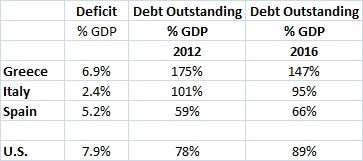
Italy. Italy has a slightly different problem. Its projected 2012 deficit is 2.4% of GDP, slightly less than the 3.0% benchmark for a sustainable level. It, therefore, does not need to make any wrenching changes to its current pace of spending. However, its debt outstanding is currently 101% of GDP. This is because Italy had excessive spending in a prior period, specifically the late 1980’s and first half of the 1990’s. Now it must pay for those earlier sins. But if Italy does not go on another spending spree and keeps its annual deficits below the 3.0% threshold, its debt as a per cent of GDP will gradually decline.
Spain. Spain has the opposite problem. Its current budget deficit is 5.2% of GDP, well beyond the acceptable 3.0% threshold. Furthermore, it is not expected to shrink below the 4.0% mark any time in the next five years. Spain’s deficit problem is a byproduct of the recession. Indeed, as recently as 2007 Spain actually had a budget surplus and its debt level was shrinking. The recession changed everything. However, debt outstanding in Spain remains quite low at 59% of GDP. It can afford to run a temporary deficit. But unless it shrinks its deficits well below the 4.0% mark during the next five years its debt burden will climb to 66% by 2016. Spain needs to make painful budget cuts in the form of higher taxes and/or reduced expenditures before it encounters a serious problem.
U.S. By way of comparison, the U.S. budget deficit is very high at 7.9% of GDP while debt outstanding is 78% of GDP — and climbing. As we have noted on numerous occasions in the past, the problems get far worse between 2020 and 2035 as our population ages and health care and Social Security expenditures skyrocket. We need a healthy dose of budget trimming – the sooner the better.
The question on the table right now is, does any European country have a deficit/debt problem that is of sufficient magnitude to cause a problem in 2012? The answer is, probably not. Italy does not have an immediate problem because it has already managed to get its deficit under control. As a result, its debt problem will diminish in the years to come as long as its stays the course. Spain is currently spending at an excessive pace, but it does not have a lot of debt. It will have problems in the future if it does not eventually reduce its budget deficit, but that does not appear to be a 2012 event. While the markets may get jittery about Europe from time to time, the fiscal difficulties in Italy and Spain should not create a meaningful problem in 2012.
Stephen Slifer
NumberNomics
Charleston, SC
Follow Me